


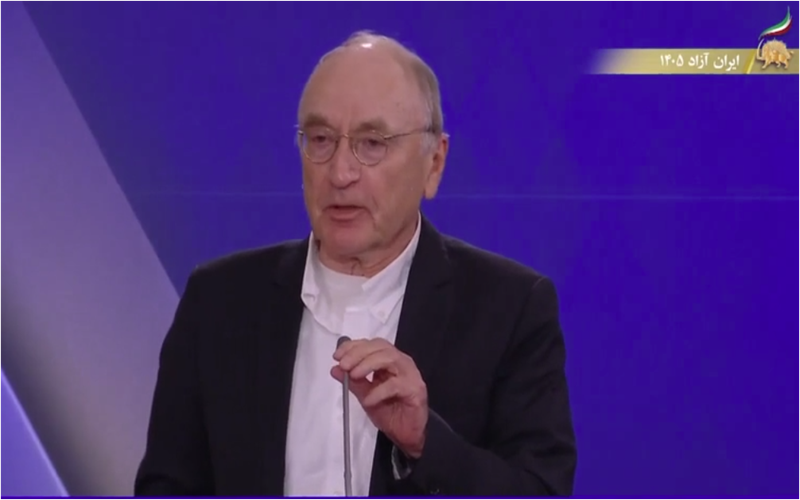

At the “Iran Beyond War – Human Rights and the Power of the People as the Solution” conference in Rome, former UN Human Rights Council President Joachim Rücker argued that neither military intervention nor appeasement can resolve Iran’s crisis, calling instead for international support for the Iranian people and the democratic opposition.
Joachim Rücker: The International Community Must Back the Iranian People’s Democratic Alternative
ROME – Joachim Rücker, former President of the United Nations Human Rights Council, addressed the international conference “Iran Beyond War – Human Rights and the Power of the People as the Solution” in Rome, arguing that the international community faces a clear choice: continue the failed policies of war and appeasement or support the Iranian people’s struggle for democracy and human rights.
Paying tribute to the victims of repression in Iran, Rücker thanked the organizers for highlighting their sacrifices and stressed that the country’s human rights crisis must remain at the center of international attention.
Military Action Cannot Resolve Iran’s Crisis
Rücker argued that recent military interventions have failed to achieve their stated objectives, whether related to regional security, nuclear concerns, missile programs, or the regime’s internal repression.
“A foreign military intervention of the type we see cannot achieve its purported goals.”
He added that the current situation has left Iran in a worse position than before, while doing little to improve the lives of ordinary Iranians.
However, he suggested that governments with leverage over Tehran should use it to demand an immediate halt to executions.
“Stopping the executions immediately would have been a reachable goal. If you have leverage, you might as well use it.”
Appeasement Is Not an Alternative
While rejecting military solutions, Rücker also warned against returning to policies of accommodation toward the Iranian regime.
“Appeasement is not the alternative to war.”
He argued that decades of engagement have failed to stop the regime’s repression, including its escalating use of executions, political persecution, and widespread violations of fundamental human rights.
According to Rücker, the Iranian people continue to pay the highest price for policies that neither weaken the regime nor improve conditions inside the country.
A Regime Weakened by Multiple Crises
Rücker outlined what he described as three converging crises that have significantly weakened the ruling establishment.
The first is a deep structural economic crisis, marked by inflation, currency depreciation, growing poverty, and chronic shortages that continue to fuel social unrest.
The second is widespread public dissatisfaction.
“Successive nationwide uprisings have demonstrated profound public rejection of the existing political system.”
He said repeated protests have shown the Iranian people’s growing willingness to challenge authoritarian rule despite severe repression.
The third factor, he noted, is increasing internal division within the regime itself.
According to Rücker, accumulating political, economic, and leadership crises have intensified factional rivalries and weakened the regime’s ability to govern effectively.
“The regime is not stronger. The regime is weaker.”
A Third Option Beyond War and Appeasement
Against this backdrop, Rücker argued that the international community should adopt what he described as the conference’s central message: a third option beyond military conflict and appeasement.
“That strategy is supporting the Iranian people in their struggle for democracy, secular governance, human rights, gender equality, the rule of law, minority rights, economic opportunity, environmental responsibility, and a non-nuclear policy committed to peace.”
He stressed that these goals reflect universal democratic values and provide a realistic path toward a peaceful transition.
Recognition of the NCRI as a Democratic Alternative
Rücker also called for greater international recognition of the National Council of Resistance of Iran (NCRI) as an organized democratic alternative.
He noted that the NCRI’s platform calls for free and fair elections within six months following the fall of the current regime, with power transferred to representatives elected by the Iranian people.
“The NCRI has exactly the agenda that is needed.”
He expressed confidence that Iranians themselves are capable of choosing their future and distinguishing genuine democratic alternatives from other political currents.
A Call for International Support
Rücker concluded by urging governments, diplomats, lawmakers, and civil society organizations to publicly support the Iranian people’s democratic aspirations.
He also emphasized the importance of protecting the rights of the Iranian diaspora to assemble and express their views freely, referring to efforts to obstruct Iranian opposition gatherings in Europe.
According to Rücker, meaningful international support should include political recognition of the Iranian people’s democratic movement and a firm commitment to a strategy that rejects both military confrontation and appeasement in favor of human rights, democracy, and the rule of law.