


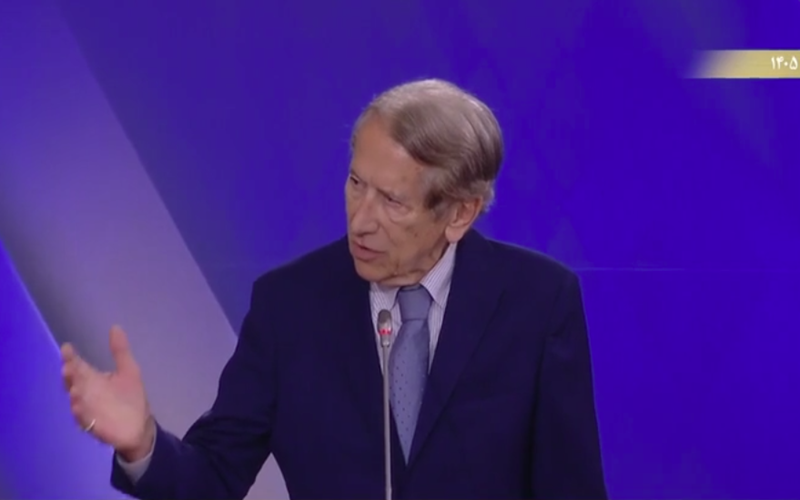

Speaking in Rome, Italian Senator Giulio Terzi praised the Iranian Resistance’s decades-long struggle, condemned the regime’s terrorism and human rights abuses, and called for stronger international action against the IRGC.
Italian Senator Giulio Terzi, former Foreign Minister of Italy, delivered a strong endorsement of the Iranian Resistance during the international conference “Iran Beyond War – Human Rights and the Power of the People as the Solution” in Rome. Addressing an audience of European political leaders, former prime ministers, parliamentarians, and international dignitaries, Terzi argued that the future of Iran rests not with military confrontation or appeasement, but with the Iranian people and their organized democratic opposition.
Throughout his speech, Terzi praised the National Council of Resistance of Iran (NCRI) and the People’s Mojahedin Organization of Iran (PMOI/MEK) for their decades of sacrifice in defense of freedom and human rights, while urging Europe to remain firm against the Iranian regime’s terrorism and repression.
A Democratic Alternative Built on Sacrifice
Opening his remarks, Terzi described it as an honor to join Maryam Rajavi and an international gathering of political leaders committed to supporting the Iranian people’s aspirations for freedom.
He emphasized that the legitimacy of the NCRI stems from decades of sacrifice and unwavering commitment to democratic values.
“The legitimacy of the National Council of Resistance of Iran rests on an extraordinary contribution of heroism, blood, suffering, and exceptional values in defending human rights and supporting the cause of freedom in Iran.”
Terzi noted that these same principles have become a recurring element in European policy discussions on Iran.
“If we examine the conclusions of the last ten European Council meetings on Iran, the defense of these fundamental values consistently emerges, reflecting the same principles defended by the PMOI.”
Exposing the Regime’s Nuclear Deception
Reflecting on his years as an Italian diplomat and senior foreign policy official, Terzi recalled witnessing firsthand how the Iranian Resistance exposed the regime’s clandestine nuclear activities.
He credited the PMOI with revealing secret nuclear sites, including Fordow and Natanz, helping bring international attention to Tehran’s concealed military nuclear program.
“What the PMOI accomplished in exposing the seriousness of the mullahs’ lies about the clandestine nuclear program was a decisive turning point.”
According to Terzi, those revelations played a critical role in subsequent deliberations at the United Nations Security Council and the international response to the regime’s nuclear ambitions.
Standing Against Both Dictatorships
Terzi stressed that the PMOI has consistently opposed dictatorship in all its forms, recalling the movement’s resistance against both the Shah’s authoritarian rule and the current theocratic regime.
He also invoked the legacy of renowned Italian journalist Oriana Fallaci, praising her early condemnation of Khomeini’s rule.
“The PMOI fought against the Shah’s authoritarianism and immediately afterward against the Khomeinist regime.”
He argued that the movement’s warnings about repression and extremism were echoed by independent journalists and observers long before many governments fully recognized the nature of the regime.
“The Future of Iran Is in the Hands of Its People”
One of the central themes of Terzi’s address was his conviction that lasting change must come from within Iran through the organized efforts of its people.
Referring to recent discussions with Maryam Rajavi and international supporters of the Iranian Resistance, he said:
“The future of Iran is in the hands of its people.”
Terzi pointed to the widespread support demonstrated during protests inside Iran and recalled the sacrifices made by thousands of resistance members over the past four decades.
He specifically referenced the 1988 massacre of political prisoners, describing it as one of the darkest crimes in modern Iranian history.
“The tragedy of the 30,000 PMOI members who were hanged in 1988 demonstrated the terrorist nature of the Iranian state.”
He further condemned the role of former regime President Ebrahim Raisi, describing him as a member of the so-called “Death Commissions” responsible for the massacre before later rising to the presidency with the backing of the Islamic Revolutionary Guard Corps (IRGC).
Terrorism as a Pillar of the Regime
Terzi argued that terrorism remains a central instrument of the Iranian regime’s foreign policy.
He cited the regime’s intelligence apparatus, diplomatic networks, and the attempted bombing of the 2018 Free Iran gathering near Paris as evidence of state-sponsored terrorism directed from Tehran.
“Terrorism is a central element of today’s Iran in its relationship with the rest of the world.”
He maintained that organizations such as the IRGC and the regime’s intelligence services operate internationally to suppress opposition and threaten democratic societies.
Welcoming Europe’s Action Against the IRGC
Terzi welcomed recent European measures targeting the IRGC, describing them as an important step toward confronting the regime’s global activities.
He stated that decisions taken by European institutions should be fully implemented by individual member states.
“The decision means treating activities connected to the IRGC as criminal in the fields of the economy, energy, technology, banking, and finance.”
According to Terzi, governments must ensure that entities linked to the IRGC cannot continue operating through international financial and commercial networks.
A Call for Democratic Change
Concluding his remarks, Terzi pledged to continue advocating in the Italian Parliament for stronger policies against what he described as a terrorist regime and reaffirmed his support for the Iranian Resistance.
“I have witnessed decades of crimes committed by this regime, which must be replaced as quickly as possible by a democratic organization such as the one we are working with today.”
Terzi ended by expressing his best wishes for the success of the Iranian Resistance and its efforts to establish a democratic future for Iran, reiterating that the country’s future belongs to its people and to a democratic alternative capable of replacing the current regime.