


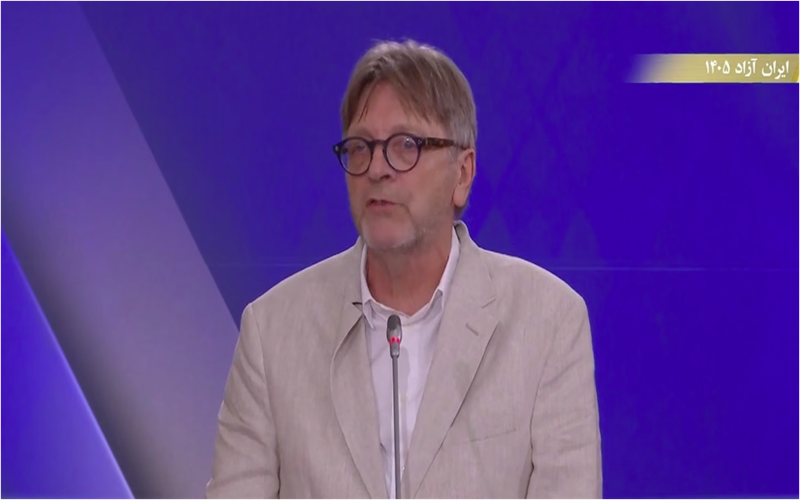

Former Belgian Prime Minister calls for a new European strategy based on isolating the Iranian regime and formally recognizing the NCRI as the legitimate representative of the Iranian people.
Former Belgian Prime Minister Guy Verhofstadt called on European leaders to abandon both appeasement and passivity toward the Iranian regime and instead adopt a strategy of active engagement with the Iranian people and their organized democratic opposition.
Speaking at the international conference “Iran Beyond War – Human Rights and the Power of the People as the Solution” in Rome, Verhofstadt argued that the future of Iran should not be determined by military confrontation or negotiations with the ruling regime, but by supporting the Iranian people’s struggle for democratic change.
Addressing Maryam Rajavi and an audience of senior international officials, Verhofstadt described the current period as a decisive moment for Iran.
“We have the impression that in these days, these weeks, these months, we are playing the future of this great country and this great people.”
Beyond War and Appeasement
Verhofstadt centered his remarks on what he described as the false choice that has dominated international policy toward Iran for decades.
He questioned whether the world must choose only between military conflict and appeasement.
“Are there only two solutions or two approaches to the question of Iran—war or appeasement?”
He criticized Europe’s longstanding policy of engagement with the regime, arguing that years of negotiations have failed to produce meaningful results.
Referring to the current Memorandum of Understanding (MoU) under discussion, he remarked:
“For me, it is not a Memorandum of Understanding; it is a Memorandum of Misunderstanding.”
According to Verhofstadt, any agreement reached with the regime would fail to achieve its stated objectives.
“It will not liberate the Iranian people. It will not end the proxy wars in the Middle East. And it will not denuclearize Iran.”
He added that the regime’s history of violating commitments leaves little basis for trust.
“Nobody trusts the mullah regime to keep its word.”
A Third Strategy: Active Engagement with the Iranian People
Rejecting both military escalation and appeasement, Verhofstadt proposed what he called a “third strategy” based on active engagement with the Iranian people and the organized Resistance.
“There is a third strategy possible—a strategy of active engagement of the democratic world with the Iranian people and the Iranian Resistance.”
He argued that Europe, rather than remaining on the sidelines, should lead this effort.
“I have heard a lot about the mullahs and American leadership, but very little about European leadership or European solutions.”
Pillar One: Completely Isolate the Regime
Verhofstadt said the first pillar of this strategy should be the comprehensive isolation of the Iranian regime.
While welcoming the designation of the Islamic Revolutionary Guard Corps (IRGC) as a terrorist organization by many countries, he insisted that this alone is insufficient.
“It’s fantastic that the IRGC has finally been designated as a terrorist organization, but more needs to be done.”
He called for sanctions extending far beyond the IRGC itself, targeting all individuals and institutions that sustain the regime.
These measures, he said, should include sanctions against:
- Judiciary and prison officials.
- Military and security personnel.
- Financial institutions and banking officials.
- Religious authorities supporting the regime.
- Individuals involved in scientific and technological cooperation with the regime.
Verhofstadt also urged European governments to close the regime’s diplomatic missions.
“Why do we continue to reason with people who represent not the Iranian people, but only a criminal regime?”
In addition, he called for the freezing and seizure of regime-linked financial assets, bank accounts, and real estate held abroad.
Pillar Two: Recognize the Democratic Opposition
The second pillar, Verhofstadt argued, is the formal recognition of the National Council of Resistance of Iran (NCRI) and the organized Resistance as the legitimate representatives of the Iranian people.
“The democratic opposition and the organized Resistance are today the only representatives of the Iranian people.”
He emphasized that recognition must go beyond political statements and be reflected in concrete diplomatic action.
Among the steps he proposed were:
- Working with the Resistance on a future constitution for a democratic republic.
- Cooperating with the Resistance’s provisional government.
- Replacing representatives of the current regime in international organizations with representatives of the democratic opposition.
- Granting the Resistance diplomatic recognition and international representation.
“Recognition means taking formal steps so that, in the diplomatic world, they are seen as the representatives of the Iranian people.”
According to Verhofstadt, such measures would significantly increase pressure on the regime while strengthening democratic forces inside Iran.
Endorsing Maryam Rajavi’s Ten-Point Plan
Verhofstadt described Maryam Rajavi’s Ten-Point Plan as an appropriate foundation for Iran’s democratic future.
“The Ten-Point Plan is a very good starting point for a future constitution and for the recognition of the democratic opposition.”
He urged European governments to replace what he characterized as a policy of silence with active support for democratic change.
“Europe must stop not only its appeasement policy, but also its policy of silence.”
“Next Time, Invite Me to Tehran”
Concluding his address, Verhofstadt reaffirmed his longstanding support for the Iranian Resistance, recalling previous events held in Brussels and Paris and expressing hope that future gatherings would take place in a free Iran.
“My only wish is that next time you invite me to Tehran—the fastest as possible.”
His remarks reinforced one of the conference’s central messages: that lasting peace and stability in Iran will not come through negotiations with the current regime or through military conflict, but through international recognition of the Iranian people’s democratic alternative and support for their struggle to establish a democratic republic.