


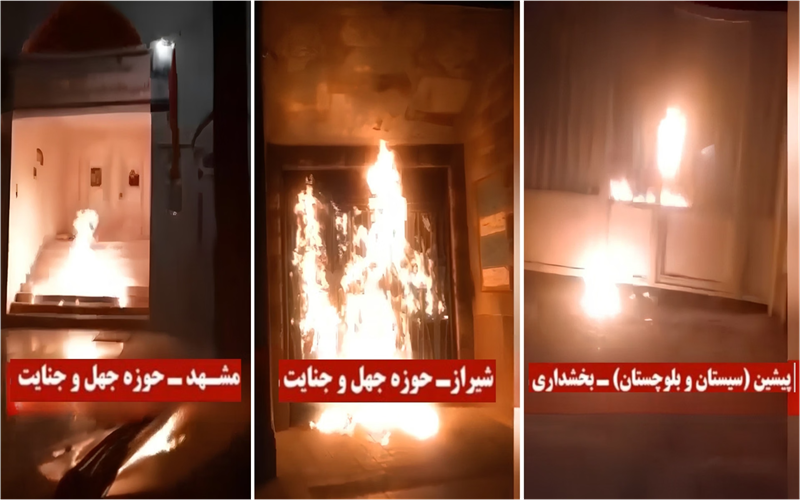

Resistance Units carried out dozens of symbolic actions across Iranian cities to commemorate the victims of the 1988 massacre and challenge the regime’s efforts to erase their memory.
The anniversary of Iran’s 1988 massacre of political prisoners has once again become a focal point for acts of defiance inside the country. According to statements attributed to Iran’s Resistance Units, activists carried out 60 operations in cities and towns across Iran, dedicating their actions to the prisoners executed during the mass killings of August 1988.
The campaign comes against the backdrop of decades of official silence and denial surrounding one of the darkest episodes in Iran’s modern history. Thousands of political prisoners were executed in the summer of 1988 following decisions by special commissions established by the regime’s leadership. Human rights organizations and United Nations experts have documented the killings and continued to call for accountability.
For years, the Iranian regime authorities have sought to suppress discussion of the massacre, while families of the victims have faced pressure for demanding information about their loved ones and the locations of their graves. The renewed activities by Resistance Units demonstrate that, despite that pressure, the memory of the victims remains a powerful part of Iran’s opposition movement.
Dozens of Actions Across Iranian Cities
The reported actions took place across a wide geographical area, extending from Tehran and Karaj to Mashhad, Shiraz, Isfahan, Kermanshah, Zahedan, Chabahar, Iranshahr, Bushehr, Ahvaz-region cities, and numerous smaller towns.
Among the reported incidents were attacks or fires targeting Basij and other regime-affiliated facilities, as well as the burning of government propaganda banners and images of senior regime figures. In Kermanshah, two Basij facilities were reportedly targeted. In Ardabil Province, an action was reported against a judicial facility.
Other incidents were reported in Mashhad, Shiraz, Tehran, Zahedan, Iranshahr, and several cities in Sistan and Baluchestan, where regime-affiliated sites or propaganda displays were targeted.
The reported campaign also extended to cities including Kerman, Urmia, Neyshabur, Qaemshahr, Babol-area communities, Borazjan, Saravan, Khash, Astara, Bandar Ganaveh, Susangerd, Malard, Semirum, and Khorramabad.
Much of the activity consisted of removing, damaging, or setting fire to official banners and portraits portraying senior regime leaders and other figures associated with its security and propaganda apparatus.
The incidents should be understood within the broader context of the Resistance Units’ campaign of street-level opposition. Their activities are intended to challenge the regime’s public displays of authority and demonstrate that dissent continues despite extensive security measures.
Keeping the 1988 Massacre Alive
The significance of this year’s campaign lies not only in the number of reported actions but also in the message attached to them.
The Resistance Units explicitly dedicated their activities to the victims of the 1988 massacre, describing those executed as prisoners who remained committed to their political convictions even when confronted with execution.
The massacre has remained a deeply contested issue in Iran. Human rights investigators have described the systematic execution of thousands of political prisoners, many of whom had already been imprisoned and were subjected to brief interrogations before being sentenced to death.
For survivors and families, the issue has never been confined to the past. They continue to seek answers about the fate of their relatives, the locations of mass graves, and accountability for officials involved in the killings.
The continued commemoration of the victims therefore represents a direct challenge to attempts to remove the massacre from public memory.
Young Activists in Zahedan Echo a Wider Message
Separate activities reported in Zahedan focused specifically on the anniversary of the 1988 executions. Young activists and supporters of the Resistance displayed messages emphasizing opposition to dictatorship and calling for political change.
Messages attributed to the activists and to Resistance figures including Massoud and Maryam Rajavi stressed that repression, executions, and intimidation have failed to eliminate opposition to the regime.
One recurring theme was that executions intended to intimidate society could instead deepen determination among young protesters and opponents of the regime.
Other messages emphasized opposition to both monarchical and clerical authoritarianism, reflecting the Resistance movement’s stated position that Iran’s political future should be based on a democratic republic rather than a return to either form of dictatorship.
Among the slogans reported in Zahedan were variations of:
“Death to the oppressor, whether Shah or Leader,”
“Neither monarchy nor clerical rule—freedom and equality,”
and
“Neither Shah nor mullahs—freedom and a democratic republic.”
These messages reflect the Resistance movement’s longstanding rejection of both the former monarchy and the current clerical system.
A Struggle Over Memory—and Iran’s Future
The latest campaign connects two dimensions of opposition activity: resistance to repression in the present and remembrance of victims of political violence in the past.
For the Resistance Units, commemorating the 1988 victims is presented as an act of refusing historical erasure. The movement argues that those who were executed cannot simply be reduced to a chapter in Iran’s past while many of the structures and officials associated with political repression remain in place.
The authorities, meanwhile, continue to face international scrutiny over executions, arbitrary detention, and restrictions on political dissent. The persistence of these issues has kept the question of accountability for past abuses closely connected to concerns about ongoing human rights violations.
The reported 60 actions therefore carry a broader political message: that repression has not succeeded in removing the memory of those killed in 1988, nor in eliminating organized opposition inside Iran.
More than three decades after the massacre, the names and memory of its victims continue to appear in the country’s political struggle. For those commemorating them, remembering the fallen is not merely an act of looking backward—it is also a declaration that the demand for accountability, freedom, and political change remains alive.