


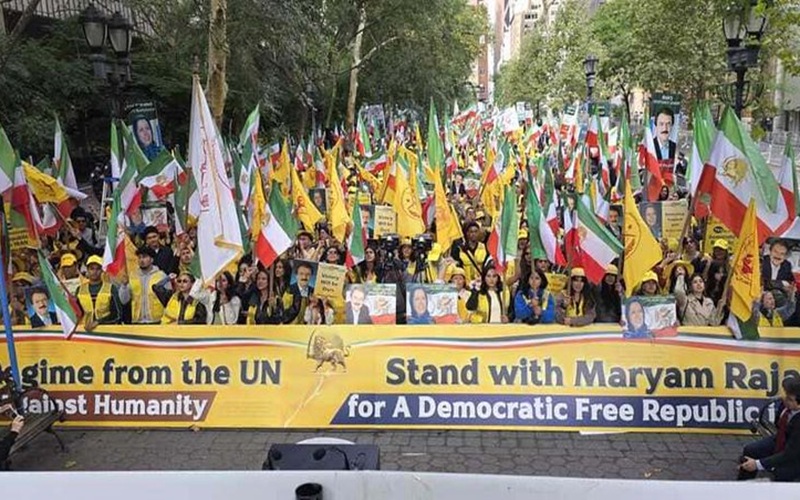

Former U.S. officials Gen. Wesley Clark, Gen. Keith Kellogg, and Ambassador Carla Sands, alongside Iranian-Canadian youth activist Parya Garmroudi, called for international support for the Iranian people and their organized Resistance during a major rally outside the United Nations in New York.
Thousands of Iranians and supporters of a free Iran gathered outside the United Nations in New York on September 22, as world leaders convened for the UN General Assembly. The rally called for an end to executions in Iran and support for a democratic republic based on Maryam Rajavi’s Ten-Point Plan.
Speakers from the United States and the Iranian diaspora focused on a common message: lasting political change in Iran must come from the Iranian people themselves and their organized Resistance, rather than through foreign intervention or a return to another form of dictatorship.
Wesley Clark: “Only the people of Iran can give freedom and power in Iran”
Former NATO Supreme Allied Commander Gen. Wesley Clark condemned the Iranian regime’s repression at home and its support for terrorism and regional destabilization. He questioned why a government with such a record should be represented at the United Nations.
Clark said the Iranian people have been denied political rights, freedom of expression and association, and basic personal freedoms. He argued that the regime’s repression and external policies have made it an obstacle to peace and freedom.
But Clark also emphasized that the solution must ultimately come from within Iran.
“There is hope for change, and that change is driven by the National Council of Resistance of Iran,” he said.
Addressing the Iranian Resistance directly, Clark stressed its organizational presence and ability to communicate developments from inside Iran. He said the MEK was active across the country and had become a feared opponent of the ruling system.
At the same time, he made clear that foreign governments could not substitute themselves for the Iranian people.
“We can’t do it for you. Only the people of Iran can give freedom and power in Iran,” Clark said.
He presented Maryam Rajavi’s Ten-Point Plan as a framework for a political transition, citing freedom of speech and association, democratic elections, separation of religion and state, and an end to nuclear weapons and regional domination.
Clark concluded by urging the international community to recognize the capacity of the Iranian people and their organized opposition to bring about political change.
Carla Sands: “The lasting solution lies in supporting the Iranian people”
Former U.S. Ambassador Carla Sands linked Iran’s internal repression to wider international security concerns. She cited hostage-taking, terrorism, the pursuit of nuclear weapons, and the regime’s role in regional conflict.
Sands argued that international policy should seek to end the threat rather than simply manage recurring crises.
She also distinguished between weakening the regime through external pressure and achieving lasting political change.
“The past few months have shown that military action certainly weakens the regime, but only the indigenous force on the ground can deliver lasting change and peace,” Sands said.
“The lasting solution lies in supporting the Iranian people and their organized Resistance in bringing about change from within Iran.”
Sands expressed support for Resistance Units inside Iran, political prisoners, and the MEK. She highlighted the movement’s long history of surviving imprisonment, executions, massacres, terrorist attacks, and campaigns of demonization.
She also emphasized the role of women within the Iranian Resistance, pointing to the succession of women who have served as MEK secretary general since 1989.
For Sands, the proposed political alternative is embodied in Rajavi’s Ten-Point Plan: “A democratic and secular republic based on free elections, the separation of religion and state, equality between women and men, respect for ethnic and religious minorities,” together with a non-nuclear Iran at peace with the world.
She argued that such a political transformation would have consequences beyond Iran, potentially changing the country’s relationship with its neighbors and the wider international community.
Keith Kellogg: “A free Iran is dependent upon you”
Gen. Keith Kellogg likewise placed responsibility for Iran’s future squarely with the Iranian people.
“To have a free Iran, you must free Iran,” Kellogg said. “You must have no illusions. A free Iran is dependent upon you and who you are.”
He urged the Iranian people to resist the Revolutionary Guards and described the rally as a message to world leaders that Iranian freedom was not negotiable.
Kellogg highlighted the NCRI as having a proposed framework for a future government and described its Ten-Point Plan as “the way forward” toward a secular, non-nuclear Republic of Iran.
He also pointed to the Resistance Units operating inside Iran, describing them as “the engine of change” and saying they were confronting the Revolutionary Guards alongside the Iranian people.
Kellogg argued that the regime’s continued executions were evidence not of strength but of vulnerability.
“The current regime has never been so weak,” he said. “It talks loudly, but its words ring hollow.”
He also argued that military action and sanctions, while weakening the regime, could not by themselves produce political transformation.
“Military attacks and sanctions have greatly weakened the regime, but it will not lead to change,” Kellogg said. “That change is dependent upon the people of Iran.”
He called for a transition leading to free elections and a secular, non-nuclear republic.
Parya Garmroudi: “Iran is not a family inheritance”
Parya Garmroudi, an Iranian-Canadian youth activist, brought a personal and generational perspective to the rally. She recalled that her uncle was executed by the Iranian regime when he was her age and connected his fate to the broader history of political repression.
Garmroudi rejected both the former monarchy and the current theocracy as models for Iran’s future.
“Today, we reject both forms of tyranny: baby Shah Reza Pahlavi and the new baby mullah Mojtaba Khamenei,” she said.
“We will not exchange a turban for a crown or one dictator’s son for another. Iran is not a family inheritance; Iran belongs to its people.”
She emphasized the continued activity of MEK Resistance Units inside Iran and their role in challenging the regime’s atmosphere of fear.
Garmroudi also highlighted the appeal of the Resistance among younger generations and connected the movement’s history to successive generations of Iranian students and political activists.
She presented Rajavi’s Ten-Point Plan as the proposed framework for a future Iran, including free elections, separation of religion and state, gender equality, equal rights for ethnic and religious communities, an independent judiciary, abolition of the death penalty, and a non-nuclear Iran at peace with the world.
Her message to the international community was direct: political prisoners must be defended, those responsible for repression must be held accountable, and the Iranian people must be allowed to determine their own future.
A common message: change driven by Iranians
Although the four speakers approached the Iranian crisis from different perspectives, their speeches converged on a central argument: outside governments cannot substitute for the Iranian people in determining Iran’s political future.
Clark said, “Only the people of Iran can give freedom and power in Iran.”
Sands argued that “only the indigenous force on the ground can deliver lasting change and peace.”
Kellogg declared that “change is dependent upon the people of Iran.”
And Garmroudi framed the same principle as a generational demand for a political system that belongs to the Iranian people rather than to a royal family or a ruling clerical establishment.
The speakers also repeatedly pointed to the Ten-Point Plan as the proposed framework for a future democratic republic, emphasizing elections, separation of religion and state, equality, minority rights, and a non-nuclear Iran.
The rally therefore placed two issues at the center of its message to the international community: ending the Iranian regime’s executions and repression, and recognizing the Iranian people’s demand for a political alternative determined by themselves.
As Clark put it, “I believe regime change is possible in Iran, and I believe it’s going to happen.” He added that he believed it would be driven by “the courage and determination of the people of Iran” and led by the National Council of Resistance of Iran and the MEK.