


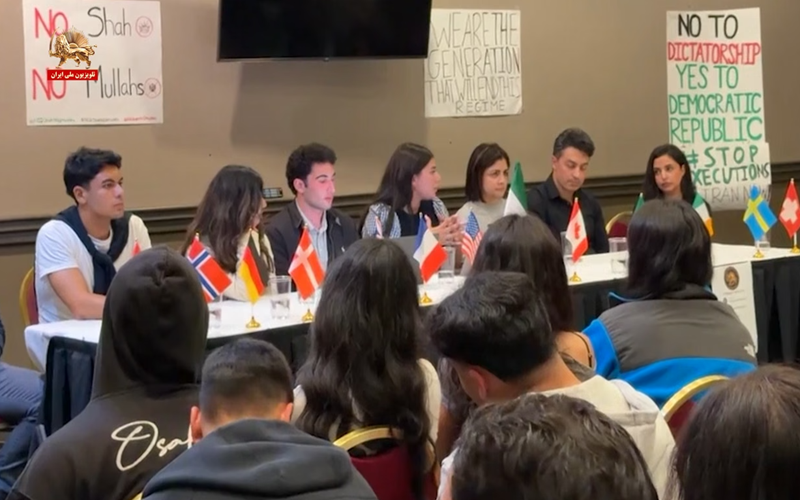

Young Iranians from the United States, Canada, and Europe discuss executions, torture, women’s rights, political participation, and the role of their generation in building a free and democratic Iran.
Against the backdrop of the United Nations General Assembly and two days of demonstrations by Iranian supporters of the Resistance in New York, a coalition of young Iranians held a conference titled “What Does a Free Iran Mean for Our Generation?”
The gathering brought together young Iranians from the United States, Canada, and several European countries to discuss Iran’s human rights crisis, the continuing wave of executions, the prospects for a free and democratic Iran, and the role of younger generations in shaping the country’s future.
Rather than focusing exclusively on opposition to the current regime, participants sought to address a broader question: what should replace repression, and what principles should define Iran’s future?
Beyond saying “No” to executions and torture
The discussion began from a clear set of principles: no to executions, no to torture, and yes to a free Iran.
Participants argued that the conversation about Iran should extend beyond the issues that dominate international discussions, such as nuclear policy, sanctions, regional security, diplomacy, and relations between governments.
Instead, they emphasized the people of Iran, fundamental rights, political participation, justice, and accountability.
One participant stressed that executions and torture in Iran should not be viewed solely as concerns for Iranians, but as violations of fundamental human rights. Young Iranians living abroad, the speaker argued, have a responsibility to raise awareness of the situation facing people inside Iran and amplify their voices internationally.
Others emphasized that this responsibility has a particular significance for Iranians abroad, who can use their position to advocate for those confronting repression inside the country.
Women’s rights as a fundamental principle
Women’s rights emerged as another central theme of the discussion.
Participants emphasized that any future Iran must guarantee women’s rights as a fundamental principle, pointing to the prominent role of Iranian women in resistance to the regime.
The speakers connected the question of women’s rights with the broader demand for political and social freedom, arguing that the future political system must protect individual rights rather than reproduce structures of discrimination and repression.
The discussion also placed particular emphasis on the younger generation. Participants expressed their belief that young Iranians have a responsibility not only to oppose the existing system but also to contribute to rebuilding the country after political change.
The role of young Iranians in rebuilding Iran
The conference repeatedly returned to the question of generational responsibility.
Participants said young Iranians abroad should draw on their education, professional experience, and knowledge to contribute to rebuilding Iran. They described the task as extending beyond political change to addressing the social and economic damage caused by decades of dictatorship.
One speaker argued that young Iranians must help “heal the wounds” of their fellow citizens and contribute to creating a new Iran.
The speakers also acknowledged the difficulty of fully understanding the experiences of people who have lived under successive authoritarian systems. Nevertheless, they argued that the younger generation has a responsibility to learn from that history and help ensure that Iran’s future does not reproduce dictatorship.
Rejecting both religious and monarchical dictatorship
A significant part of the conference focused on the political system participants envision for Iran.
Speakers and participants in the question-and-answer session called for the rejection of the current clerical regime and urged the international community to end its policy of engagement and accommodation with Tehran.
They also expressed support for the National Council of Resistance of Iran (NCRI) as a democratic alternative and for Maryam Rajavi’s Ten-Point Plan for the Future of Iran.
The participants presented the future political choice as extending beyond opposition to the current regime. They argued that the Iranian people reject both religious dictatorship and a return to monarchical dictatorship and should be able to establish a democratic republic.
The emphasis on “No to Shah, No to Mullahs” placed the conference within a broader political message articulated by participants: Iran’s future should be determined by its people rather than by another form of authoritarian rule.
A generation focused on Iran’s future
The New York conference offered a platform for young Iranians to discuss Iran from a perspective centered on human rights, political participation, and the country’s future rather than exclusively on the regime’s foreign policy or nuclear program.
Participants stressed that ending executions and torture is only one part of their vision. They also raised questions about the institutions needed to protect individual rights, ensure accountability, guarantee women’s equality, and enable citizens to participate in determining their country’s future.
The discussions ultimately placed the younger generation at the center of the question of Iran’s future, with participants expressing their determination to contribute to a political transition toward a free and democratic Iran.