


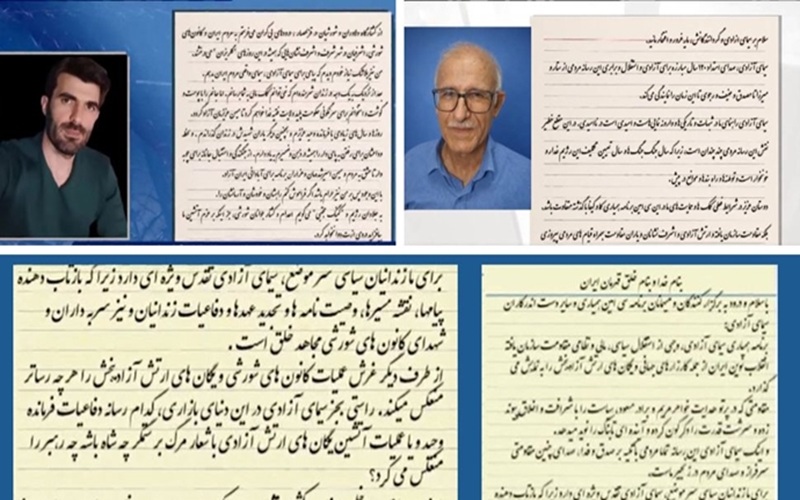

Messages from political prisoners in Qezel Hesar and Karaj Central prisons emphasize the importance of independent media, organized resistance, and solidarity with the Iranian people amid escalating repression.
Political prisoners in Iran have issued messages from Qezel Hesar and Karaj Central prisons in support of Simay-e Azadi, calling on Iranians inside and outside the country to strengthen their support for the broadcaster during its 30th solidarity campaign.
The messages, sent under extremely difficult conditions, portray independent media as an essential instrument for breaking through censorship, documenting repression, and conveying the voices of prisoners and protesters to the outside world.
The prisoners also stressed that the current period is a decisive one for Iran, arguing that the regime’s intensifying repression cannot extinguish the determination of those seeking fundamental political change.
Political prisoner: Simay-e Azadi is a source of hope
In a message from Qezel Hesar Prison, political prisoner Ali Moezzi described Simay-e Azadi as a source of pride and an important continuation of Iran’s long struggle for freedom and independence.
“Simay-e Azadi, the voice extending 120 years of struggle for freedom, independence and equality, represents the people’s media,” Moezzi wrote, referring to a historical tradition of political and social movements in Iran.
He described the broadcaster as a guide amid what he called “darkness,” confusion, and distorted information, adding that its role has become particularly important during the current period.
Moezzi urged supporters to make their assistance to the 30th solidarity campaign different from previous years, both in scale and in substance.
“Our help and support in this 30th solidarity campaign must be different from the past, both in quantity and quality.”
He linked support for the broadcaster to the broader struggle for political change in Iran and expressed hope that organized resistance, the “Army of Freedom,” resistance supporters, and popular uprisings would ultimately bring about victory.
Moezzi concluded his message by expressing his support for a provisional government leading toward a democratic republic and paying tribute to those killed in the resistance.
Prisoners: The broadcaster carries the voices of those behind bars
A separate message signed by political prisoners supporting the People’s Mojahedin Organization of Iran (PMOI/MEK) in Qezel Hesar and Karaj Central prisons highlighted another dimension of Simay-e Azadi’s role: giving political prisoners a platform to communicate with the outside world.
The prisoners described the broadcaster as an independent popular media outlet and said its solidarity campaign reflects aspects of the political, financial, and organizational independence of the organized resistance.
“For us, political prisoners who remain steadfast in our positions, Simay-e Azadi has a special significance,” they wrote, explaining that it has broadcast messages, statements, defenses, final declarations, and other communications from prisoners as well as accounts concerning those killed in the resistance.
They also emphasized the broadcaster’s coverage of resistance activities and protests, arguing that such reporting provides an alternative to the heavily controlled media environment inside Iran.
The prisoners called on Iranians both inside and outside the country to participate in the 30th solidarity campaign, either through financial contributions or by providing content.
They described such support as solidarity with what they call the popular front and with national solidarity, arguing that it can contribute to accelerating political change.
“Executions only strengthen our determination”
Another message came from political prisoner Loughman Aminpour, writing from Qezel Hesar Prison. His message focused particularly on executions and the continued repression of young protesters.
Aminpour recalled spending years in prison with resistance members who were later executed, describing his memories of their final days and their determination in the face of execution.
He said that although he has been imprisoned for nearly a decade and cannot provide financial assistance to Simay-e Azadi, he remains committed to the struggle for a free Iran.
“My life, with my flesh, blood and bones, I will sacrifice for the overthrow of the wicked rule of the velayat-e faqih so that our beloved homeland may be free.”
Aminpour also recalled those who were executed and said he remains determined not to forget their lives, ideals, and aspirations.
Addressing the authorities directly, he argued that the execution and killing of young protesters would not extinguish resistance.
“The execution and killing of young protesters will only increase our fiery determination.”
He ended his message with a pledge to continue the struggle until the end and a tribute to those who were killed.
A message from inside Iran’s prisons
Taken together, the messages from Qezel Hesar and Karaj Central prisons reflect a broader confrontation over information, repression, and political legitimacy in Iran.
For the prisoners, Simay-e Azadi is not simply a broadcaster. They portray it as a channel through which the experiences of political prisoners, protesters, and resistance activists can reach audiences beyond the regime’s censorship apparatus.
Their appeals also underline the importance they attach to solidarity from Iranians abroad. Despite being deprived of their freedom and, in some cases, unable to make financial contributions themselves, the prisoners called on others to provide financial support, information, and content.
The messages were issued as executions, arrests, and other forms of repression continue to shape the political environment in Iran. Their authors argue that these measures cannot erase the grievances driving popular opposition.
Instead, they say, repression can deepen determination among those already committed to political change.
The messages from Qezel Hesar therefore carry a dual appeal: support an independent source of information, and maintain solidarity with those confronting repression from inside Iran’s prisons.
For the prisoners who signed the statements, keeping those voices alive is itself part of the struggle for a future in which Iranians can determine their own political destiny.