


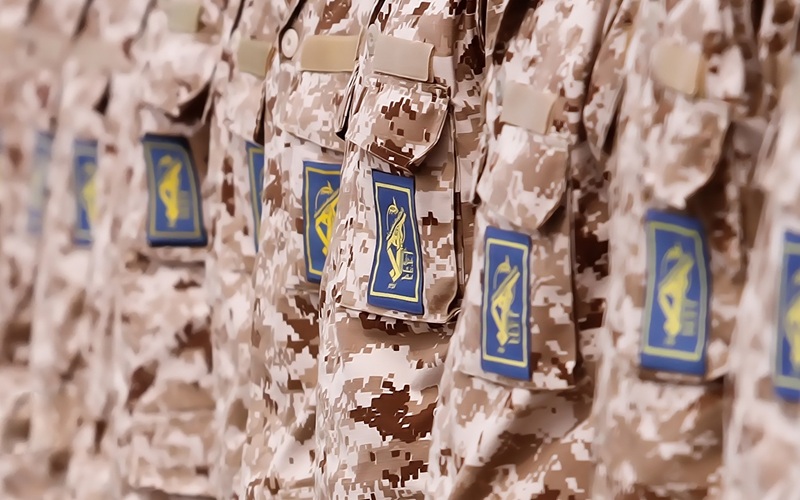

A sweeping reshuffle of Iran’s military and security leadership is consolidating operational command under Mojtaba Khamenei while restoring figures associated with repression and wartime policy.
The latest reshuffle of Iran’s military and security leadership under Supreme Leader Mojtaba Khamenei points not to a change in direction, but to the consolidation and continuation of the policies that have defined the regime for decades: internal repression, militarization, and confrontation abroad.
In a series of appointments issued on August 10, Mojtaba Khamenei appointed Ali Abdollahi as chief of staff of the armed forces and ordered the completion of the merger between the General Staff of the Armed Forces and the Central Headquarters of Khatam al-Anbiya, the regime’s highest operational military command.
The move is significant because the two institutions traditionally performed different functions. The General Staff has been responsible for military strategy, coordination among the army, Islamic Revolutionary Guard Corps (IRGC), police, and other armed forces, as well as overall preparedness. The Central Headquarters of Khatam al-Anbiya, meanwhile, has been responsible for joint operational command during wars, major crises, and military operations.
Bringing the two structures under a more centralized chain of command effectively concentrates strategic planning, military preparedness, and operational command in one hierarchy.
Mojtaba Khamenei explicitly described completion of the merger as one of Abdollahi’s three priorities and instructed him to implement a plan initiated by his father, Ali Khamenei, referring to it as the “measure of the martyred Imam.” The terminology itself underscores the new leadership’s effort to portray continuity with the previous supreme leader rather than a departure from his policies.
Concentrating wartime command
Abdollahi is not a newcomer to the regime’s military command structure. He had headed the Central Headquarters of Khatam al-Anbiya since 2025 and served as the regime’s senior operational commander during the current war.
His elevation to chief of staff effectively transfers the operational authority he previously exercised at Khatam al-Anbiya into the highest level of the armed forces.
No replacement for Abdollahi was announced for the Central Headquarters, further indicating that the government intends to reorganize the command structure around his new position rather than simply fill a vacant post.
Abdollahi replaces Major General Abdolrahim Mousavi, who was killed at the beginning of the war on February 28, 2026, alongside IRGC commander Mohammad Bagheri and Defense Minister Aziz Nasirzadeh.
The new chief of staff has also been a prominent voice in the regime’s military rhetoric, repeatedly issuing threats against the United States and warning of military retaliation. Under his previous command, the Central Headquarters played a central role in coordinating the regime’s missile operations and its military use of the Strait of Hormuz as a means of exerting pressure.
His appointment therefore carries a clear message: the regime is responding to the severe military and security shocks it has suffered by concentrating command rather than reconsidering its confrontation-oriented policies.
Reversing a previous separation
The restructuring also partially reverses an arrangement established in 2016, when Ali Khamenei separated the leadership of the General Staff from the command of the Central Headquarters.
Before that change, Hassan Firouzabadi had headed both institutions. After his departure, Ali Khamenei appointed Mohammad Bagheri as chief of staff and Gholam Ali Rashid as commander of Khatam al-Anbiya.
Under the subsequent structure, the General Staff focused primarily on strategic planning, coordination, and preparedness, while Khatam al-Anbiya assumed direct responsibility for planning and directing joint military operations during wartime.
The new arrangement moves back toward a more concentrated command model—at precisely the moment when the regime is facing heightened military, political, and domestic pressures.
Mojtaba Khamenei has also instructed Abdollahi to strengthen the “defensive and security readiness” of the armed forces and the Basij and to ensure their ability to respond rapidly to conventional, cognitive, and hybrid threats.
The emphasis on “cognitive” and “hybrid” threats is particularly relevant to the regime’s domestic security doctrine, in which political dissent, public protests, information campaigns, and opposition activity are routinely portrayed as security threats requiring state intervention.
The return of a key security figure
Among the other appointments, the return of Hossein Taeb to the command of the Basij is particularly revealing.
Taeb previously commanded the Basij before spending more than a decade as head of the IRGC Intelligence Organization. He was removed from that position in 2022 following a series of security breaches and operations attributed by the regime to foreign infiltration.
His departure from the intelligence post, however, did not sever his ties to the regime’s inner power circles. He remained close to the political and security establishment surrounding Mojtaba Khamenei and continued to participate in high-level security and political consultations.
His return to command the Basij brings a veteran of the regime’s intelligence and internal-security apparatus back into a powerful position overseeing one of the main instruments of domestic repression.
The appointment is therefore difficult to interpret as a move toward political moderation. Rather, it points toward the reinforcement of the very security networks that have been used to suppress protests and intimidate Iranian society.
A military-security apparatus still incomplete
Despite the extensive reshuffle, several crucial military and intelligence positions remain vacant.
No permanent heads have yet been announced for the two principal intelligence organizations within the IRGC. Maj. Gen. Majid Khademi, who headed the IRGC Intelligence Organization and its Protection and Intelligence Organization, was killed in Tehran in April.
These institutions perform separate but complementary functions. IRGC Intelligence has a major role in political and security operations and domestic repression, while the IRGC Protection and Intelligence Organization is responsible for counterintelligence, monitoring loyalty within the IRGC, and preventing infiltration.
The permanent leadership of the intelligence organization of the Law Enforcement Command also remains unresolved following the death of its commander, Gholamreza Rezaeian, at the beginning of the war.
Two senior positions within the General Staff—deputy intelligence chief and deputy operations chief—have likewise remained without permanent successors following the deaths of their previous occupants during the war.
The gaps suggest that the regime’s leadership remains engaged in a broader process of reconstructing its security and military apparatus after suffering substantial losses among senior commanders.
Vacancies at the Defense and Intelligence ministries
The uncertainty extends into the civilian government.
The Defense Ministry continues to be run by an acting minister, Majid Ibn al-Reza, following the death of Defense Minister Aziz Nasirzadeh at the beginning of the war. Despite representing the ministry in official meetings and international contacts for months, he has not been formally presented to parliament for a confidence vote.
The Intelligence Ministry has also lacked a permanent minister since the death of Esmail Khatib in March. Although the presidential office announced that an acting official had been appointed, it did not disclose his identity.
Reports have indicated that efforts by President Masoud Pezeshkian to appoint a permanent intelligence minister have encountered opposition from senior IRGC commanders, including Interior Minister and former IRGC commander Ahmad Vahidi.
The contrast with the military appointments is telling. While the supreme leader can directly appoint senior military commanders as commander-in-chief, cabinet ministers must formally be appointed by the president and receive parliamentary approval. Yet in practice, appointments to sensitive ministries such as Defense and Intelligence remain closely tied to the supreme leader and the IRGC power structure.
No sign of a strategic change
Taken together, the appointments reveal a regime attempting to rebuild and centralize its coercive machinery after a devastating period of military and security losses.
There is no evident sign in these moves of a reassessment of the policies that have brought the regime into repeated confrontation with both its own population and the outside world. Instead, the emerging structure places greater emphasis on centralized military command, rapid response, intelligence control, and the mobilization of security forces.
The return of Hossein Taeb, the elevation of a wartime operational commander to the top military post, and the consolidation of strategic and operational command all point in the same direction.
Rather than signaling a new course, Mojtaba Khamenei’s appointments demonstrate continuity.
The leadership has changed, commanders have been replaced, and institutional structures are being reorganized—but the underlying priorities remain strikingly familiar: preserve the regime through repression at home, strengthen its military and security apparatus, and maintain a posture of confrontation abroad.
For a population already facing deep economic, social, and political crises, the reshuffle offers little indication that the regime intends to address the roots of those crises. Instead, it suggests that its principal response remains the strengthening of the machinery of coercion and war.