


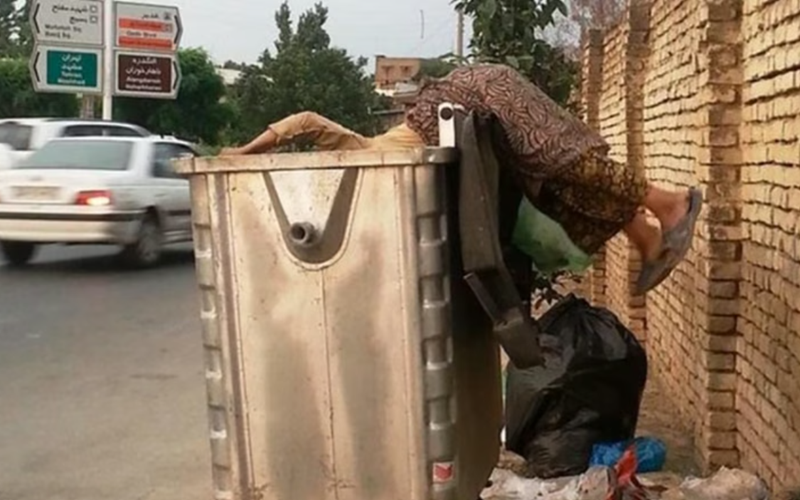

MP Hossein Samsami warns that the Pezeshkian government’s proposed one-million-toman payments will be wiped out by inflation, as parliamentary officials acknowledge that around eight million Iranians are already trapped in absolute poverty and malnutrition, with up to 50 million struggling to afford basic food.
At the same time, the head of the regime parliament’s Social Affairs Commission has acknowledged that approximately eight million people are suffering from absolute poverty and malnutrition, while up to 50 million face serious difficulties securing basic food and meeting minimum nutritional requirements.
On November 8, 2026, Hossein Samsami, a member of parliament, directly challenged the government’s plan to liberalize prices and pay each person one million tomans in compensation. In a speech to parliament, he described the proposed payments as a deceptive policy that would leave ordinary people worse off.
“Mr. Government, don’t do it. Fear God. Fear the Iranian people. Today, the parliament faces a test: Do not approve this,” Samsami said.
He warned that the proposed price liberalization would trigger another round of inflation, affecting housing, household appliances, automobiles, clothing, and virtually every other commodity.
Questioning the basis for the promised one-million-toman payment, he argued that the government was offering a negligible amount while preparing to impose much greater costs on the population.
“An additional 200 million tomans has been added to the price of a car, and you want to give people one million tomans,” he said, warning that continued inflation would eventually make even a simple snack unaffordable with that payment.
Samsami delivered his sharpest criticism in an unusually direct description of the regime’s subsidy policy:
“Giving subsidies means inflation and a form of theft. They put one toman in your pocket and take 10 tomans in return, transferring it into the pockets of the wealthy.”
His remarks expose a central contradiction in the regime’s economic policies. While officials present cash payments as assistance to vulnerable households, price increases and inflation steadily erode purchasing power, leaving ordinary people to bear the cost.
Eight million Iranians in absolute poverty and malnutrition
The scale of the crisis was further acknowledged by the head of the regime parliament’s Social Affairs Commission, who disclosed that more than 10 percent of the country’s population—approximately eight million people—have fallen into absolute poverty and malnutrition.
He also warned that the situation extends far beyond those already classified as living in absolute poverty. Up to 50 million people are caught in a vicious cycle of struggling to obtain essential commodities and meet minimum daily calorie and nutritional requirements.
Describing the plight of low-income households, he said that many have been pushed into extreme deprivation and are now struggling simply to stay alive.
He particularly highlighted the devastating consequences of illness among impoverished families. When a family member becomes sick, the high cost and shortage of medicines can turn a medical problem into a death sentence.
These admissions reveal the depth of Iran’s economic and social crisis. The regime’s own parliamentary figures acknowledge that poverty is no longer confined to a small marginalized section of society but has become a widespread threat to food security and basic survival.
A crisis that cash handouts cannot solve
The confrontation over subsidies reflects more than a disagreement over economic management. It exposes the consequences of a system in which inflation, price manipulation, corruption, and the concentration of wealth continue to undermine the living standards of millions.
A one-million-toman payment cannot compensate for the cumulative impact of rising prices across housing, food, transportation, medicine, and other necessities. As Samsami warned, nominal financial assistance can quickly become meaningless when the same policies drive the cost of living even higher.
The simultaneous admissions of a parliament member and the head of its Social Affairs Commission paint a stark picture: millions of Iranians are being pushed toward hunger and absolute poverty, while the regime’s proposed remedies threaten to deepen the very crisis they supposedly address.