


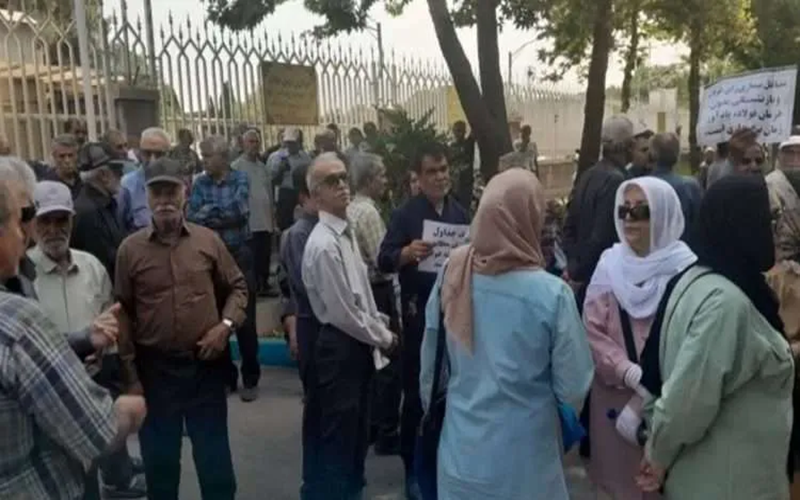

With food inflation reaching 128.1 percent and basic household costs surging, millions of Iranian families are being forced to choose between food, medicine, rent, and other necessities.
For millions of Iranian families, meat has long since disappeared from the shopping list. Now, milk, dairy products, fruit, and even inexpensive sources of protein are becoming unaffordable. After paying rent, many households are left with little more than a monthly exercise in deciding what they can no longer buy.
This is no longer simply a story about rising prices. It is a story about the systematic erosion of living standards under the Iranian regime, where wages have fallen dramatically behind the real cost of survival.
A woman describing her household’s situation captures the reality facing many families: when meat became expensive, they switched to chicken. When fruit became expensive, they bought less of it. Now, she says, everything has become expensive at once—from bread, milk, and yogurt to medicine and rent.
“We are practically hungry, and we no longer have the strength to continue,” she says.
Inflation is no longer an abstract statistic
The latest figures from Iran’s official statistics agency provide a stark confirmation of what households are experiencing every day.
Point-to-point inflation across the country reached 87.9 percent in July 2026, meaning households needed nearly 88 percent more money to purchase the same basket of goods and services compared with the corresponding period a year earlier.
But the pressure on food prices was dramatically higher.
Food and beverage inflation reached 128.1 percent. In other words, the cost of maintaining even a basic food basket has, on average, more than doubled over the past year.
Some categories have experienced increases that are even more devastating. Oils and fats rose by 261.5 percent, while dairy products, milk, and eggs increased by 147.1 percent. Red and white meat rose by 145.2 percent, bread and cereals by 116.7 percent, and fruit and dried fruit by 115.4 percent.
These figures expose the depth of the crisis. Food is not a discretionary expense. Families cannot simply decide to stop buying bread, milk, or basic proteins. When such necessities become unaffordable, the result is not merely reduced consumption—it is deteriorating nutrition and a lower standard of living.
The numbers become harsher at the supermarket
The official inflation figures become more tangible when translated into everyday prices.
On August 10, reports from Iranian domestic media showed sheep muscle meat selling for at least 2.15 million tomans per kilogram, while beef muscle had reached approximately 2.12 million tomans. Even relatively cheaper cuts of sheep meat were selling for around 1 million tomans per kilogram.
For a minimum-wage worker earning roughly 22 million tomans a month, buying 10 kilograms of sheep muscle would consume virtually an entire monthly income—before paying rent, utilities, transportation, medicine, clothing, or purchasing any other food.
Dairy products are following the same trajectory. A 350-gram package of cream cheese was reported at around 200,000 tomans, while a 400-gram package of white cheese cost approximately 225,000 tomans. An 800-gram package of Pegah cheese reached 745,000 tomans, while a tub of yogurt was around 460,000 tomans.
Milk, once among the most basic and affordable household necessities, has also become increasingly expensive. Even a small 200-milliliter chocolate milk was selling for roughly 60,000 tomans.
And when families attempt to substitute meat with cheaper sources of protein, they encounter another problem: those alternatives are no longer reliably cheap.
A kilogram of red beans was reported at around 360,000 tomans, chickpeas at 389,000, lentils at 375,000, and pinto beans at approximately 580,000 tomans.
The traditional strategy of replacing expensive foods with cheaper ones is therefore collapsing.
Families are being forced to choose what not to buy
The most revealing evidence of the crisis comes not from official statistics but from the choices families are making.
One parent describes having previously bought fruit, milk, yogurt, and snacks for the children. Now, before placing anything in the shopping cart, she calculates its price. When a child asks for something, she often has to say no.
Meat may be purchased only once a month.
For retirees, medicine has become another unavoidable burden. A retired resident of Shiraz describes setting aside money for medicine and utility bills immediately after receiving a pension. Whatever remains is then used for food.
Previously, she says, a low pension was difficult but manageable. Now, the money can run out before the middle of the month.
This is the defining characteristic of Iran’s current economic crisis: households are no longer simply reducing discretionary spending. They are cutting into essential consumption.
Rent consumes the income before food can be purchased
Food inflation is only one component of the crisis.
Housing costs are simultaneously consuming an enormous share of household income. In Tehran and other major cities, many renters have already been forced into smaller apartments, cheaper neighborhoods, or peripheral areas.
For one worker in Ahvaz, the landlord reportedly demanded 700 million tomans to renew the lease—an amount far beyond the family’s means.
Moving to a cheaper area is not necessarily a solution. A more distant home means higher transportation costs, adding another burden to a household budget already under extreme pressure.
The same income therefore has to absorb higher rent, higher food prices, higher medicine costs, and higher transportation expenses.
Something has to disappear.
Increasingly, it is food.
The wage–cost gap has become unsustainable
The fundamental problem is the widening gap between wages and the actual cost of living.
Iran’s minimum wage in 1405, including benefits, is around 22 million tomans per month. Independent estimates, however, place the minimum cost of a basic household living basket for working families in major cities at more than 73 million tomans.
Even if two members of a four-person household are employed, a substantial monthly gap remains between income and the minimum cost of living.
Families have traditionally attempted to bridge this gap through second jobs, overtime, borrowing, using savings, selling assets, or eliminating parts of their consumption.
But these coping mechanisms have limits.
Savings eventually disappear. Assets cannot be sold indefinitely. Debt has to be repaid. Working additional hours is impossible beyond a certain point.
And cutting consumption eventually reaches the point where there is nothing left to cut.
Poverty is becoming visible
The consequences are increasingly visible in Iranian cities—from Tehran and Isfahan to Shiraz, Mashhad, and Ahvaz.
People describe shrinking food baskets, fewer purchases of meat and dairy, postponed medical expenses, mounting rent burdens, and children being denied even relatively inexpensive treats.
The deterioration is also visible in household clothing and other basic consumption. What was once considered ordinary is increasingly becoming a luxury.
This is why the current crisis should not be reduced to the headline inflation rate.
An inflation rate of 87.9 percent is devastating enough. But an inflation rate of 128.1 percent for food tells a much more consequential story: the Iranian regime’s economic crisis is reaching directly into the household kitchen.
A political crisis disguised as an economic one
The regime will inevitably present inflation, currency depreciation, housing costs, and food prices as separate economic problems. But for ordinary Iranians, they are interconnected manifestations of a single reality: incomes are no longer sufficient to sustain a basic standard of living.
The question is therefore not simply why a kilogram of meat costs more or why milk has become unaffordable.
The deeper question is why a country with substantial natural resources, a large educated population, and significant economic potential has reached a point where millions of families must decide whether to buy food, medicine, or pay rent.
The answer lies in years of structural mismanagement, corruption, resource diversion, economic isolation compounded by regime policies, and the prioritization of political and security objectives over the welfare of the population.
The result is a society in which poverty is no longer confined to the most vulnerable. Workers, retirees, salaried employees, and middle-class families are all being pushed downward.
The shrinking family table is therefore more than an economic indicator. It is a measure of the regime’s failure to provide even the most basic conditions for a dignified life.
When families can no longer afford meat, dairy products, fruit, medicine, or adequate housing—and when even beans and lentils become expensive—the crisis has passed far beyond inflation.
It has become a crisis of survival.