


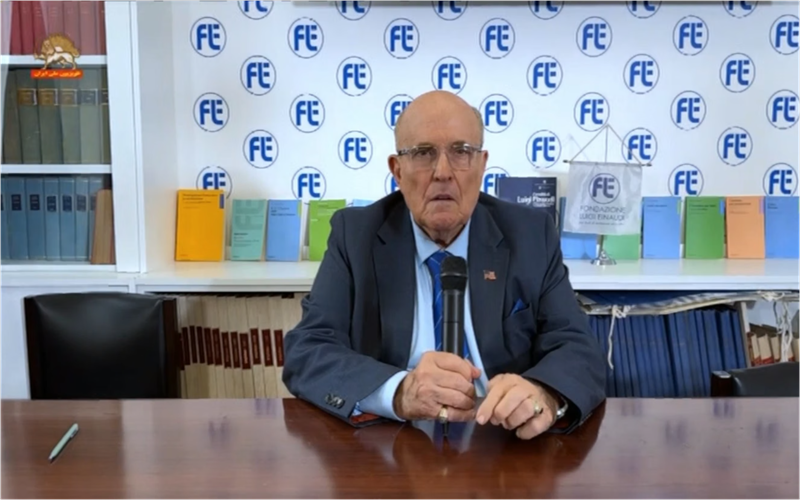

In an interview with Simay-e Azadi, former New York City mayor Rudy Giuliani said the NCRI and PMOI are prepared to lead a transition to a democratic republic in Iran.
Former New York City Mayor Rudy Giuliani has reaffirmed his support for Iran’s organized democratic opposition, arguing that the National Council of Resistance of Iran (NCRI) and the People’s Mojahedin Organization of Iran (PMOI/MEK) constitute a prepared and viable alternative to the ruling regime.
In an exclusive interview with Simay-e Azadi at the Luigi Einaudi Foundation in Rome, Giuliani said the international community should recognize that there is a political force prepared to lead Iran through a transition and establish a democratic republic.
The interview came amid growing internal pressure on the Iranian regime, continued protests, and an intensified campaign of executions.
A Prepared Alternative for Iran’s Transition
Giuliani emphasized that the question of what happens after the fall of the regime already has an answer.
According to him, the NCRI and PMOI have spent decades preparing for a political transition and have developed a network of experienced individuals capable of assuming responsibility for key government ministries during a transitional period.
He pointed specifically to the 10-point plan of NCRI President-elect Maryam Rajavi, which provides a political framework for establishing a democratic system in Iran.
A central element of that program is the commitment to hold free elections within six months of the establishment of a transitional government.
Giuliani argued that the regime’s collapse should not be viewed as a distant or hypothetical possibility. In his assessment, the critical question is not whether the regime will fall, but when.
He identified sustained internal pressure as one of the most important forces driving this process. Public protests have repeatedly demonstrated the depth of opposition inside Iran, despite brutal crackdowns, mass killings, arrests, and executions.
For Giuliani, the continuation of social pressure despite repression demonstrates that the underlying demand for political change has not disappeared.
The Regime’s Repression Has Failed to Eliminate Dissent
Giuliani pointed to the regime’s repeated use of violence against protesters as evidence of its vulnerability rather than its strength.
Public demonstrations have been violently suppressed, while executions have increasingly been used to intimidate society and deter further resistance.
Yet, he argued, the pressure from within Iran remains.
This creates an increasingly important question for the international community: if the regime is eventually removed, who is prepared to manage the transition?
Giuliani maintained that the answer should not be sought among forces that have neither an organized political structure nor a coherent democratic program. Instead, he pointed to the NCRI, the PMOI, and the broader resistance movement, which he said have spent decades preparing for such a moment.
Information Warfare Against Iran’s Opposition
Giuliani also addressed what he described as extensive censorship and propaganda directed against the PMOI and NCRI.
He identified two principal sources of this campaign: the Iranian regime and supporters of the former monarchy.
According to Giuliani, the regime has invested heavily in propaganda designed to discredit its principal opposition and obscure the existence of an organized alternative.
He also criticized Reza Pahlavi and the monarchist current, arguing that replacing one authoritarian system with another would not represent genuine democratic change.
Giuliani portrayed the monarchist alternative as fundamentally incompatible with the aspirations of the Iranian people for freedom and democracy. He also raised concerns about reported contacts between Pahlavi and elements connected to the Islamic Revolutionary Guard Corps (IRGC), while explicitly characterizing those concerns as suspicions rather than accusations.
His broader argument was that Iran should not emerge from one form of authoritarianism only to return to another.
Giuliani: Threats Made Me More Determined
During the interview, Giuliani also discussed the threats and terrorist plots that have targeted both him and members of the Iranian Resistance.
The interviewer referred to plots and attacks involving the Iranian regime, including threats associated with events in Albania and Paris in 2018.
Giuliani said that these experiences had strengthened rather than weakened his commitment.
The threats, he explained, made him more aware of the danger faced by Iranian dissidents who do not have the same resources or protection available to prominent international supporters.
He argued that the regime has killed hundreds of thousands of people and that his own experience of being threatened reinforced his determination to expose its conduct to the international community.
For Giuliani, the issue therefore goes beyond political preference. He described democratic change in Iran as a fundamental necessity grounded in principles including democracy, human dignity, freedom, and respect for human life.
His Experience With Ashraf Residents
Giuliani also discussed his relationship with the members of the Iranian Resistance who lived in Ashraf and later Camp Liberty before relocating to Albania.
He recalled his efforts to support the PMOI’s removal from terrorist-designation lists and to protect its members during periods when they faced serious security threats.
His visits to Ashraf 3 in Albania, including a visit with Dr. Maria, further strengthened his commitment to their cause, he said.
Giuliani described the residents as highly educated, committed, and deeply conscious of the meaning of freedom.
He argued that their experience and political outlook could contribute not only to Iran’s future but also serve as an example internationally.
In particular, he highlighted the importance of women’s rights, religious freedom, and democracy, arguing that a democratic Iran could make a significant contribution to the international community.
A Message to the Iranian People
At the conclusion of the interview, Giuliani addressed Iranians inside the country directly.
His message was to remain committed to the goal of freedom while exercising caution because of the regime’s willingness to use lethal force against dissenters.
At the same time, he argued that there are ways for people to continue advancing the struggle while minimizing the risks they face.
Giuliani said that when an opportunity emerges to take control of the country’s political future, the Iranian people should seize it.
He portrayed the regime as increasingly weakened by its own internal failures, particularly its economic crisis.
In his assessment, the point will eventually come when the regime can no longer sustain itself.
A Political Transition Requires Preparation
Giuliani’s central message was that the future of Iran should not be viewed as a vacuum awaiting an uncertain outcome.
The NCRI and PMOI have spent decades developing an organized political alternative, while Maryam Rajavi’s 10-point plan provides a stated framework for the country’s future political order.
The significance of this argument has grown as Iran faces simultaneous economic deterioration, political repression, social unrest, and an expanding use of executions.
For supporters of a democratic transition, the challenge is therefore twofold: maintaining pressure on the regime while ensuring that a credible political alternative is ready when a transition becomes possible.
Giuliani’s remarks in Rome underscore his belief that such an alternative already exists—and that the NCRI and PMOI are prepared to assume a central role in a transition toward a democratic republic.
Watch the full interview with Rudy Giuliani below.