


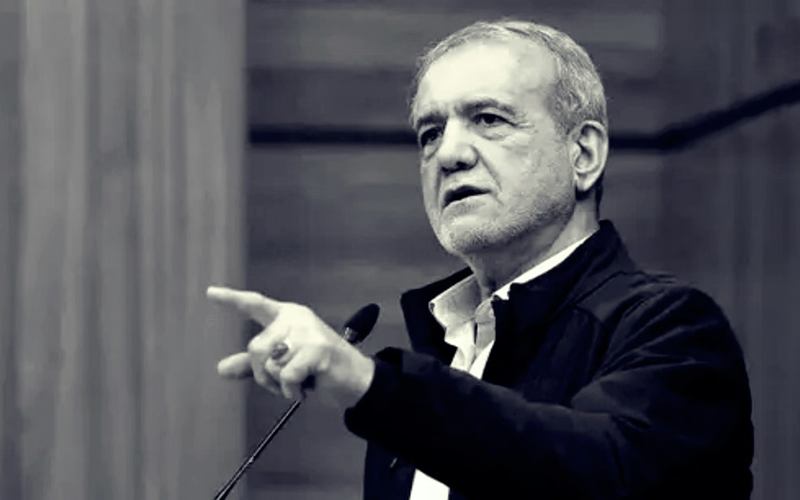

Impeachment battles, public attacks, and disputes over diplomacy expose the competing interests dividing Iran’s ruling establishment, while fear of another popular uprising shapes its struggle for survival.
The regime’s president Masoud Pezeshkian recently argued that unity and the avoidance of internal disputes were essential for victory. But events inside the regime tell a different story. Parliamentary impeachment proceedings, public confrontations among officials, and disputes over negotiations with foreign powers have continued despite the wartime circumstances.
The contradiction reflects a fundamental problem for Iran’s ruling establishment: its factions share an interest in preserving the existing system, but they disagree over how to protect their positions within it. Personal rivalries, competing economic interests, and fear of renewed popular unrest make genuine unity increasingly difficult to achieve.
Impeachment Battles Expose Deepening Factional Warfare
The campaign to impeach ministers in Pezeshkian’s administration has become one of the clearest manifestations of the escalating conflict. Parliamentary proceedings against the the regime’s economy minister have advanced, while Foreign Minister Abbas Araghchi and Labor Minister Ahmad Meydari have also faced pressure from lawmakers.
Pezeshkian has repeatedly attempted to downplay the importance of personnel changes, arguing that replacing individual officials would not resolve the country’s underlying problems. Nevertheless, the impeachment campaign has continued, with political factions using ministerial appointments and dismissals as instruments in their broader struggle for influence.
The confrontation extends well beyond parliament.
A dispute between lawmaker Hamid Rasaei and parliament speaker Mohammad Bagher Ghalibaf escalated into legal proceedings and Rasaei’s imprisonment, according to accounts circulating within the regime’s political circles. Fellow hard-line lawmaker Amirhossein Sabeti subsequently invoked the fate of former president Akbar Hashemi Rafsanjani to warn rival officials against widening their confrontation with the supreme leadership.
His remarks reflected the increasingly threatening language used by rival factions, with political disagreements turning into warnings about the possible consequences of crossing powerful figures within the establishment.
Religious officials have also entered the fray. Ahmad Alamolhoda’s fellow cleric Rasoul Falahati publicly challenged officials associated with Pezeshkian over their participation in a diplomatic celebration in New York, demanding that they explain on whose behalf they had attended.
Meanwhile, supporters of the Foreign Ministry have argued that undermining Araghchi during a sensitive diplomatic period could weaken the country’s negotiating position. One argument advanced in the domestic debate was that diplomacy forms part of a country’s deterrence capacity and that weakening the foreign minister could impose additional costs on the military and diplomatic fronts.
These competing positions reveal a leadership unable to agree on how to manage the pressures confronting it. Even when officials invoke national security, their arguments frequently serve as weapons in the struggle between rival political camps.
Diplomacy Becomes Another Front in the Power Struggle
The divisions are particularly visible over negotiations with foreign powers.
Mohammad Reza Bahonar, a member of the Expediency Discernment Council, pushed back against critics who questioned why the government was negotiating. He argued that negotiations were a continuation of war by other means and that no war could continue indefinitely. He also emphasized the need for the armed forces to follow the political leadership’s decisions on the direction of the conflict.
Such remarks underscore a fundamental disagreement within the establishment. One faction sees negotiations as necessary to manage the consequences of confrontation, while another fears that diplomatic concessions could weaken its political standing or undermine the ideological foundations on which it justifies its position.
The dispute over the Foreign Ministry is therefore not simply a disagreement about diplomatic tactics. It is also a struggle over who has the authority to determine the regime’s course and which faction will bear responsibility for the consequences.
The same pattern has emerged in the controversy surrounding the oil minister. The impeachment campaign has intersected with questions about intermediaries used to circumvent sanctions and the handling of oil revenues. Critics have argued that the minister is being made a scapegoat amid disputes over the performance and interests of these networks.
The allegations and counterarguments surrounding these cases have become part of a wider political contest in which each faction seeks to shift responsibility for policy failures onto its rivals.
For ordinary Iranians, however, the consequences extend beyond the internal balance of power. Economic hardship, declining purchasing power, and uncertainty about the country’s direction remain unresolved while senior officials devote substantial energy to political score-settling.
Why Calls for Unity Keep Failing
The repeated failure of unity appeals points to a structural problem within the regime. Its factions have a common interest in preserving the system from which they derive their political authority and economic advantages. But that shared interest does not eliminate their competition over access to resources, appointments, influence, and control of policy.
Instead, the struggle to protect individual and factional interests often takes precedence over any collective response to the country’s crises.
Even figures within the establishment have acknowledged the problem. Cleric Mohsen Gharavian, a seminary and university professor, criticized what he described as personal score-settling among officials, arguing that impeachment initiatives and public attacks were being driven by personal motives rather than the country’s interests.
He questioned the wisdom of weakening political and diplomatic officials during a period of military, political, and economic confrontation. He also criticized state television for broadcasting remarks that undermine the elected government and its mandate.
These criticisms are significant because they reflect concerns voiced from within the establishment itself. The problem is not merely that officials disagree. It is that their disagreements repeatedly become public confrontations that undermine the regime’s own appeals for cohesion.
The competing factions also lack a common understanding of the concessions, compromises, and policy changes required to address the crisis. Each seeks to preserve its own influence while limiting the power of its rivals, making collective action difficult even when the costs of division are evident.
Fear of Another Uprising Shapes the Regime’s Internal Conflict
Beyond personal rivalries and economic interests, fear of another popular uprising is a major factor driving the factional struggle.
The regime’s competing camps differ over how to prevent renewed mass protests, particularly when economic pressures and coercive policies risk provoking public anger. Their disagreements reflect different calculations about the balance between repression, social control, and the economic measures required to keep the state functioning.
One camp may argue that restrictions such as the morality patrols should be relaxed to avoid provoking protests similar to the 2022 uprising. Hard-line opponents counter that dismantling such enforcement mechanisms would weaken the regime’s capacity to maintain control of public spaces and intimidate potential protesters.
The same conflict emerges over fuel prices and government spending. Some officials warn that increasing fuel prices could trigger unrest, pointing to the November 2019 protests that followed a sudden fuel-price hike. Others argue that the government faces severe financial constraints and must secure sufficient revenue to meet its obligations, including payments to security and military institutions.
The dilemma is difficult to resolve. Raising prices can intensify public anger, but avoiding unpopular economic measures can deepen fiscal pressures. Reducing coercive measures may ease social tensions, but hard-liners fear losing instruments of control. Maintaining those measures, meanwhile, risks further alienating a population already burdened by economic hardship and political repression.
Each faction advances its own solution according to its priorities, while the consequences of policy failures are passed between institutions and rival political camps.
A Regime Trapped Between Survival and Division
The continuing factional warfare demonstrates the limits of the unity repeatedly demanded by Iran’s leaders. Appeals for solidarity cannot resolve conflicts rooted in competing interests, struggles over economic resources, and disagreements about how to confront domestic opposition.
The regime’s factions remain tied to a common objective: preserving the political system. Yet their competing strategies for achieving that objective generate persistent conflict, particularly as the costs of confrontation and economic pressure increase.
Their fear of another popular uprising adds urgency to these disputes. Decisions on fuel prices, social restrictions, government spending, and negotiations are not simply policy questions; they are also calculations about the risks of renewed public unrest.
The result is a ruling establishment that continues to demand unity while struggling to overcome its own divisions. Its leaders can postpone difficult decisions, blame rival factions, and seek to contain popular anger, but none of these measures resolves the underlying tensions.
As long as preserving factional power takes precedence over addressing the grievances of the Iranian people, calls for unity are likely to remain in conflict with the political realities inside the regime.