


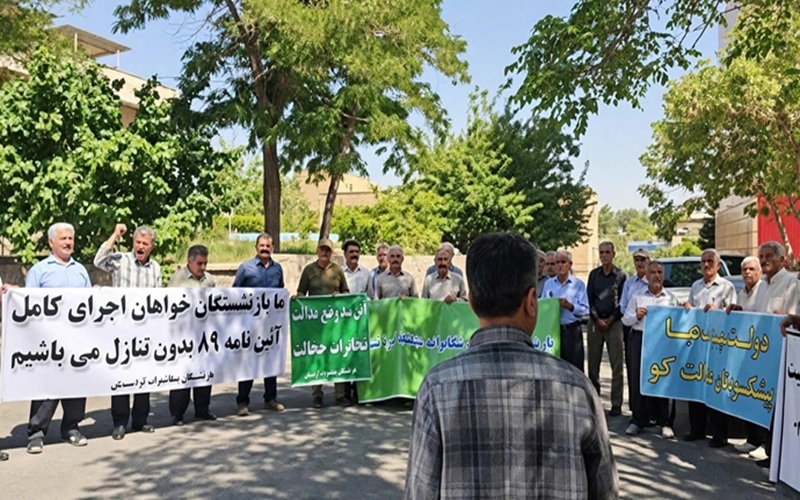

A widening gap between wages and living costs is pushing millions of Iranian workers and retirees deeper into poverty, debt, and deprivation.
Iran’s economic crisis is pushing the country’s working families into an unprecedented struggle to meet even the most basic costs of daily life. The gap between wages and living expenses has become so severe that a full month of work can no longer cover even half of the minimum cost of supporting a family.
Recent estimates put the minimum monthly cost of living for a working-class household at approximately 90 million tomans, while a married worker with one child and one year of experience earns only about 24.9 million tomans, even after receiving all benefits.
The figures expose the depth of Iran’s poverty crisis. A worker earning a full salary can cover only a fraction of the expenses required to maintain a basic standard of living.
Living Costs More Than Double in Four Months
The deterioration has accelerated dramatically in recent months.
Estimates based on official statistics and a standard food basket indicate that the minimum cost of living for workers increased from approximately 42.9 million tomans in March to more than 90 million tomans by the end of July.
That means the minimum cost of survival more than doubled in only four months.
At the beginning of the year, a worker’s income could theoretically cover around 58 percent of minimum living expenses, equivalent to roughly 17.5 days of household costs. By the end of July, that figure had collapsed to just 27.58 percent, enough to cover approximately 8.27 days.
In practical terms, workers who spend their entire monthly salary are left without sufficient income for more than three weeks of the month. Families must therefore borrow money, take second jobs, draw down whatever savings they have left, or eliminate essential expenditures simply to survive.
Food Inflation Makes Survival More Difficult
Food prices have become one of the most severe drivers of the crisis.
Official statistics put year-on-year inflation for food and beverages at 128.1 percent in July, while overall year-on-year inflation reached 87.9 percent and annual inflation stood at 66 percent.
The consequences are visible in the most basic shopping baskets. A tray of eggs, an ordinary household staple, reportedly starts at around 525,000 tomans in some stores and can reach approximately 747,000 tomans for certain packaged varieties.
For families already spending most of their income on food, rent, and utilities, such price increases rapidly translate into hunger and deprivation.
Retirees Face the Same Crisis
Retirees are also being pushed deeper into poverty.
Many Social Security retirees are struggling to pay for food and medical treatment simultaneously as prices continue to rise. The growing number of retirees participating in demonstrations across Iranian cities reflects the widening gap between pensions and actual living costs.
For elderly people dependent primarily on pensions, the consequences are particularly serious. When income is insufficient to cover both food and medicine, healthcare becomes a luxury rather than a basic right.
The result is a growing pattern of postponed medical treatment, reduced consumption of essential goods, and mounting household debt.
Government Relief Falls Far Short
Even measures presented as assistance to vulnerable households cannot bridge the enormous gap.
According to calculations cited by a member of the regime’s parliament’s economic commission, the increase in the official foreign-exchange rate and the removal of the subsidized exchange rate could impose more than 5 million tomans in monthly inflationary costs on each person, while the value of the government’s proposed food voucher amounts to only around 1 million tomans.
The disparity illustrates the inadequacy of temporary subsidies in confronting structural inflation. A government cannot compensate for tens of millions of tomans in additional household expenses through small monthly credits while the underlying economic policies driving inflation remain unchanged.
Families Are Selling What They Have Left
Perhaps the clearest indication of the depth of the crisis is the increasing need for families to liquidate personal possessions to cover basic expenses.
Reports from Iran’s market for natural hair indicate that some women are selling their hair to pay rent, university tuition, medical bills, or other essential expenses. Long, healthy, untreated hair can reportedly be valued at as much as 30 million tomans.
Selling hair may appear unusual, but it is symptomatic of a much broader phenomenon: families are increasingly exhausting whatever assets or resources remain available to them.
Food is being removed from household budgets. Medical treatment is postponed. Borrowing is increasing. Personal possessions are sold. A second job becomes necessary simply to keep pace with basic expenses.
This is no longer a crisis confined to unemployed or extremely poor households. Millions of people who work or receive pensions are nevertheless unable to afford the minimum cost of living.
Poverty Is Becoming a Structural Crisis
The Iranian regime’s economic policies have failed to protect purchasing power while inflation continues to erode wages and pensions. Resources that could contribute to improving living standards remain entangled in costly state priorities, systemic corruption, military and security expenditures, and policies that have contributed to economic isolation and instability.
The consequence is an economy in which nominal wages can increase while real living standards continue to collapse.
A family earning less than 25 million tomans cannot realistically meet minimum monthly expenses of 90 million tomans through “saving” or better budgeting. The mathematics simply does not work. The only remaining options are debt, additional labor, deprivation, or selling possessions.
Iran’s expanding poverty crisis is therefore not merely a temporary consequence of inflation. It reflects a profound failure of economic governance that is transferring the cost of the regime’s policies directly onto ordinary people.
As workers and retirees continue to protest across the country, their demands are increasingly about survival itself: affordable food, housing, healthcare, and wages and pensions that reflect the actual cost of living.
The growing gap between income and survival costs is turning poverty into a nationwide social crisis—and the regime’s continued policies are leaving millions of Iranians with fewer and fewer ways to endure it.