


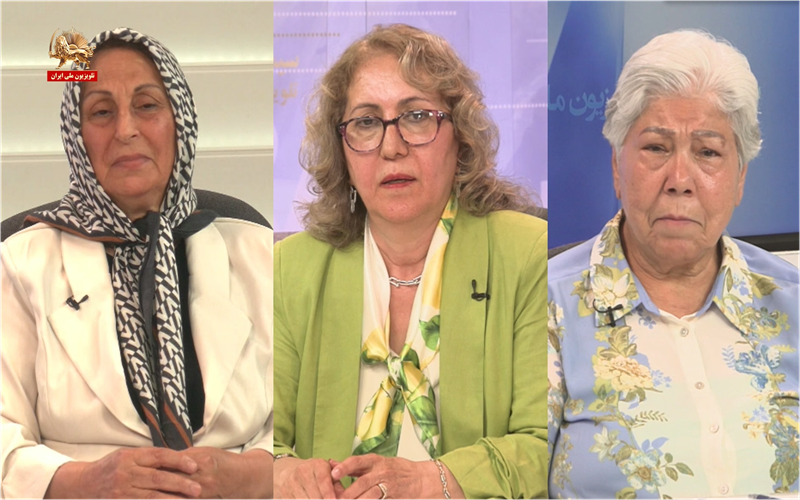

From the prisons of the Shah’s secret police to the executions and persecution that followed, Iranian families have paid a devastating price for their commitment to freedom. Their stories remain part of the country’s living history.
For decades, the struggle for freedom in Iran has been accompanied by repression, imprisonment, executions, and profound personal sacrifice. While the names of political prisoners and those killed for their opposition are sometimes recorded in history, the stories of the families left behind are far less frequently told.
Behind every execution was a mother who lost a son, a family whose life was shattered, and relatives who were often subjected to persecution themselves. Many mothers carried their grief for decades while continuing to preserve the memory of their children and the cause for which they had sacrificed their lives.
Among these stories is that of Eshrat Najibzadeh, known as “Mother Dehghan,” the mother of three members of the People’s Mojahedin Organization of Iran (PMOI/MEK) who were killed, and a former political prisoner in Shiraz. Another is that of Robab Barayi, a former political prisoner of Adelabad Prison in Shiraz.
Their experiences offer a glimpse into the enormous human cost of political repression in Iran and the determination of families who refused to allow those sacrifices to disappear from collective memory.
A Young Boy Who Entered the Struggle
The story of Mother Dehghan’s family began even before the 1979 revolution.
Her son, Mehran Dehghan, was still a teenager when he began participating in demonstrations and writing slogans against the Shah’s rule. A student at Darius High School in Shiraz, he was around 15 years old when he first became involved in political activities alongside his friends.
In early 1978, as demonstrations intensified across Iran, security forces arrested Mehran while he was writing political slogans. His family spent hours desperately searching for him without knowing where he had been taken.
Late that night, the Shah’s secret police, SAVAK, contacted the family and informed them that Mehran was being held at their office. His father went to retrieve him.
The arrest did not end Mehran’s political activity. Instead, it marked the beginning of a path that would increasingly involve the entire family.
Mother Dehghan recalled that she supported her son and accompanied him in his activities. She became involved in the same struggle, following him wherever she could and helping him whenever possible.
But the family’s ordeal intensified after the 1979 revolution, as the new regime began systematically persecuting political opponents.
Repression Extends Beyond the Prisoner
The execution of Mohammad Reza Najibzadeh, a nephew of Mother Dehghan, became a turning point for the family.
Following his execution, authorities targeted the family and their livelihoods. His father’s pharmacy was shut down, while another brother’s bookstore was also forced to close. Mohammad Reza’s brothers and sisters were expelled from school and prevented from continuing their education.
The repression was not confined to the person accused of political opposition. It extended to parents, siblings, relatives, workplaces, businesses, and even children.
For families like the Najibzades, political persecution became a collective experience.
The treatment of Mohammad Reza’s body revealed another dimension of that repression: even in death, authorities sought to control and intimidate the victim’s family.
An 18-Year-Old Executed and Buried in His Family’s Yard
Mohammad Reza Najibzadeh was only 18 years old when he was executed.
His family was not immediately allowed to receive his body. They repeatedly went to the authorities, including the Revolutionary Guard, demanding that the remains be returned.
Eventually, in the early hours of the morning, the family was given his body—but under conditions that made even mourning an act of defiance.
The authorities did not allow the family to take him to a cemetery.
Instead, his relatives were forced to bury him in the courtyard of the family home.
The family washed his body themselves. But what they encountered was devastating. According to Mother Dehghan’s account, Mohammad Reza had been shot repeatedly, with approximately 22 bullets striking his body. A final bullet had struck his head, leaving his injuries catastrophic.
The family brought cotton from a pharmacy in an attempt to stop the bleeding before they could prepare the body for burial.
By the time they finally buried him, the house itself had become his gravesite.
This was not merely a family tragedy. It was an example of how political repression reached into the most intimate spaces of ordinary life, turning homes into places of mourning and families into witnesses to state violence.
The Wounds That Time Cannot Erase
Decades may pass, but some memories do not fade.
For Mother Dehghan, the images of those years remain vivid. The loss of her nephew, the persecution of her family, the executions, and the humiliation surrounding the burial are memories that time has not erased.
Such experiences illustrate an often-overlooked dimension of Iran’s modern history: the cost paid not only by those who were imprisoned or executed, but also by the families who survived them.
Mothers in particular carried a unique burden. They endured arrests, searches, executions, the disappearance of loved ones, restrictions on education and employment, and years of uncertainty. Yet many continued to preserve the names and stories of their children.
Their testimony is therefore more than a personal recollection of grief. It is part of the historical record.
Preserving the Memory of Those Who Paid the Price
The history of Iran’s political repression cannot be understood solely through official documents, prison records, or lists of executions. It must also be understood through the memories of those who witnessed what happened inside their own families.
The story of Mother Dehghan and other mothers like her demonstrates how the consequences of repression extended across generations.
A teenager writing slogans could become a political prisoner. An 18-year-old could be executed. A family business could be closed because of a relative’s political activities. Children could be expelled from school. And a family could be denied even the right to bury its dead in a cemetery.
Yet the memory of those who were killed survived.
For the younger generation of Iranians, these stories carry a particular significance. They show that the struggle for freedom did not begin with one particular uprising or one particular generation. It has been sustained over decades by people who endured imprisonment, persecution, and death—and by families who carried their memories forward.
The mothers who witnessed these losses are themselves part of that history. Their suffering is inseparable from the story of Iran’s struggle for freedom.
Their testimonies deserve to be preserved not as distant memories, but as evidence of the price that countless Iranian families have paid—and continue to pay—for their pursuit of a free future.