


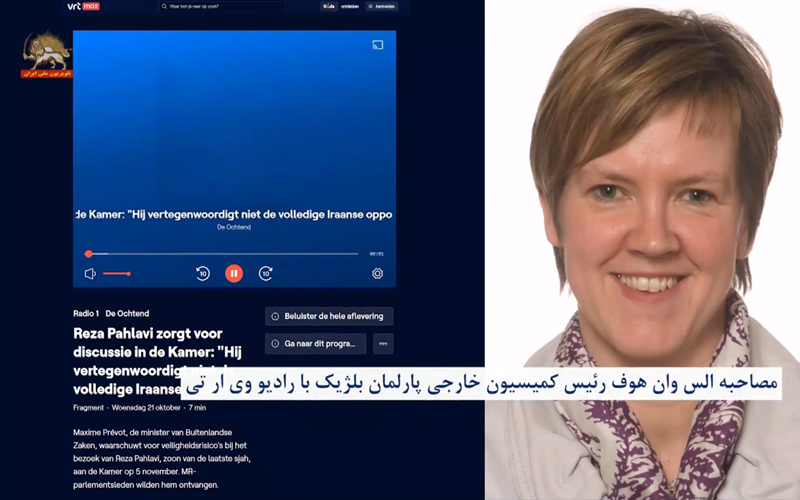

Els Van Hoof argues that giving the son of Iran’s last shah an official parliamentary platform could be interpreted as Belgian support for one faction, stressing that Iranians themselves must determine their country’s democratic future.
Belgian Lawmaker Challenges Proposed Invitation to Reza Pahlavi
Els Van Hoof, chair of the Foreign Affairs Committee of Belgium’s Federal Parliament, has opposed a proposed invitation to Reza Pahlavi, the son of Iran’s last shah, warning that an official parliamentary reception could create the impression that Belgium is endorsing one particular faction among Iran’s diverse opposition movements.
Speaking to Belgian public broadcaster VRT ahead of a meeting of parliamentary group leaders, Van Hoof argued that the proposal was politically unwise, particularly given the divisions surrounding Pahlavi within the Iranian diaspora and the absence of a clear basis for treating him as a representative of the broader opposition.
Her intervention highlights a central question for European policymakers: how can democratic governments support the Iranian people’s aspirations for freedom without conferring political legitimacy on an individual or faction whose claim to represent them is contested?
Van Hoof’s position was that an official invitation would risk blurring that distinction. Rather than providing Pahlavi with a parliamentary platform to advance his political campaign, Belgium should avoid appearing to choose a preferred figure in Iran’s opposition.
Parliamentary Recognition Could Be Seen as Political Endorsement
Van Hoof’s principal objection concerned the political signal that an official parliamentary reception would send. Because Iran’s opposition encompasses different political currents, she argued, granting Pahlavi a prominent institutional platform could be interpreted as Belgium taking sides.
Such a move could allow Pahlavi to use the visibility and standing of the Belgian Parliament to strengthen his political position and pursue broader international recognition. Van Hoof questioned the appropriateness of providing that opportunity through an official parliamentary invitation.
Her concerns extend beyond the individual invitation. Pahlavi has sought engagement with political institutions in several countries, making the question of parliamentary access part of a wider debate over international recognition and the representation of Iran’s opposition.
Van Hoof maintained that Belgium should not become a participant in this competition for political legitimacy. In her view, the country should instead support Iranians through approaches that do not imply endorsement of a particular opposition faction.
Questions Over Pahlavi’s Representative Role
A further element of Van Hoof’s opposition was her assessment that Pahlavi is a divisive figure rather than a unifying representative of Iran’s opposition.
She questioned whether his current level of popular support could be established and rejected the assumption that he speaks for the opposition as a whole. An official invitation, she suggested, could give an impression of representative legitimacy that has not been demonstrated.
These concerns touch on a broader issue in discussions about Iran’s political future: the distinction between visibility abroad and a demonstrable mandate among the Iranian people.
International appearances and meetings with foreign politicians can increase a political figure’s profile, but they do not, on their own, establish that the individual represents the full range of opposition forces or enjoys a popular mandate inside Iran.
Van Hoof’s argument was that Belgium should not allow the prestige of its parliament to be interpreted as confirmation of such a mandate.
Invitation Proposal Draws Attention to Divisions Over Iran Policy
According to Van Hoof, the proposal originated with colleagues from the Reformist Movement party, including Georges-Louis Bouchez.
She opposed the initiative in the context of existing geopolitical tensions and the divisions surrounding Pahlavi among sections of the Iranian diaspora. She argued that an official invitation would be particularly ill-advised under these circumstances, when supporting freedom and democracy in Iran should not mean endorsing one individual abroad.
Her position also reflected concern about security considerations raised by Belgian Foreign Minister Maxime Prévot. Van Hoof argued that Belgium should avoid becoming entangled in a politically contentious initiative when other ways of supporting the Iranian people remain available.
The dispute illustrates how decisions about parliamentary invitations can carry implications beyond protocol. An official reception may be presented as an opportunity for dialogue, but it can also be interpreted as a signal of political preference, particularly when the invited figure is associated with a contested claim to represent an opposition movement.
Supporting Iranians Without Choosing Their Political Future for Them
Van Hoof emphasized that Belgium should concentrate on supporting the Iranian people’s aspirations for freedom, democracy, and civil rights rather than elevating a particular opposition figure.
She pointed to the suffering Iranians have endured under the ruling regime and argued that support for their rights should remain distinct from backing a specific political faction.
This distinction is particularly relevant for European governments seeking to respond to repression in Iran while avoiding the impression that they intend to determine the country’s future leadership from abroad.
The principle articulated by Van Hoof is that Iranians themselves must decide their political future. For Belgium, that means supporting democratic aspirations without presenting Pahlavi as the representative of the opposition or allowing an official parliamentary event to be understood as an endorsement of his political project.
Her intervention does not settle the wider debate over Iran’s opposition or the forms of international engagement that may be appropriate. It does, however, make clear her objection to using Belgium’s parliamentary institutions to confer prominence on a figure whose claim to represent Iran’s opposition remains contested.
The underlying issue is not whether European governments should support the Iranian people’s pursuit of democratic rights. It is how they can do so without confusing solidarity with political endorsement.
Van Hoof’s position places that question at the center of the controversy over the proposed invitation: Belgium can support the Iranian people’s demand for freedom and democracy without choosing a political figure to speak on their behalf.