


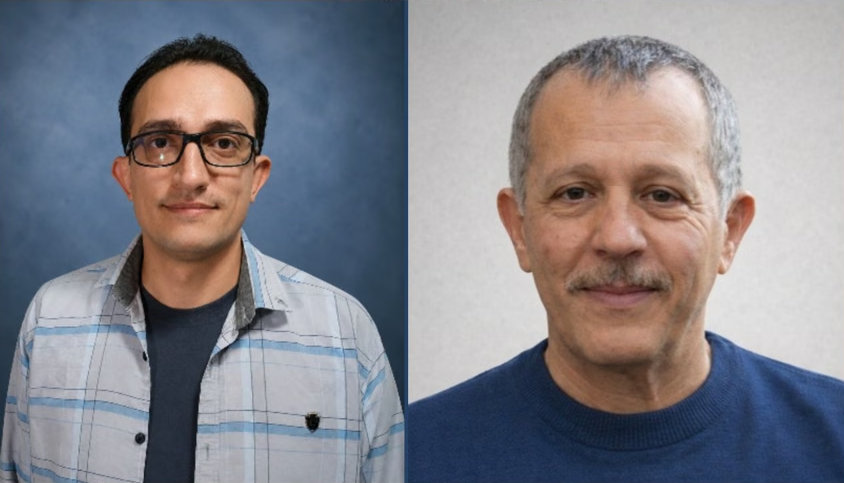

From Qezel Hesar Prison, political prisoners Khosrow Rahnama and Sepehr Emamjomeh highlighted organized resistance, the Resistance Units, and the role of the PMOI in confronting dictatorship in Iran.
Two Iranian political prisoners held in Qezel Hesar Prison have reaffirmed their commitment to the People’s Mojahedin Organization of Iran (PMOI/MEK), describing organized resistance and the Resistance Units as essential elements in the struggle against the Iranian regime.
Khosrow Rahnama and Sepehr Emamjomeh issued separate messages from Qezel Hesar Prison in September 2026 to mark the 61st anniversary of the PMOI’s founding. Their messages emphasized the importance of an organized political movement capable of confronting dictatorship and sustaining the struggle for freedom despite repression.
Khosrow Rahnama: Organized resistance is essential
In his message, Khosrow Rahnama described the PMOI’s 61-year history as a period of confrontation with both the former monarchy and the current clerical regime. He linked the organization’s history to a broader tradition of political resistance in Iran, referring to the Constitutional Revolution, the movement led by Mirza Kuchik Khan, Mohammad Mossadegh’s national movement, and the 1979 revolution.
Rahnama argued that the experience of Iran’s modern history demonstrates the need for a powerful and committed national organization capable of opposing dictatorship regardless of its political form.
“The experience of the struggles of the past century against two royal and clerical dictatorships has proven that only organized revolutionary resistance is capable of confronting the inhuman clerical regime.”
He identified the PMOI’s organizational structure and the Resistance Units as the principal manifestations of what he described as organized resistance.
According to Rahnama, the continued expansion of the Resistance Units and their appeal among young Iranians demonstrate the persistence of this political current despite the regime’s repression.
He also asserted that the PMOI has become a particularly feared name for the Iranian regime, writing:
“For the regime in Iran, there is no name redder and more frightening than ‘Mojahed-e Khalq.’”
Rahnama concluded by expressing confidence in what he described as the eventual victory of the Iranian people and the prospect of peace and freedom.
Sepehr Emamjomeh: “If it had not existed, what would have happened?”
Sepehr Emamjomeh’s message took a different approach. Rather than presenting a chronological account, he repeatedly posed the question of what Iran’s history might have looked like if the PMOI and its leaders had not existed at critical moments.
He argued that the organization’s role could only be understood by examining the historical consequences of its political and organizational decisions.
“Every time I go over this question in my mind and think, ‘What would have happened if it had not existed?’ there are turning points in the century-long history of the Iranian people’s struggle against the two dictatorships of the Shah and the clerics whose greatness and importance only become apparent with the passage of time.”
Emamjomeh attributed particular importance to the leadership of Massoud Rajavi and the role he says the PMOI played following the 1979 revolution. He argued that without an organized opposition, the revolution could have been rapidly consolidated under the rule of Ayatollah Ruhollah Khomeini.
He also pointed to the PMOI’s military and political history during the Iran-Iraq War, arguing that the organization’s calls for peace had consequences for the continuation of the conflict.
The prisoner further highlighted Maryam Rajavi’s role, particularly in relation to women’s political participation and leadership within the resistance movement. He connected this with what he described as an internal transformation within the PMOI that challenged gender-based hierarchies and strengthened its organizational capacity.
The Resistance Units as a strategic force
A central theme of both messages is the role of the Resistance Units, which the PMOI describes as networks of activists inside Iran engaged in organized opposition activities.
Rahnama portrayed the Resistance Units as an increasingly important component of the resistance movement, arguing that their expansion reflects the continuing appeal of organized opposition among younger generations.
Emamjomeh similarly linked the Resistance Units to the emergence and continuation of popular uprisings. He argued that without an organized resistance infrastructure and the experience accumulated over decades, Iran’s protest movements would face greater difficulty challenging the regime.
He wrote:
“If its victorious strategy and its Resistance Units had not existed, how would the uprisings have ignited?”
Emamjomeh also emphasized the importance he attributes to the experience of PMOI members who have endured years of imprisonment, displacement, and political struggle. In his view, this accumulated experience provides an organizational foundation for confronting the Iranian regime.
A declaration from Qezel Hesar
The two messages come from Qezel Hesar Prison, where Iranian political prisoners continue to issue statements despite the restrictions imposed on them.
Neither Rahnama nor Emamjomeh focused primarily on their own imprisonment. Instead, both used the 61st anniversary of the PMOI to reaffirm their political commitment and present their imprisonment as part of a broader struggle over Iran’s political future.
Their messages also reject both forms of dictatorship they identify as the Shah and the clerical regime. Rahnama ended his statement with the slogan:
“Down with reaction, whether clerical or royal; greetings to the Resistance Units and the Army of Peace and Freedom.”
Emamjomeh concluded by celebrating the PMOI’s 61st anniversary and expressing his hope for what he called the “new democratic revolution of the Iranian people.”
Written from inside one of Iran’s most notorious prisons, the two messages represent a continued expression of political defiance by imprisoned activists. Their central argument is that sustained resistance to authoritarian rule requires organization, leadership, and a political alternative capable of translating popular discontent into political change.