


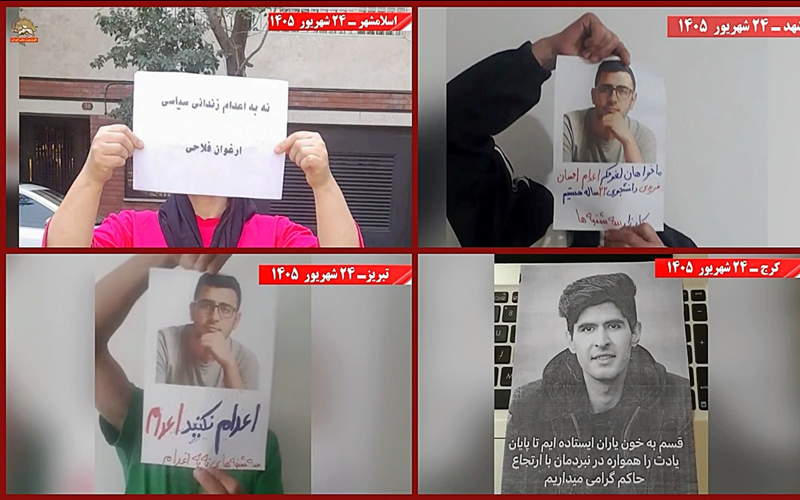

Memorials, photo actions, audio messages, posters, stickers, and graffiti call for an end to executions and support political prisoners facing death sentences
A new wave of activities supporting the “No to Execution Tuesdays” campaign was reported across cities throughout Iran on September 15, with Resistance Units staging memorials, photo actions, audio messages, poster installations, stickers, and graffiti in opposition to executions and in support of political prisoners.
The activities took place in Tehran, Karaj, Rasht, Tabriz, Mashhad, Ahvaz, Islamshahr, Isfahan, Shiraz, Yazd, Varamin, Najafabad, Lahijan, and Malayer.
The campaign has become a recurring expression of opposition to the death penalty in Iran, particularly in cases involving political prisoners and protesters sentenced to death.
Memorial for Executed Prisoner in Karaj
In Karaj, a memorial was held for Mehdi Khanaki, featuring his photograph and a song in his memory. A message displayed during the memorial said that his memory would remain part of the struggle against the ruling system.
Additional photo actions in Karaj focused on the fate of the bodies of executed prisoners. Activists demanded information about the whereabouts of Vahid Bani-Amiryian, Behrouz Ehsani, Mehdi Hosseini, and Babak Alipour, whose bodies were described in the slogans as having not been returned to their families.
Support for Prisoners Facing Execution
In Rasht, an audio message called for support for political prisoners facing execution and demanded the immediate cancellation of the death sentences against Arghavan Fallahi, Farshad Etemadifar, Zahra Tabari, Mohammad Javad Vafaei Thani, and Issa Chari.
Posters were also installed calling for the cancellation of Manouchehr Fallah’s sentence and opposing Zahra Tabari’s execution.
In Tehran, another audio message expressed support for political prisoners and emphasized continuing their path of resistance. Two photo actions specifically carried the message “No to the execution of Arghavan Fallahi.”
Posters installed in different parts of the capital called for the families of executed prisoners to be informed about the whereabouts of their loved ones’ remains and reiterated the “No to Execution” message.
Actions in Tabriz, Mashhad, and Ahvaz
In Tabriz, a photo action featuring Ehsan Faridi called for an end to executions and promoted the “No to Execution Tuesdays” campaign. Another action featured Issa Chari and carried a similar message.
In Mashhad, activists demanded the cancellation of Ehsan Faridi’s death sentence, describing him as a 22-year-old student. Other photo actions called for the immediate cancellation of Arghavan Fallahi’s death sentence and opposed the execution of boxer Mohammad Javad Vafaei Thani.
In Ahvaz, photo actions featured Issa Chari and Farshad Etemadifar alongside messages opposing executions. A poster separately called for an end to the execution of Alireza Mardasi.
In Islamshahr, photo actions opposed the execution of Arghavan Fallahi and Mohammad Javad Vafaei Thani, who was described in the campaign materials as a boxing champion.
Campaign Activities Continue Across Iran
In Isfahan, two photo actions carried the message that the execution of loved ones was being condemned under the banner of the “No to Execution Tuesdays” campaign.
In Shiraz, stickers bearing the messages “No to Execution” and “We Continue” were placed on bus seats.
In Yazd, a photo action carried a message describing the response to executions as continued resistance and uprising.
In Varamin, activists again raised questions about the whereabouts of the bodies of Behrouz Ehsani and Ali-Akbar Daneshvarkar.
In Najafabad, a photo action called for the immediate cancellation of the death sentences against Amir-Hossein Akbari and Masoud Jamei. It also called for the cancellation of what the activists described as unjust sentences against Mansour Jamali and Manouchehr Fallah.
In Lahijan, a photo action and poster installation carried the message that no one should be executed and described execution as a crime against humanity.
In Malayer, two instances of graffiti opposed oppression and dictatorship. One rejected oppression regardless of whether it came from a monarch or another ruler, while another condemned dictatorship and oppression regardless of whether the ruler was a monarch or the current supreme leader.
A Nationwide Campaign Against Executions
The September 15 activities brought together a range of tactics—from public memorials and photo actions to audio messages, posters, stickers, and graffiti—across at least 14 Iranian cities.
The campaign’s messages focused particularly on political prisoners facing execution, while also demanding information about the remains of prisoners who have already been executed.
The Resistance Units presented these actions as part of the continuing “No to Execution Tuesdays” campaign, linking opposition to the death penalty with support for political prisoners and a broader rejection of political repression in Iran.