


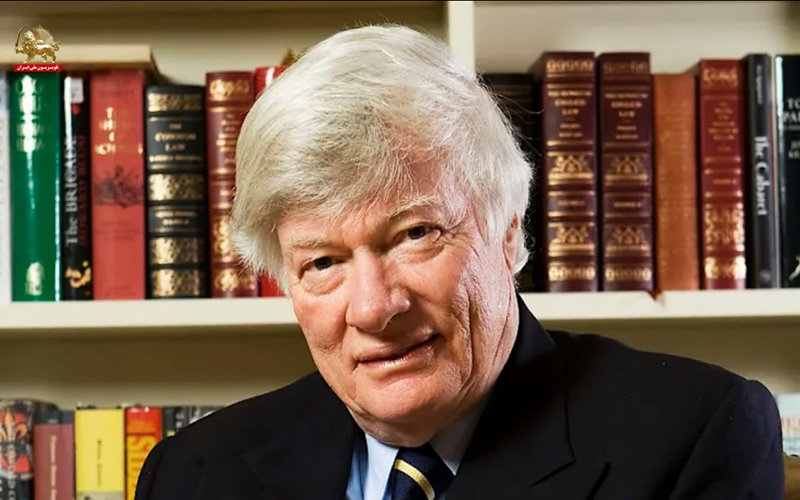

Speaking at a conference on Iran’s ongoing political executions, the international human-rights lawyer described his investigation into the 1988 massacre and called for an international tribunal to hold those responsible accountable.
The unresolved legacy of Iran’s 1988 massacre continues to shape the country’s political repression, according to Geoffrey Robertson KC, the international human-rights lawyer who investigated the killings and documented the evidence in a landmark report.
Speaking at the September 4 conference, “Ongoing Crimes Against Humanity: Political Executions in Iran and the Duty to Act,” Robertson recalled his investigation into the mass execution of political prisoners and argued that the absence of accountability helped create the conditions for subsequent atrocities. The conference, organized by Justice for the Victims of the 1988 Massacre in Iran (JVMI), brought together international jurists, former UN officials, human-rights experts, and victims’ representatives to examine both the 1988 massacre and the continuing use of executions against political opponents in Iran.
Robertson, a former founding president of the UN Special Court for Sierra Leone, said he began investigating the 1988 killings in 2009. He interviewed approximately 50 survivors and victims, examined previously published accounts, and reviewed Iranian government newspapers from the period. His findings were subsequently published in a detailed report, The Massacre of Political Prisoners in Iran, 1988, and in his book Mullahs Without Mercy.
Inside Iran’s Prisons: The 1988 Massacre
Robertson described the operation that began in Iranian prisons in late July 1988 as a systematic campaign carried out under conditions of extreme secrecy.
According to his investigation, prisons were suddenly placed under lockdown as the Iran-Iraq war was drawing to a close. Family visits were canceled, radio and television broadcasts were shut down, newspapers were discontinued, and prisoners were confined to their cells.
Into the prisons came delegations consisting of a religious judge, a prosecutor, and an intelligence official. These officials became known as the “death committees.” Prisoners were brought before them individually and questioned about their political affiliations, particularly their relationship with the People’s Mojahedin Organization of Iran (PMOI/MEK).
Robertson said that prisoners who demonstrated continued allegiance to the PMOI were sent to their deaths. His investigation documented executions by hanging and firing squad, followed by the clandestine removal and burial of bodies in mass graves. Families were subsequently denied information about the location of their loved ones’ graves and, according to his account, were prevented from publicly mourning them.
His report concluded that thousands of prisoners were killed by the state without trial or appeal. The Abdorrahman Boroumand Center, which published Robertson’s investigation, likewise records the prison lockdowns, the death committees, and the executions of political prisoners in its presentation of the report.
The Killings Did Not End With the PMOI
Robertson emphasized that the repression did not stop with prisoners associated with the PMOI.
He recalled that a subsequent wave of executions targeted other political and ideological groups, including leftists and people accused of religious or ideological dissent.
This continuation of the killings, he argued, demonstrated that the 1988 operation was not an isolated episode of violence but part of a broader system of repression designed to eliminate political opposition and enforce the regime’s ideological order.
His earlier research similarly documented the continuation of executions against Marxists, communists, atheists, and others accused of being enemies of the state.
Impunity Became Part of the Problem
For Robertson, the most consequential aspect of the 1988 massacre is not only the killings themselves but what happened afterward: the perpetrators were never brought to justice.
Instead, officials implicated in the repression continued to occupy senior positions within the Iranian state.
Among them was Ebrahim Raisi, who had served as a member of one of the death committees in 1988 and later became president of Iran. Robertson has previously argued that Raisi’s role in the 1988 executions warranted prosecution.
The progression of officials implicated in the massacre into senior government positions became a powerful symbol of what human-rights advocates describe as institutional impunity.
For Robertson, this failure to establish accountability has consequences far beyond the historical record. When perpetrators of mass atrocities are promoted rather than prosecuted, the absence of punishment can signal that similar crimes may be committed again without serious consequences.
From 1988 to Today’s Executions
Robertson connected the unresolved crimes of 1988 with the continuing use of executions against political opponents in Iran.
He referred to the large-scale killings of protesters during the unrest earlier in 2026, arguing that the same culture of impunity has allowed lethal repression to continue.
The precise number of people killed during the 2026 crackdown remains difficult to establish, particularly because communications restrictions limited the flow of information at the time. Robertson therefore emphasized the need for credible investigation and documentation rather than allowing the passage of time to erase evidence.
The connection between past and present executions was a central theme of the September conference. International experts participating in the event examined what organizers described as a continuity between the unresolved crimes of 1988 and the current wave of political executions. They called for stronger international accountability mechanisms, universal jurisdiction, preservation of evidence, and protection for political prisoners.
Robertson’s Call: Diplomatic Pressure and Justice
Robertson argued that governments should reconsider their diplomatic relationships with Tehran in light of the regime’s record of political executions and its use of diplomatic channels to deny or obscure abuses.
He proposed severing diplomatic relations as one possible response, arguing that governments committed to human-rights principles should not treat the Iranian regime as an ordinary diplomatic partner while serious allegations of crimes against humanity remain unresolved.
But his principal proposal was judicial rather than diplomatic.
Robertson called for the establishment of an ad hoc international tribunal capable of prosecuting those responsible for the 1988 massacre, including through trials in absentia where legally appropriate.
Many of those allegedly responsible remain alive, while others, including Raisi, have since died. Robertson argued that the death of an individual perpetrator should not prevent the historical and legal record from being established.
Why a Trial Matters
For Robertson, an international trial would serve a purpose beyond punishment.
He pointed to the Nuremberg trials as an example of how an authoritative judicial judgment can establish an enduring historical record. A properly conducted international trial, he argued, could determine what happened, identify those responsible, and create an authoritative record that could not simply be dismissed as political accusation.
That principle is particularly important in the case of Iran’s 1988 massacre, where victims’ families have spent decades demanding information about their relatives and accountability for those responsible.
The international community has already accumulated substantial documentation concerning the killings. Robertson’s own investigation, survivor testimony, human-rights documentation, Iranian official material, and subsequent investigations have contributed to that body of evidence. His report was based on interviews with survivors and examination of available documentation, including Iranian government sources.
The question, therefore, is no longer simply whether the evidence exists. It is whether governments and international institutions will act on it.
Breaking the Cycle of Impunity
Robertson’s intervention at the conference placed the 1988 massacre within a larger question confronting the international community: what happens when crimes against humanity remain without accountability?
For decades, families of the victims have continued to seek the location of mass graves and recognition of what happened to their loved ones. Meanwhile, individuals associated with the machinery of repression have reached the highest levels of the Iranian state.
The current wave of political executions has renewed that concern.
The lesson Robertson draws is straightforward: historical crimes cannot simply be left unresolved and then treated as closed chapters. Without accountability, the structures and individuals responsible can survive, adapt, and continue.
An international judicial mechanism would not bring back those killed in 1988. But it could establish an authoritative record, identify responsibility, and challenge the culture of impunity that has surrounded the massacre for nearly four decades.
For the victims and their families, that would represent more than historical recognition. It would be a step toward justice—and a warning that crimes committed by a state do not become less serious merely because those responsible have remained beyond the reach of justice for decades.