


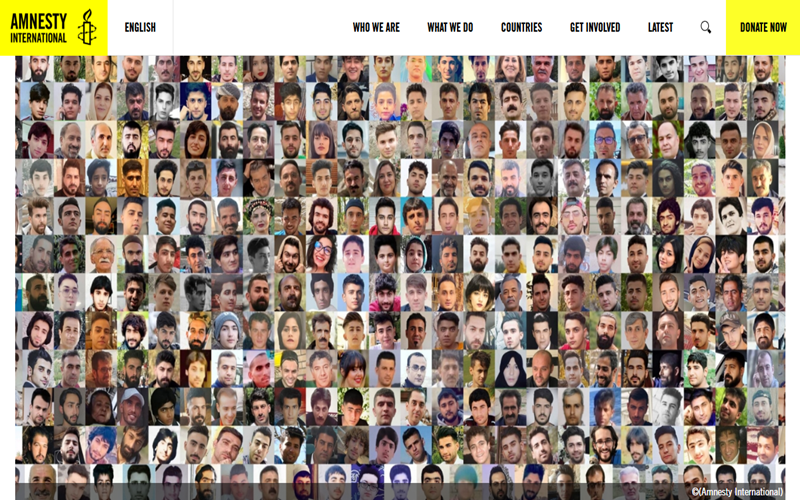

New investigation maps the state machinery behind the repression of Iran’s 2022 uprising and identifies 87 officials who should face criminal investigation.
Amnesty International has concluded that Iranian authorities committed crimes against humanity during the brutal suppression of the 2022 uprising, documenting a coordinated state apparatus responsible for killings, torture, enforced disappearances, arbitrary imprisonment, rape and persecution.
In a major new investigation published on September 16, Amnesty mapped the chains of command behind the repression and identified 87 officials who, based on the organization’s findings, should be subject to criminal investigation for their alleged roles in crimes against humanity.
The more than 1,000-page report, titled Architects of Atrocities: State Machinery Orchestrating Crimes Against Humanity in Iran’s 2022 Uprising, examines the security structures and decision-making mechanisms used to suppress nationwide protests following the death in custody of Zhina Mahsa Amini in September 2022.
A State Machinery Built to Suppress Dissent
According to Amnesty, the repression was not the result of isolated actions by individual security personnel. Its investigation describes a coordinated system involving national, provincial and local security bodies that directed and facilitated the use of lethal force against protesters and bystanders.
The organization identified the Islamic Revolutionary Guard Corps (IRGC) and the Police Command of Iran, known as FARAJA, as the two principal security forces involved in lethal protest dispersals. Their operations were implemented within a broader structure involving the Supreme National Security Council, provincial and county security councils, and other state institutions.
Amnesty says its investigation found evidence that security forces used military-grade firearms and shotguns loaded with metal pellets against protesters. Hundreds of people were unlawfully killed, including children, while thousands of others were subjected to arbitrary detention, enforced disappearance, torture and other forms of ill-treatment.
The report identifies seven categories of crimes against humanity: murder, torture, rape, sexual violence, enforced disappearance, imprisonment and persecution on political, gender, ethnic and religious grounds.
377 Victims Documented
Alongside its main investigation, Amnesty published a separate document documenting the deaths of 377 protesters and bystanders during the 2022 uprising, including 56 children.
The organization stresses that the actual number of people killed cannot be established with certainty. Its documented cases nevertheless provide extensive evidence of patterns in the use of lethal force. Amnesty found that 326 of the 377 documented victims were killed by security forces using firearms or other lethal methods, most during attempts to disperse protests.
The investigation also describes the persecution of families seeking truth and justice for those killed. Relatives of victims were subjected to intimidation and other forms of pressure, adding another layer to what Amnesty characterizes as a systematic campaign designed not only to suppress protests but also to prevent accountability.
87 Officials Identified for Investigation
One of the report’s most significant findings is its identification of 87 officials who Amnesty says merit criminal investigation.
The group includes 10 officials at the national level and 77 officials at regional, provincial and county levels. Amnesty based its assessment on the officials’ positions within the security hierarchy, their authority and control over subordinates, evidence of their involvement in coordinating operations, public statements supporting security-force actions, leaked orders, and other links to documented crimes.
The organization says it applied a “reasonable grounds to believe” standard when identifying individuals for investigation. This is not equivalent to a judicial finding of guilt, but rather an assessment that the available evidence warrants criminal investigation.
Impunity and the Risk of Further Mass Killings
Amnesty links the lack of accountability for the 2022 crackdown to subsequent waves of repression in Iran.
The organization argues that the failure to establish meaningful accountability allowed the same structures responsible for earlier abuses to continue operating. It points specifically to the mass killings during the January 8–9, 2026 protests, which Amnesty says followed the same patterns of repression seen in 2022 but on an even greater scale.
For Amnesty, the central issue is therefore not only documenting past crimes but preventing their recurrence.
The organization is calling on the UN General Assembly to establish an international criminal justice mechanism focused on crimes against humanity in Iran. It is also urging UN Security Council members to refer the situation in Iran to the Office of the Prosecutor of the International Criminal Court.
Amnesty further calls on national prosecution authorities to investigate Iranian officials under universal or other forms of extraterritorial jurisdiction where legal requirements are met and sufficient evidence exists.
Accountability Beyond Iran
The report places Iran’s 2022 repression within a broader challenge for international justice. Amnesty argues that repeated mass killings of protesters, combined with the absence of domestic accountability, have created a pattern in which state officials can expect little consequence for serious abuses.
Its latest investigation therefore seeks to move the question of accountability beyond Iran’s domestic judicial system.
Four years after the beginning of the 2022 uprising, Amnesty’s findings provide a detailed account of the security structures involved in its suppression and a list of officials it says should be investigated. The report also underscores the continuing importance of preserving evidence and documenting victims as international efforts to establish accountability remain unresolved.
For the victims and their families, the question is no longer only how many people were killed or detained during the 2022 uprising. It is also whether those who planned, authorized, coordinated or carried out the repression will ever face an independent judicial process.