


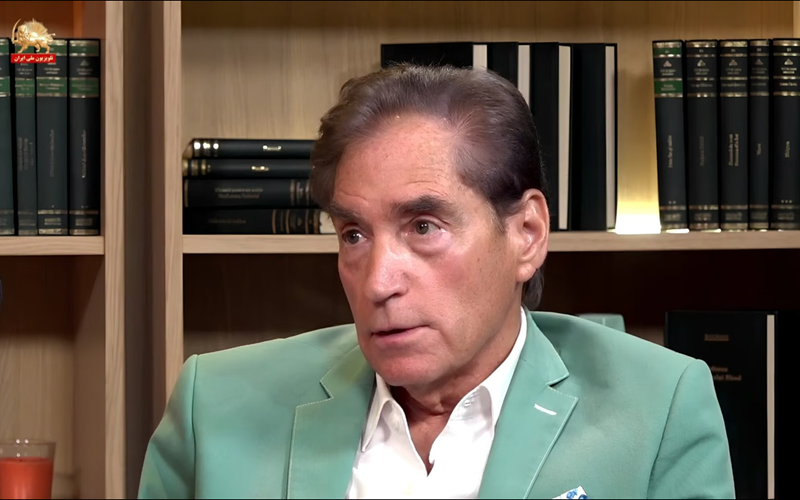

Romania’s first post-communist prime minister draws parallels between the fall of Ceaușescu and Iran’s struggle for freedom, urging democratic governments to strengthen their support for the NCRI and the Iranian opposition.
Petre Roman Urges Greater Support for Iran’s Opposition
Petre Roman, Romania’s first prime minister after the fall of Nicolae Ceaușescu in 1989, has called on democratic governments and freedom advocates to strengthen their support for Iran’s organized opposition, emphasizing that the country’s future depends on the courage and determination of those fighting the regime from within Iran.
Speaking at a conference marking the October 10 World Day Against the Death Penalty, Roman described Iran’s political and regional situation as increasingly complex. He pointed to executions, arrests, violence, and torture as evidence of the Iranian regime’s repressive nature, while criticizing the limited attention given by international media to the courage of the Iranian people and their resistance.
Roman argued that supporters of democracy must do more to communicate the objectives and programs of the Iranian opposition, particularly those of the National Council of Resistance of Iran (NCRI).
“We must increase our capacity to speak in support of the Iranian opposition and in favor of the National Council of Resistance of Iran and its programs,” he said.
He warned that the international information environment does not adequately reflect the strength of Iran’s opposition or the confidence that democratic societies should place in the Iranian people’s ability to bring about political change.
Romania’s Revolution Offers Lessons for Iran
Roman drew on his own experience during Romania’s December 1989 revolution, when the Ceaușescu dictatorship collapsed after years of repression. As the country’s first prime minister following the overthrow of the communist regime, he said he remembered how Western governments recognized Ceaușescu’s brutality but lacked a clear assessment of how the dictatorship could be brought to an end.
He sees a comparable problem in the international response to Iran today: awareness of repression does not necessarily translate into a coherent approach to supporting democratic change.
Roman’s comparison underscored the importance of looking beyond diplomatic calculations and immediate security concerns. Efforts to prevent Iran from acquiring nuclear weapons, end state violence, and address tensions surrounding the Strait of Hormuz, he argued, cannot be achieved through simplistic solutions that leave the underlying political crisis unresolved.
Instead, he called for a fundamental shift in international priorities toward those struggling for freedom inside Iran.
Solidarity With Iran’s Organized Resistance
Roman emphasized that the real solution lies in directing international attention, conviction, and solidarity toward Iran’s resistance movement. He urged democratic countries and their citizens to place greater confidence in the Iranian opposition and to intensify their efforts to support its objectives.
His message was that international policy should not focus exclusively on the Iranian regime’s nuclear activities, regional conduct, or security threats while overlooking the people challenging its rule.
For Roman, meaningful change requires recognizing the role of Iran’s organized opposition and helping amplify its voice internationally.
“Let us place much greater focus on the Iranian opposition, with deeper conviction and redoubled effort,” he concluded.
His remarks highlighted a central question for democratic governments: whether their approach to Iran will remain centered on managing the regime’s conduct or give greater attention to the Iranian people and their organized struggle for a democratic future.