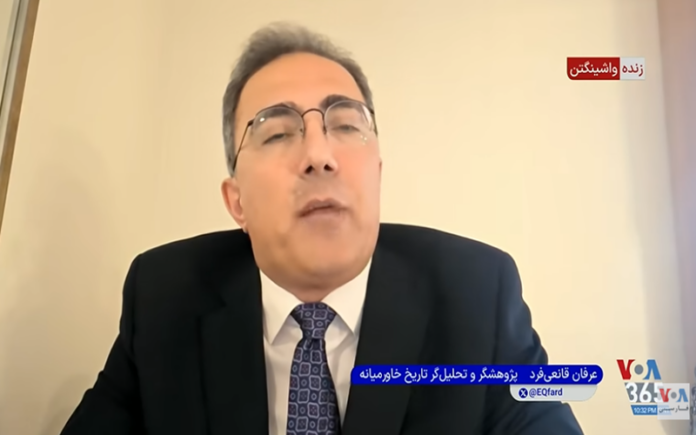
On 11 October 2026, during Voice of America’s Meydan programme, titled “The Trial of Parviz Sabeti: SAVAK in the Test of Justice,” Erfan Ghanei-Fard defended the former SAVAK official, dismissed survivors’ demands for accountability, and denounced rival opposition movements while promoting Reza Pahlavi’s political agenda.
Erfan Ghanei-Fard, a self-proclaimed researcher and one of Reza Pahlavi’s political promoters, exposed the political priorities behind his public advocacy during his appearance on Voice of America’s Meydan programme – The Trial of Parviz Sabeti: SAVAK in the Test of Justice.
Defending a former senior official of the Shah’s secret police, Ghanei-Fard portrayed SAVAK as the target of decades of historical distortion, dismissed the demands of former political prisoners, and repeatedly branded rival opposition movements as terrorists. He also defended Reza Pahlavi’s proposed role in Iran’s political transition while denouncing those seeking accountability for abuses under the monarchy.
His remarks are revealing not simply because of what he said about SAVAK, but because of the broader political narrative they reinforce. Ghanei-Fard has publicly promoted Pahlavi while attacking the People’s Mojahedin Organization of Iran (PMOI/MEK) and other opposition currents. His sustained collaboration with Parviz Sabeti adds another dimension to this record: the rehabilitation of a former security official whose role in the Shah’s repressive apparatus remains a subject of historical and legal scrutiny.
The resulting picture raises serious questions about the political agenda Ghanei-Fard advances, the historical record he chooses to defend, and the systematic delegitimization of alternatives to the monarchist current.
Defending Sabeti, Dismissing the Victims
During the program, Ghanei-Fard described Sabeti as a gifted security analyst who provided the Shah with candid assessments of the country’s internal security. He claimed that Sabeti personally prevented the execution of 75 students and argued that the former official had been unfairly portrayed by his opponents.
Throughout the interview, Ghanei-Fard brazenly mocked or sought to justify SAVAK’s use of torture. Whenever questioned about the torture inflicted on political prisoners, he attempted to excuse these abuses by branding the victims “terrorists”, as though simply labelling someone a terrorist could somehow legitimise their torture. He went so far as to indiscriminately describe political prisoners of every political persuasion as terrorists, regardless of their ideological affiliations. In one particularly contemptuous instance, he openly ridiculed an account of torture involving weights attached to a victim’s genitals, sarcastically asking whether the organ was “a crane cable, a climbing rope, an African elephant’s trunk, or a spinning chandelier!”
The purpose of this rhetoric was unmistakable: to ridicule testimony about abuse rather than seriously examine the historical record.
SAVAK was the Shah’s secret police and a central instrument of political surveillance and repression. Sabeti served as head of its Third Directorate, responsible for internal security, and became one of the most prominent figures in the organization. Three former political prisoners subsequently brought a civil lawsuit against him in the United States, alleging that he was responsible for their torture. A federal court rejected his request to dismiss the case at an early stage, allowing the litigation to proceed. That procedural decision was not a final determination of liability, but it demonstrated that the case could not simply be dismissed as the extortion Ghanei-Fard described. Radio Farda
Instead of addressing the substance of the survivors’ pursuit of justice, Ghanei-Fard characterized the proceedings as a conspiracy by political enemies. He declared that the case had “absolutely nothing to do with justice” and was “purely for extortion and blackmail.”
He then portrayed the plaintiffs and their political backgrounds as disqualifying factors, describing them as highway robbers masquerading as champions of liberation.
Ghanei-Fard’s appearance was not an isolated defense of the former SAVAK official. He has played a direct role in presenting Sabeti’s account of the Shah’s era to the public, including through the extensive Persian-language oral-history book Dar Damgahe Hadeseh, for which Ghanei-Fard conducted and edited interviews with Sabeti.
During the program, Ghanei-Fard acknowledged meeting Sabeti while recording the book. He portrayed their work as part of a decades-long effort to counter what he described as distortions spread by leftists, the MEK, and other opponents of the monarchy.
The Political Pattern: Pahlavi as the Alternative, Rivals as Terrorists
Ghanei-Fard’s position on Sabeti is inseparable from his public advocacy for Reza Pahlavi. His published commentary has promoted Pahlavi as a unifying figure and a leader for Iran’s future, while directing sweeping denunciations at competing opposition movements.
In his commentary for the Washington Examiner, Ghanei-Fard described Pahlavi as “the only alternative and the leader of Iran’s national uprising.” He then portrayed a broad spectrum of opposition forces—including religious-nationalists, reformists, communists, Kurdish opposition organizations, human-rights activists, and the MEK—as effectively aligned with the Iranian regime.
This is not merely an argument in favor of one political figure. It is an attempt to discredit virtually the entire spectrum of competing opposition currents while elevating a single personality as the exclusive alternative.
This approach benefits the political narrative he advances: Pahlavi is presented as the legitimate national alternative, while competing movements are branded as terrorists, mercenaries, or accomplices of the regime.
Who Is Erfan Ghanei-Fard?
Erfan Ghanei-Fard, also known as Erfan Fard, is a self-described counterterrorism analyst and Middle East researcher based in the United States. Behind this public profile, however, lies a controversial history of reported associations with figures connected to the Islamic Republic’s security establishment, alongside his increasingly vocal political advocacy for Reza Pahlavi, the son of Iran’s former Shah.
Particularly noteworthy are his reported contacts with Mohsen Rezaee, the former commander-in-chief of the Islamic Revolutionary Guard Corps (IRGC) and the current Secretary of Iran’s Supreme National Security Council. Photographs circulated in background material show Ghanei-Fard apparently meeting Rezaee. More significantly, an analysis published by the Jamestown Foundation explicitly named Ghanei-Fard among individuals alleged to have connections with the IRGC, particularly Rezaee. The analysis also raised concerns about his efforts to rehabilitate the reputation of SAVAK, the Shah’s notorious secret police.
In recent years, Ghanei-Fard has emerged as an outspoken promoter of Reza Pahlavi. Through articles published in international outlets, including The Times of Israel, he has repeatedly portrayed Pahlavi as Iran’s principal hope for political change while disparaging competing opposition movements. His writings frequently employ accusations of terrorism, separatism and political illegitimacy against Pahlavi’s opponents. The contrast between Ghanei-Fard’s reported past associations with figures from the Islamic Republic’s establishment and his present role as a prominent defender of the Pahlavi political project warrants closer examination.
Meanwhile, numerous reports, social media posts and online discussions have circulated concerning Ghanei-Fard’s alleged relationships with officials of the Islamic Republic and individuals associated with its intelligence and security services. The circulation of these reports, combined with specific allegations documented in published analyses and his reported encounters with senior regime figures, underscores the need for greater scrutiny and transparency regarding his political background and connections.
The central issue is not merely Ghanei-Fard’s political allegiance, but the striking contradictions surrounding his public role: a commentator facing questions about alleged connections with figures from the Islamic Republic’s security establishment, who simultaneously promotes Reza Pahlavi, defends a senior official of the Shah’s secret police, and seeks to discredit other Iranian opposition movements. At a time when victims of political repression continue to demand truth and accountability, such a record deserves rigorous public examination rather than unquestioning acceptance.