


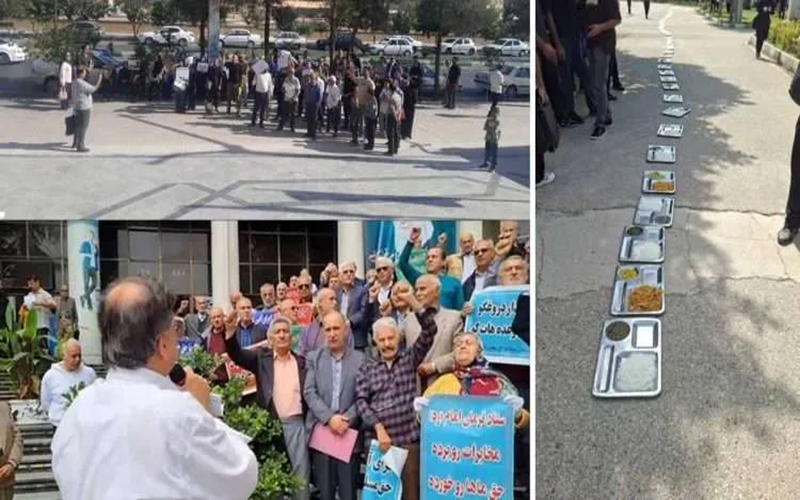

Retirees and workers accounted for 130 protests, while shopkeepers, healthcare workers, students, job seekers, and housing applicants joined demonstrations and strikes across the country.
The protests spanned multiple sectors, from oil and gas installations and industrial plants to universities, hospitals, commercial districts, and housing projects. Their distribution shows that economic grievances continued to affect a broad cross-section of Iranian society, with many demonstrations driven by demands that had remained unresolved over time.
Retirees and Workers Lead September Protests
Retirees accounted for the largest share of recorded protest actions, with 79 incidents during the month. Retirees from the Social Security Organization, telecommunications sector, and steel industry protested over inadequate pensions, deteriorating living conditions, healthcare problems, and unpaid entitlements.
Workers ranked second, with 51 protest actions. Their grievances included delayed or unpaid wages, unemployment, job insecurity, unresolved employment status, poor working conditions, inadequate meals, discriminatory treatment of Baluch workers, and company decisions affecting their workplaces.
The concentration of protests among these two groups highlights the continuing pressure on household incomes and employment conditions.
Workers in the oil, gas, and petrochemical sectors staged protests at multiple facilities. These included 13 sections and offshore platforms operated by Pars Oil and Gas Company, 10 offshore platforms associated with South Pars, the Bahregansar oil and gas complex, the Shazand oil and gas complex, South Pars facilities, and the first region of the nationwide gas transmission network, including stations in Bidboland and Ahvaz.
Steelworkers in Shadegan also protested. Other actions involved workers at HEPCO machinery manufacturing company in Arak, Pouya Nakh in Ilam, contractors and employees in industrial and municipal services, hospital service workers in Golestan Province, and security personnel at Maroun Oil and Gas Company.
The range of workplaces involved demonstrates that labor disputes extended beyond a single industry, affecting both major energy installations and smaller industrial and service operations.
Shopkeepers Stage Strikes Across Multiple Cities
Shopkeepers and business owners accounted for 16 recorded protest actions. Auto-parts sellers in Yasuj demonstrated against remarks by the provincial director-general of industry, mining, and trade.
Commercial strikes also took place in Sanandaj, Baneh, Divandarreh, Oshnavieh, Saqqez, Bukan, Piranshahr, Mahabad, Qorveh, Marivan, Urmia, Kermanshah, Kamyaran, and Ilam. The strikes coincided with the anniversary of the 2022 nationwide uprising.
The participation of businesses across several provinces added another dimension to the month’s protests, as commercial grievances intersected with broader economic discontent.
Healthcare Workers, Students, and Teachers Demand Change
Healthcare workers and nurses staged five protest actions over unpaid entitlements, staffing shortages, unequal compensation, and difficult working conditions. Protests involved nurses at Hakim Hospital in Nishapur, healthcare personnel in Fasa and Kurdistan Province, and medical staff in Kermanshah.
Students recorded four protest actions at universities including Allameh Tabataba’i, Shiraz, and Lorestan. Their complaints centered on inadequate student services and the poor quality and quantity of meals.
Students also raised broader institutional concerns, chanting slogans including “Free political prisoners,” “Neither barracks nor business enterprises—long live the university,” and “University administration, answer us.”
Teachers held two protests in Tehran and Yasuj over stagnant pay, the failure to adjust base salaries in line with inflation, and incomplete implementation of the teacher-ranking system.
Additional demonstrations involved family physicians in Fars Province over compensation and insurance, truck drivers at the Pishin border crossing over prolonged uncertainty and poor working conditions, and bakers in Saveh protesting reduced flour allocations and unpaid bread subsidies.
Unemployment and Housing Disputes Fuel Further Protests
Another 41 protest actions were recorded among other social groups, many involving unemployment, housing, and financial disputes.
Job seekers gathered near the North Azadegan oil field in the Hoveyzeh area, while local youths in Salah al-Din Minarud protested the failure to hire local workers. Job seekers in Ahvaz demonstrated for several days outside the Da’bal Khazaei agro-industrial company. Others in the city of Horr, in Shush County, gathered outside the Haft-Tappeh agro-industrial complex.
Delivery drivers also protested over declining earnings and rising operating costs. SnappBox drivers in Arak and Semnan went on strike over low fares, gasoline expenses, and commission rates. Motorcycle couriers in Arak stopped working and moved through the city collectively to press their demands.
Housing and property disputes generated further demonstrations. Protesters included applicants for National Housing Movement projects in Shiraz and Kashan, residents awaiting housing units in Rasht and Hamedan, military personnel seeking housing in Kermanshah, applicants for a residential project in Pardis, and landowners in Yazdanshahr.
Other groups sought to recover money or resolve outstanding financial disputes involving investment schemes, currency exchanges, and property or vehicle purchases. These included claimants connected to Fajr Bahman shares, the Cryptoland exchange, Unique Finance, Excoino, and the Global case in Tabriz, as well as buyers awaiting delivery of Shahin cars in Tehran.
Additional protests involved Tehran landscaping contractors, staff and academics at the Esfarayen Higher Education Complex, customs brokers and companies in Khorramshahr, municipal drivers in Tabriz, and security personnel at the Yadavaran Jofeir oil project.
Unresolved Grievances Keep Protests Going
Of the 201 recorded protest actions in September, retirees, workers, and shopkeepers accounted for 146 combined incidents. Retirees alone represented nearly two-fifths of the total.
The figures also show how grievances extend beyond conventional labor disputes. Unemployment, housing costs, unpaid financial obligations, healthcare, education, and the viability of small businesses all featured in the month’s demonstrations.
Repeated protests over pensions, wages, employment, and housing point to the persistence of unresolved demands. From offshore energy platforms to university campuses and residential developments, demonstrators continued to seek answers to economic and social problems affecting their livelihoods.
The September figures provide a snapshot of this continuing discontent: 201 recorded protest actions involving diverse groups, with economic insecurity and unfulfilled demands at the center of many of them.