


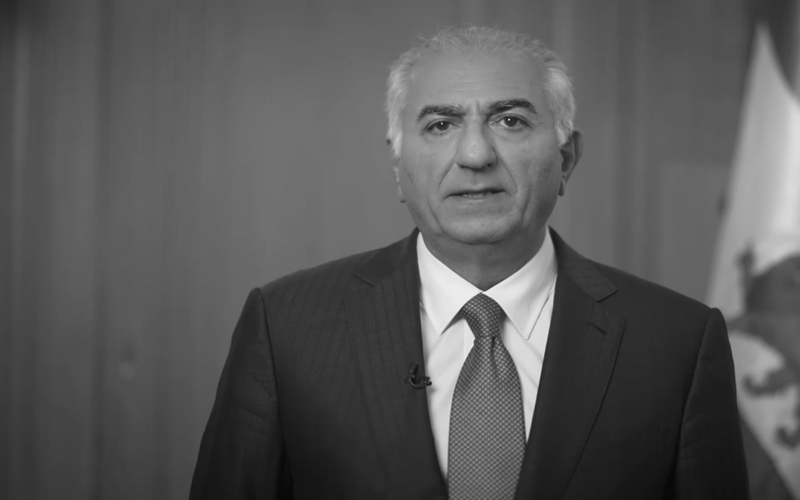

After promises of a secure national cooperation network and claims of tens of thousands of recruits, Reza Pahlavi’s latest digital initiative raises an awkward question: where are the results, and who is protecting the people being asked to sign up?
Reza Pahlavi has apparently discovered a new shortcut to organizing Iran’s opposition: a Telegram bot. His latest appeal invites Iranians to join a campaign called “National Cooperation for Saving Iran” and establish direct contact with his team. The pitch is ambitious. The practical questions are considerably less reassuring.
Within days of the announcement, users were circulating screenshots of conversations with the bot and questioning why it requested personal information. Concerns emerged over the collection of real names and other identifying details, the security of the system, and the risks facing people who might use it from inside Iran. Reports of fake bots with usernames resembling the purported official account added another complication.
For a political figure who has repeatedly presented digital registration systems as secure channels for organizing opposition to Iran’s regime, this is an inconvenient development. The promise is national cooperation. The immediate public debate is about whether people should hand their personal information to a Telegram bot.
Apparently, before saving Iran, the campaign must settle a more basic question: can prospective participants safely register?
A Campaign Built on Trust—and a Growing List of Questions
Pahlavi’s latest initiative is not his first attempt to recruit supporters through digital platforms. In June 2025, he announced the National Cooperation campaign, initially presenting it as a channel through which military personnel, security forces, government employees, and others could establish contact with him.
At the time, he emphasized security precautions, including instructions to access the registration system through a QR code displayed during a live broadcast on a Persian-language television channel outside Iran.
In July 2025, Pahlavi told Politico that at least 50,000 government officials and military personnel had registered. Yet he also acknowledged that their information still required examination and verification, a process that would take time.
That qualification mattered. Registration figures are not the same as verified identities, and verified identities are not the same as operational cooperation or defections from the regime.
More than a year into this expanding digital enterprise, the public still lacks independently available evidence establishing how many previous registrations resulted in practical cooperation, how many purported insiders were authenticated, and what measurable outcomes the campaign produced.
The numbers may be impressive on a promotional graphic. Their political significance, however, depends on what they actually represent.
A registration is not a defection. A message is not an organized network. And a claimed list of tens of thousands of insiders is not proof that tens of thousands of people have taken action.
These distinctions should not be difficult for a campaign that presents itself as a serious alternative to Iran’s ruling establishment.
The Security Problem Is Not a Technical Footnote
The concerns surrounding the new Telegram bot deserve particular attention because of the circumstances in which people inside Iran operate. Iran’s regime has extensive experience suppressing dissent, monitoring opponents, and punishing people suspected of political activity. Identifying information can therefore carry consequences far beyond ordinary online privacy.
Telegram bots do not provide the end-to-end encryption available in Telegram’s Secret Chats. Messages sent to a bot are made available to the bot’s operators, whose own systems and security practices become part of the equation. Depending on what a bot requests, participants may disclose information that makes them easier to identify.
Telegram says bots do not ordinarily receive users’ phone numbers unless users provide them. A bot can nevertheless receive account information, including a user’s numerical account identifier, display name, username, profile picture, and language settings. Information submitted directly by users can expose considerably more.
None of this proves that the new bot has been hacked, that its operators are mishandling information, or that Iran’s security services have gained access to its records. The absence of end-to-end encryption alone does not establish that third parties can read a conversation.
But that is precisely why the campaign needs to explain its safeguards rather than expect people to fill the gaps with faith.
Who operates the system? What information is genuinely necessary? Where is it stored? Who can access it? How long is it retained? What protections exist against unauthorized access, impersonation, or infiltration? And what should a participant do if the system is compromised?
These are not hostile questions designed to sabotage an opposition campaign. They are basic questions about the safety of the people the campaign claims to represent.
The appearance of lookalike bots makes clear why authentication procedures and public security guidance matter. A warning not to submit sensitive information until the communication channel has been verified is sensible advice. It is also an implicit acknowledgment that users cannot simply assume that every account bearing a familiar name is trustworthy.
For people living under a repressive regime, a mistake may carry a much higher price than an embarrassing social-media exchange.
The Remarkable Business of Recruiting People Who Remain Unaccounted For
The new bot also revives an older question: what became of the people supposedly recruited through earlier versions of the National Cooperation campaign?
In January 2026, Pahlavi announced that the system had been upgraded to respond more quickly to applicants, including people who had registered previously but received no response. He again emphasized the importance of using the designated QR code.
The announcement raises an obvious question. If the campaign had already attracted tens of thousands of applicants, why were some still waiting for a response months after registering? An upgraded system may improve administration, but it does not by itself demonstrate that the organization behind it has translated registrations into effective action.
The issue became more prominent in July 2026, when a discussion of Pahlavi’s earlier statements about contacts with members of the Islamic Revolutionary Guard Corps (IRGC) and the Basij prompted renewed scrutiny. Asked about his 2018 remarks in an interview with Reuters, he explained that many of those contacts had involved informal social-media messages from people claiming to belong to those institutions and expressing an interest in breaking with the regime, rather than direct negotiations with the IRGC command.
His office subsequently defended the National Cooperation system, stating that it had been established in June 2025 to organize contacts and verify applicants. It said that tens of thousands of people from political, military, and administrative institutions had registered, including thousands of members of the armed forces and senior officials whose identities had allegedly been verified using national identity cards.
These are substantial claims. Yet independently verifiable evidence supporting the published totals has not been made available to the public.
Security considerations can legitimately prevent the disclosure of names or identifying details. Nobody should expect an opposition organization to publish information that could expose people to arrest or retaliation. But protecting individual identities does not eliminate the need for credible, aggregate evidence of organizational progress.
A campaign could report how many applicants have been verified, how many have established sustained contact, how many have become active participants, and how many cases remain unresolved—without revealing anyone’s identity.
Instead, the public is left with impressive recruitment figures, explanations about verification, reports of delayed responses, and now another registration channel.
If the objective is to build an effective political organization, surely the results should eventually become more visible than the registration process itself.
From Saving Iran to Collecting Personal Data
Pahlavi’s earlier website, “We Take Iran Back,” was presented as a platform for mobilizing and organizing supporters, receiving reports of corruption, gathering information from within the government, and collecting financial and logistical support. The new Telegram bot extends the broader effort to recruit people from different sections of Iranian society.
There is nothing inherently illegitimate about using digital tools to organize political opposition. Nor is collecting personal information automatically evidence of wrongdoing. Serious organizations may need to verify participants, prevent infiltration, and coordinate activities.
The problem is the combination of extraordinary claims, limited independently verifiable results, and unresolved questions about how sensitive information is protected.
The people being invited to participate are not signing up for a harmless online fan club. Some may be living in Iran, where exposure of political activity could place their freedom and safety at risk. Others may be members of institutions where suspected disloyalty could carry severe consequences.
For such people, “trust our system” is not an adequate security policy.
A responsible campaign would explain its data-protection procedures before encouraging people to submit identifying details. It would distinguish clearly between information required for registration and information that is merely convenient to collect. It would provide verifiable guidance on authentic channels and explain what happens to submitted data.
Above all, it would recognize that the risks are borne primarily by participants, not by the people promoting the campaign from abroad.
That imbalance makes transparency a duty, not a favor.
Iran Needs a Democratic Alternative, Not Another Cult of Personality
There is a wider political problem here. Pahlavi’s campaign repeatedly presents him as the central point of contact for a nationwide effort to replace Iran’s regime. Yet a democratic alternative cannot be measured simply by the number of people encouraged to register through a system bearing one political figure’s name.
Iran’s future cannot depend on personal loyalty, unverified recruitment statistics, or the assumption that a prominent name automatically guarantees competent organization. Nor does opposition to the current regime give any political figure a blank check to demand trust without providing answers.
The question is not whether Iran needs organized opposition. It does. The question is what kind of opposition can credibly promise a democratic future.
A democratic republic requires institutions accountable to the public, political pluralism, free elections, and safeguards against the concentration of power. It must reject both the clerical dictatorship that has oppressed Iran and the restoration of hereditary rule under a new political brand. The principle of “No Shah, No Mullahs” is not a slogan to be discarded when monarchist ambitions are repackaged as national salvation.
Pahlavi’s supporters may regard the latest bot as another step toward organizing the opposition. But political branding cannot substitute for accountability, and the promise of national rescue cannot excuse inadequate answers about the safety of those being recruited.
Reza Pahlavi may call his initiative “National Cooperation for Saving Iran.” But before asking people to entrust their identities and potentially their safety to another digital system, his campaign should demonstrate what the previous systems achieved, explain how the new one protects participants, and establish why its claims deserve confidence.
Iran’s people have already paid a devastating price for political promises made in the name of their salvation. They should not be expected to take unnecessary digital risks on the strength of another promise.
Saving Iran is a serious political undertaking. Collecting the identities of people who may be vulnerable to repression is a serious responsibility. Neither should be treated as a publicity campaign—and neither should require blind faith in a bot.