


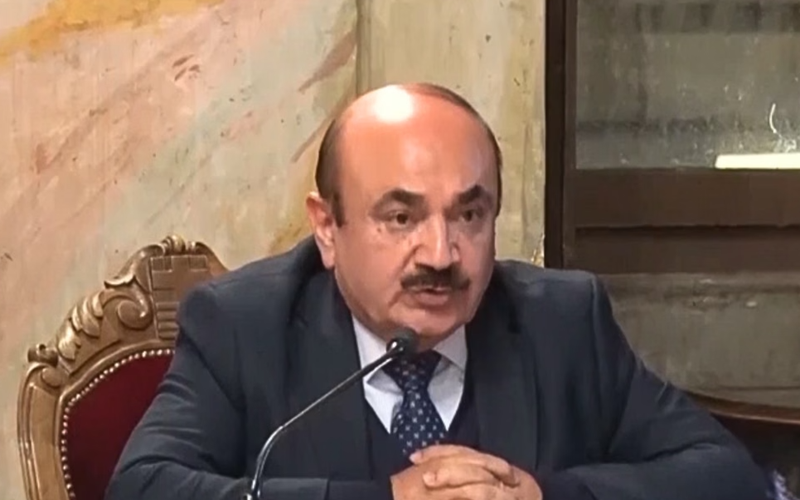

Addressing a conference at Cuneo City Hall in Italy, Mahmoud Hakamian condemns the execution of political prisoners and calls for a democratic republic based on the free vote of the Iranian people.
CUNEO, Italy — Mahmoud Hakamian, a member of the Foreign Affairs Committee of the National Council of Resistance of Iran (NCRI), has called for international recognition of the Iranian people’s right to determine their political future, reporting that 1,186 people had been executed in Iran since the beginning of 2026.
Speaking at a conference at Cuneo City Hall, Italy, Hakamian highlighted the continuing executions of political prisoners, the resistance inside Iranian prisons, and the need for a democratic alternative to the country’s ruling religious dictatorship. He argued that international condemnation of human rights violations must be accompanied by recognition of the Iranian people’s right to establish a free republic based on popular sovereignty.
“When we speak about Iran, we must first think of the people who pay an enormous price every day for demanding freedom and fundamental rights,” Hakamian said, referring to political prisoners, families of victims, women, young people, and others facing arrest, repression, and execution.
According to the figures he presented, 1,186 people had been executed in Iran since January 1, 2026. He also reported that nearly 50 political prisoners had been executed since the outbreak of the war, including nine members of the People’s Mojahedin Organization of Iran (PMOI/MEK).
The figures underscore the scale of the repression described in his address and the risks facing political opponents and those demanding fundamental freedoms.
Resistance Continues Inside Iran’s Prisons
Despite the executions and pressure on dissidents, Hakamian said resistance continues among political prisoners, women, young people, and protesters across Iran.
He emphasized that the struggle for freedom cannot be understood solely through the regime’s campaign of repression. The persistence of resistance, he argued, demonstrates the determination of Iranians to challenge the existing political system despite the severe consequences they face.
Hakamian urged the international community to move beyond statements condemning executions and other abuses. Governments and international institutions, he said, should recognize the Iranian people’s right to change their political system and establish a democratic republic founded on the will of the population.
His remarks placed political prisoners at the center of the international debate, arguing that their plight is inseparable from the broader question of Iran’s political future.
The Ten-Point Plan and a Democratic Alternative
Hakamian stressed the importance of an organized democratic alternative capable of replacing dictatorship. He pointed to the NCRI and its network of supporters abroad, alongside the activities of PMOI Resistance Units inside Iran, as components of a movement seeking fundamental political change.
He presented the Ten-Point Plan advanced by Maryam Rajavi, the NCRI’s president-elect, as a roadmap for a future democratic Iran. Its central principles include the separation of religion and state, full equality between women and men, abolition of the death penalty, respect for political and social freedoms, and a non-nuclear Iran.
The plan, Hakamian said, has received support from thousands of parliamentarians and prominent political figures internationally.
He argued that Iran’s future must not be defined by a choice between the current religious dictatorship and a return to the former monarchy. Instead, political legitimacy must rest on the freely expressed will of the Iranian people.
The slogan “No to the Shah, No to the Sheikh” encapsulates this position: rejecting both monarchical and religious dictatorship in favor of a democratic republic.
International Support for the Iranian People’s Right to Choose
Hakamian concluded by urging the international community to adopt a clear position in support of freedom, popular sovereignty, and democratic change in Iran.
His message linked the immediate demand to stop executions with the longer-term objective of ending dictatorship. Condemning executions, he argued, is essential, but it should form part of a broader commitment to the rights of Iranians to choose their government and shape their country’s future.
The central demand of his address was unequivocal: no executions, no dictatorship—religious or monarchical—and no return to the past.
Instead, Hakamian called for a free and democratic Iran in which political authority derives exclusively from the freely cast votes of its people.