


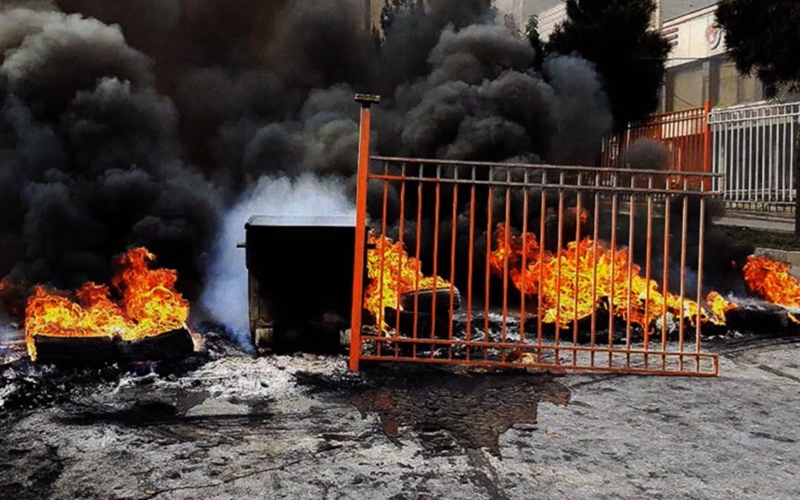

The nationwide uprising of November 2019 emerged from inside Iran, driven by popular anger at the regime and its policies. Reza Pahlavi’s later attempts to present himself as the country’s natural alternative do not establish that he organized, led, or directed that revolt.
The November 2019 uprising—known as Aban 98—remains one of the defining moments of popular resistance to Iran’s regime. It began on November 15, after the government abruptly raised fuel prices, but the protests quickly moved beyond the immediate economic trigger. Across the country, people challenged a political system they held responsible for repression, corruption, and the destruction of their livelihoods.
The scale was unmistakable. A United Nations report recorded that the protests spread to 29 of Iran’s 31 provinces between November 15 and 21, with as many as 200,000 participants. Amnesty International documented demonstrations in more than 100 cities and verified footage showing security forces using lethal force against protesters. The regime then imposed a near-total internet shutdown, attempting to conceal the extent of its crackdown.
This was not a political event manufactured by an exile figure or delivered to the streets by a self-appointed leader. It was an uprising rooted in the lived experience of millions of Iranians.
A revolt that went beyond fuel prices
The increase in gasoline prices was the immediate trigger, not the underlying cause. The protests rapidly developed into a broader rejection of the regime. Amnesty International documented slogans calling for fundamental political change, including an end to the existing system. The burning of images of the current and former supreme leaders further illustrated the depth of public anger.
The uprising brought together people from different cities, social backgrounds, and generations. Its defining feature was not allegiance to a particular political personality, but opposition to a system that had left people without meaningful political freedoms or economic security.
The regime’s response exposed how seriously it viewed this challenge. Security forces killed protesters, carried out mass arrests, and used the internet shutdown to obstruct the flow of information. Amnesty International later documented at least 304 deaths during the five days of protests, while warning that the actual toll could be higher.
These facts matter because they establish the character of Aban 98: a nationwide uprising against the ruling system, paid for in blood by people inside Iran.
Rewriting history is not the same as making it
Reza Pahlavi was not the organizer or commander of the November 2019 uprising. The available contemporaneous record does not establish that he planned the demonstrations, coordinated their spread, directed their participants, or provided the organization that sustained them.
His own public remarks at the time are revealing. In an interview published on November 20, 2019, he described his responsibility as “no more and no less than any other Iranian” and called for unity and solidarity. That statement may reflect his support for the protests, but it is not evidence that he led them.
There is an essential distinction between expressing support for an uprising and having a demonstrable role in organizing or directing it. Political figures in exile may comment on events, issue appeals, and seek to influence how those events are understood. None of that gives them ownership of a movement whose participants took the risks, faced the bullets, and paid the price.
The distinction becomes especially important when political narratives are built retrospectively. A public figure’s later prominence, media visibility, or claims to national leadership cannot be projected backward to establish a role that the historical record does not demonstrate.
Aban 98 belongs first and foremost to the people who rose up inside Iran.
Neither hereditary rule nor clerical dictatorship
The struggle over the meaning of November 2019 is part of a wider question about Iran’s political future. The rejection of the ruling system does not automatically translate into support for a monarchy, just as opposition to the Shah’s dictatorship did not justify the establishment of clerical rule.
Iran’s people have paid an enormous price under successive forms of authoritarianism. They have every right to reject both theocratic rule and hereditary political power. No family, faction, or individual can claim an inherited entitlement to govern the country.
The democratic alternative must be based on popular sovereignty: free and fair elections, political pluralism, equality before the law, separation of religion and state, and institutions accountable to the people. It must be a republic in which political authority comes from citizens—not from a crown, a clerical office, or a claim of personal destiny.
The slogan “No Shah, No Mullahs” expresses this rejection of authoritarianism in both its old and new forms. It is not a call to exchange one unelected ruler for another. It is a demand that the Iranian people determine their own future.
The November 2019 uprising cannot be reduced to the political ambitions of figures who were not shown to have organized or led it. Its historical significance lies in the courage of the people who confronted the regime, the breadth of their rejection of the existing system, and the price they paid for demanding change.
Aban 98 was not a project belonging to an exile politician. It was an uprising of the Iranian people. Their sacrifices cannot be appropriated, and their demand for freedom cannot be confined to a choice between two dictatorships.