


From subsidized production in Azerbaijan to exorbitant prices at home, Iran’s automotive industry exposes a system of state privilege, currency manipulation, and profiteering linked to the IRGC and regime-affiliated networks.
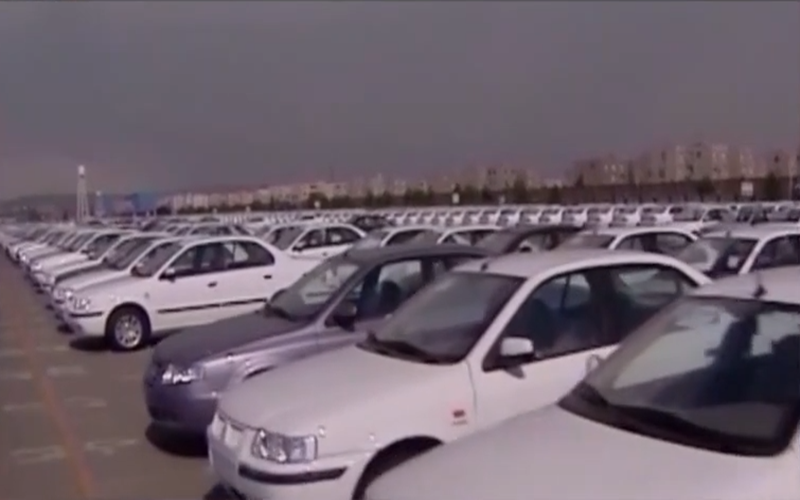
For ordinary Iranians, buying a car has become an increasingly expensive struggle. Domestic vehicles are often overpriced and difficult to obtain, while imported models reach consumers at prices far beyond their actual production or market value. Even after paying enormous sums, customers face delivery delays, prompting protests by buyers who have paid for vehicles they have yet to receive.
The case of the Khazar and Khazar Lada models, assembled in Azerbaijan under the name Khazar, illustrates how this system works.
How Iranian subsidies help make cars cheaper abroad
The same vehicle that reportedly sells for between $8,000 and $10,000 in Azerbaijan can command more than $20,000 in Iran. The price difference is particularly revealing because the production arrangement involves Iranian and Azerbaijani interests, with components manufactured in Iran and sent across the border for assembly.
Azerbaijan’s automotive strategy is designed to compete with inexpensive Russian Lada models and used European and Asian vehicles. To attract buyers in such a competitive market, manufacturers must keep prices relatively low.
However, the economics of this arrangement raise serious questions about who ultimately bears the cost.
Iranian-produced components benefit from access to government-controlled resources, including subsidized raw materials and preferential currency arrangements. These advantages reduce production costs before the components are exported to Azerbaijan.
In effect, resources financed or subsidized by Iranian public wealth help support the production of vehicles sold to Azerbaijani consumers. Meanwhile, Iranian buyers face substantially higher prices when comparable vehicles enter their own market.
The public effectively subsidizes the production chain, but the benefits do not translate into affordable vehicles at home.
Currency collapse turns cars into luxury investments
The second mechanism behind the price disparity is Iran’s collapsing national currency.
Ordinary Iranian consumers have no comparable access to preferential foreign exchange rates. When vehicles are imported or priced according to foreign currency, buyers must contend with the much more expensive exchange rates prevailing in the open market.
The regime thus benefits from a system in which production inputs can receive preferential treatment, while consumers shoulder the consequences of currency depreciation.
The result is a market in which the price of a vehicle is increasingly disconnected from its actual value.
The collapse of the rial has also transformed the role of automobiles in Iranian society. For many households, a car is no longer merely a means of transportation. It has become a defensive investment against inflation and the continuous erosion of purchasing power.
People buy vehicles partly because holding cash means watching their savings lose value. This additional demand, combined with restricted supply and distorted pricing, creates further opportunities for profiteering.
The IRGC-linked networks behind the two-tier market
The problem extends beyond currency manipulation and production subsidies. Iran’s automotive market operates through a deeply unequal system of access and distribution.
Vehicles are offered through different pricing channels, including lower factory prices and substantially higher open-market prices. Access to factory-priced vehicles is limited, leaving ordinary consumers competing for a restricted supply while politically connected individuals and commercial networks enjoy privileged access.
This two-tier arrangement creates enormous opportunities for intermediaries.
According to the described market structure, large shipments of vehicles entering Iran are diverted away from ordinary distribution channels and into networks of dealerships and commercial entities linked to state interests and the Islamic Revolutionary Guard Corps (IRGC).
These intermediaries can then sell vehicles at prices far above their original value, reportedly reaching $15,000 to $20,000 for models costing substantially less in Azerbaijan.
The difference is not simply commercial profit. It reflects the power of networks that benefit from privileged access to imports, distribution channels, and state-controlled resources.
In such an environment, competition becomes secondary to political connections. The ordinary buyer has little influence over prices and few alternatives, while regime-affiliated businesses occupy positions from which they can extract substantial profits.
An automotive industry serving power rather than the public
The same relationship between economic privilege and political control is visible in other parts of Iran’s vehicle industry.
Domestic manufacturers produce vehicles and motorcycles in a market where access to products and distribution is heavily influenced by state institutions. Motorcycle production, in particular, has also been associated with the regime’s security apparatus. Estimates cited in discussions of the industry indicate that thousands of motorcycles are allocated annually to plainclothes forces and other regime-affiliated personnel.
This illustrates a broader pattern: resources and industrial capacity that could serve public needs are also used to support the regime’s political and security networks.
Iran’s automotive crisis is therefore not simply a story of inefficient factories or expensive imports. It is part of a wider economic structure in which public resources, currency controls, restricted competition, and politically connected businesses reinforce one another.
The contrast with Azerbaijan is especially telling. Iranian resources help make vehicles cheaper to produce across the border, yet Iranian consumers are forced to pay considerably more for those same vehicles.
A market organized around public welfare would use domestic production capacity and available resources to make transportation more affordable. Iran’s regime has instead presided over a system in which ordinary citizens absorb the costs while privileged networks capture the profits.
The result is an automotive market held hostage by political and economic monopolies: a system that turns even the basic need for transportation into another source of extraction from an already impoverished population.