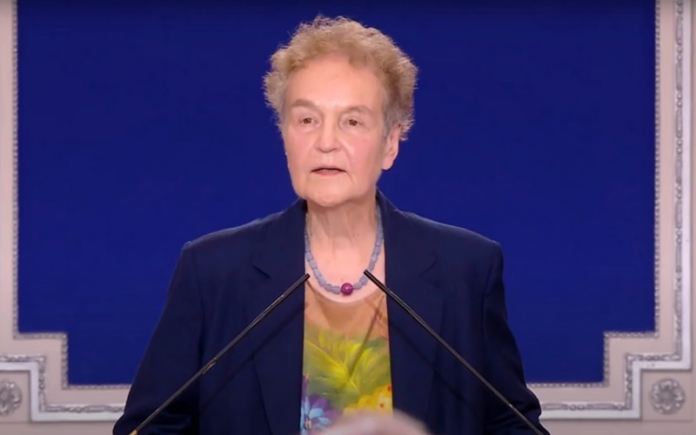
Herta Däubler-Gmelin warns that the Friedrich Naumann Foundation’s decision to have the Shah’s son receive its 2026 Freedom Prize in Frankfurt risks politically elevating a figure without a democratic mandate, while overlooking Iran’s diverse democratic opposition.
In a guest contribution published by the German newspaper Sonntagsblatt on October 30, Däubler-Gmelin argued that honoring the Iranian people for their struggle for freedom and democracy is justified, but designating the son of the former Shah to receive the award raises serious questions about representation, historical responsibility, and the future political system of Iran.
The ceremony is scheduled for November 7 at Frankfurt’s historic Paulskirche, a landmark associated with Germany’s struggle for parliamentary democracy and civil liberties.
A symbolic award that risks elevating an unelected figure
The Friedrich Naumann Foundation announced on September 14 that its 2026 Freedom Prize would honor the Iranian people and their struggle against repression and for democracy. According to the foundation, Reza Pahlavi would accept the award in a fiduciary capacity until it could be handed over to freely elected representatives of Iran.
However, Däubler-Gmelin argues that this arrangement does not resolve the fundamental problem. By placing Pahlavi on the stage, publicly presenting him with the award, and allowing him to receive it in the name of an entire nation, the foundation effectively provides him with significant political recognition.
She warned that this could undermine the credibility of the award and the principles of freedom and democracy it is intended to represent.
Däubler-Gmelin has joined numerous figures from politics, academia, and the legal community in signing an open letter calling on the foundation to reconsider its decision.
The Shah’s dictatorship cannot be separated from the Pahlavi name
A central part of Däubler-Gmelin’s criticism draws on her personal experience of the Shah’s 1967 state visit to West Berlin.
At the time, she was a student representative at the Free University of Berlin. She recalled witnessing members of the Shah’s notorious SAVAK secret police jumping over police barriers outside Schöneberg Town Hall and attacking peaceful demonstrators with batons.
Later that evening, student Benno Ohnesorg was shot dead by a police officer during protests outside the Berlin Opera. Däubler-Gmelin described these events as among the most disturbing episodes in Germany’s democratic history.
She also recalled that the Shah’s return to power in 1953 had been facilitated by a military coup against democratically elected Prime Minister Mohammad Mossadegh.
The Shah’s rule was characterized by political persecution, censorship, torture, and the suppression of democratic opposition. SAVAK became a central instrument of that repression.
Däubler-Gmelin argued that these historical realities cannot be ignored when considering whether the Shah’s son should be elevated to a representative political role in Iran’s future.
She also referred to a protest letter sent to the foundation by six former political prisoners of the Shah’s dictatorship. Their accounts of imprisonment, torture, humiliation, and the killing of fellow prisoners, she noted, demonstrate why the proposed recognition has reopened painful historical wounds.
Democratic legitimacy cannot come from inheritance
Däubler-Gmelin further questioned Pahlavi’s democratic credentials, arguing that he has failed to establish an unequivocal distance from his father’s authoritarian rule.
She also raised concerns about public appearances by supporters displaying SAVAK symbols and reports of intimidation targeting critical journalists in circles associated with Pahlavi supporters.
In her view, commitment to democracy must be measured not merely by declarations in favor of elections, but also by the treatment of political opponents, critics, and minorities.
She rejected the notion that the Iranian people face a choice between two forms of dictatorship. Instead, she emphasized that Iran’s political future belongs exclusively to its people and that the country’s diverse democratic movements deserve recognition.
Importantly, she explicitly identified the National Council of Resistance of Iran (NCRI) among these democratic forces, describing its Ten-Point Plan for a secular, democratic, and rule-of-law-based republic as remarkable.
Her argument challenges the assumption that international prominence or dynastic inheritance can confer the authority to speak for an entire nation.
As she emphasized, political legitimacy must derive from the free will of the people, not ancestry, public recognition, or international support. Pahlavi, she argued, possesses no democratic mandate authorizing him to represent the Iranian people.
The Paulskirche and the meaning of freedom
Däubler-Gmelin also questioned the appropriateness of holding the ceremony at Frankfurt’s Paulskirche.
The historic building represents the struggle for parliamentary democracy, civil rights, and the rule of law in Germany. She argued that its symbolism makes the decision particularly problematic, since freedom and democracy are not bestowed upon societies by prominent individuals or institutions. They must be won by the people themselves and protected through democratic institutions.
With the November 7 ceremony approaching, Däubler-Gmelin called on the Friedrich Naumann Foundation to reconsider its approach. She maintained that honoring the Iranian people is appropriate, but allowing Pahlavi to appear as their representative risks turning the award into an instrument of political elevation.
Her intervention adds to the growing debate in Germany over the decision to associate the Iranian people’s struggle for democracy with the son of the former Shah.
The fundamental issue raised by this controversy goes beyond the identity of an award recipient: no individual, regardless of family background or international visibility, can claim the right to determine or represent Iran’s political future without the freely expressed consent of its people.
For Iranians seeking an end to dictatorship, the demand is not a return to the past or the replacement of one authoritarian system with another. It is the establishment of a democratic republic in which sovereignty belongs to the people.