Threats against Dr. Ali Bagheri, a prominent Iranian opposition supporter in Belgium, included references to the killing of Masoud Masjoody and an explicit pledge to resurrect the Shah’s notorious secret police. Bagheri has filed a complaint with Belgian police.
Supporters of Reza Pahlavi threatened to kill Dr. Ali Bagheri, a prominent Iranian opposition activist in Belgium, as Pahlavi visited the country. The threats, posted on X on October 31, invoked the killing of Iranian dissident Masoud Masjoody in Canada and explicitly called for the restoration of SAVAK, the Shah’s notorious secret police.
Bagheri, a senior research engineer at an aeronautical research center and president of the International Coalition for Freedom of Expression in Belgium, is a known supporter of the People’s Mojahedin Organization of Iran (PMOI/MEK). He had publicly opposed Pahlavi’s visit and protested against giving a platform to the son of the former Shah, whom he and other Iranian activists regard as an authoritarian figure seeking to impose a new hereditary rule.
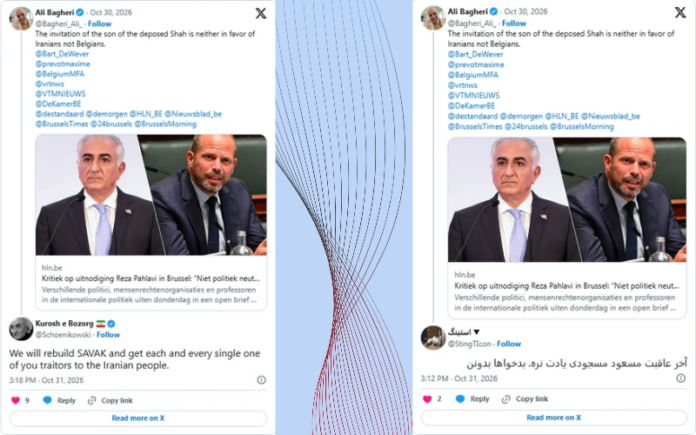
The threats appeared in comments posted under Bagheri’s protest messages on X. One account, operating under the name Kurosh e Bozorg (@Schoenikowski), wrote on October 31:
“We will rebuild SAVAK and get each and every single one of you traitors to the Iranian people.”
We will rebuild SAVAK and get each and every single one of you traitors to the Iranian people.
— Kurosh e Bozorg 🇮🇷 (@Schoenikowski) October 31, 2026
Another account, using the name Sting (@StingTIcon), posted a direct reference to Masoud Masjoody, an Iranian opposition activist who was killed in Canada:
“Don’t forget what happened to Masoud Masjoody. Let the ill-wishers know.”
آخر عاقبت مسعود مسجودی یادت نره. بدخواها بدونن
— ▼ استینگ (@StingTIcon) October 31, 2026
The reference to Masjoody’s killing gives the message a particularly threatening character. Rather than merely expressing political hostility, it invokes the fate of a murdered opposition figure to intimidate another activist.
On Thursday morning, November 5, Dr. Ali Bagheri informed Belgian police of the threats and formally filed a complaint. He also notified Belgian journalists about the incident.
Threats against opponents and the growing authoritarian rhetoric of the monarchist current
The incident comes amid a wider pattern of intimidation, harassment, threats, and physical attacks against Iranian opposition figures and critics of Reza Pahlavi’s political ambitions in several Western countries.
Since the January 2026 uprising, reports of confrontations and intimidation involving Pahlavi supporters have emerged from Britain, Germany, France, Austria, the Netherlands, Italy, Canada, and the United States. Targets have included PMOI/MEK and Kurdish activists, leftist opponents, journalists, business owners, and individuals who have challenged the monarchist current.
These incidents have included confrontations at political gatherings, online harassment campaigns, threats against activists, and physical assaults. Reports of violence against Kurdish journalists in London and criminal proceedings in Canada concerning the killing of a Pahlavi critic have further intensified concerns about the safety of Iranian dissidents abroad.
The threats against Bagheri also recall the security concerns surrounding the June 20, 2026, Paris demonstration organized by the Iranian Resistance. A French court ruling dated that day referred to an official assessment by the French security services concerning bomb threats attributed to monarchist supporters targeting the Resistance demonstration.
The reference to SAVAK in the latest threats is particularly revealing. Under the Shah, SAVAK was responsible for surveillance, arbitrary arrests, torture, and the suppression of political dissent. Its invocation as a model for future political action raises fundamental questions about the democratic credentials of a movement whose supporters openly threaten opponents with the revival of the former dictatorship’s security apparatus.
The issue goes beyond hostility between competing political currents. It concerns the fundamental right of Iranians to express political opinions, organize, and oppose any proposed system of government without facing intimidation or threats to their lives.
A warning about the meaning of political pluralism
Reza Pahlavi has repeatedly presented himself as an advocate of national unity and a democratic future for Iran. Yet threats against activists who reject the restoration of the monarchy expose a serious contradiction between that rhetoric and the conduct of elements within his political support base.
No democratic alternative can be built by threatening political opponents, glorifying a former secret police apparatus, or invoking the murder of dissidents to silence critics.
Iran’s future must be determined by its people through free elections and a genuinely pluralistic democratic process—not through intimidation, hereditary claims, or the imposition of another authoritarian system.
The threats against Dr. Ali Bagheri are therefore not simply a personal matter. They underscore the need for European governments and law-enforcement authorities to take threats against Iranian dissidents seriously and ensure that freedom of political expression is protected, regardless of the identity or political affiliation of those targeted.