


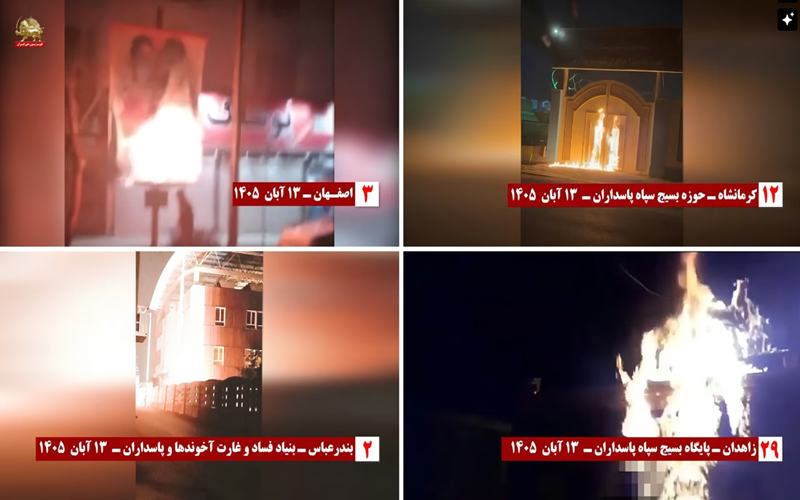

In response to the execution of Amirhossein Ebrahimi and Amirhossein Maleki in Isfahan, Resistance Units carried out 30 reported operations in 17 cities, targeting regime symbols, Basij facilities, and institutions associated with the ruling establishment.
Following the execution of two January uprising protesters, Amirhossein Ebrahimi and Amirhossein Maleki, in Isfahan’s Dastgerd Prison, Resistance Units launched a coordinated campaign of 30 operations across 17 Iranian cities, honoring the two executed protesters and challenging the regime’s machinery of repression.
The operations, reported in Tehran, Isfahan, Mashhad, Tabriz, Shiraz, Kermanshah, Bandar Abbas, Zahedan, Sabzevar, Dezful, Marand, Chabahar, Mahshahr, Iranshahr, Bijar, Rask, and Noorabad in Fars Province, involved attacks on regime symbols, the burning of official banners, and actions against facilities associated with the Islamic Revolutionary Guard Corps (IRGC), the Basij, and other state institutions.
The campaign was dedicated to Ebrahimi and Maleki, whose executions have further intensified anger over the regime’s use of capital punishment against protesters.
Operations Target Regime Institutions and Symbols
In Tehran, Resistance Units reported an explosion at a committee affiliated with the Imam Khomeini Relief Foundation. In Bandar Abbas, they reported an explosion at a foundation described as an institution associated with corruption and the plundering of public wealth by clerical and IRGC networks.
In Isfahan, several operations targeted banners bearing images of former supreme leader Ruhollah Khomeini and current regime leaders Ali Khamenei and Mojtaba Khamenei. Other actions targeted a sign identifying an intelligence ministry surveillance headquarters. Some of the actions were accompanied by slogans including:
- “Death to the principle of velayat-e faqih!”
- “Long live the Liberation Army!”
- “Long live Rajavi!”
In Mashhad, Resistance Units reported setting fire to a Basij base described as targeting students, as well as banners depicting Ali Khamenei.
In Tabriz, operations targeted banners depicting Mojtaba Khamenei and Ali Khamenei at several locations. Similar actions against banners portraying the regime’s leadership were reported in Shiraz and Kermanshah.
Basij Bases and Security-Related Facilities Targeted
A significant part of the campaign focused on facilities associated with the regime’s security and intelligence apparatus.
Resistance Units reported setting fire to Basij facilities affiliated with the IRGC in Kermanshah, Zahedan, Sabzevar, Chabahar, Iranshahr, and Bijar. In Rask, Sistan and Baluchestan Province, they reported an operation against a base used by the regime’s proxy forces.
Other reported actions included burning banners depicting Ali Khamenei in Zahedan, Sabzevar, and Mahshahr, and targeting images of the regime’s former and current leaders in Dezful.
In Marand, an operation targeted a banner depicting Mojtaba Khamenei. In Noorabad, Fars Province, Resistance Units reported burning banners depicting Khomeini, Ali Khamenei, and Mojtaba Khamenei.
The Noorabad operation was accompanied by the slogan:
“Death to the oppressor, whether Shah or Supreme Leader.”
The slogan underscored the movement’s rejection of both monarchical and clerical dictatorship.
A Message of Defiance Following the Executions
The 30 reported operations were presented as a response to the executions of Ebrahimi and Maleki and a tribute to their resistance. Their timing reflects the continuing confrontation between the regime’s campaign of executions and the activities of organized opposition networks inside Iran.
By targeting symbols of the ruling establishment and facilities associated with its security apparatus, the Resistance Units sought to demonstrate that executions and repression have not silenced opposition to the regime.
The slogan raised in Noorabad, rejecting oppression whether exercised by a shah or a supreme leader, also articulated the movement’s call for a democratic alternative to dictatorship.
The executions of Ebrahimi and Maleki have added two more names to the growing list of protesters put to death by the regime. The response across 17 cities carries a message of solidarity with the executed protesters and defiance against the policy of using capital punishment to intimidate Iranian society.