
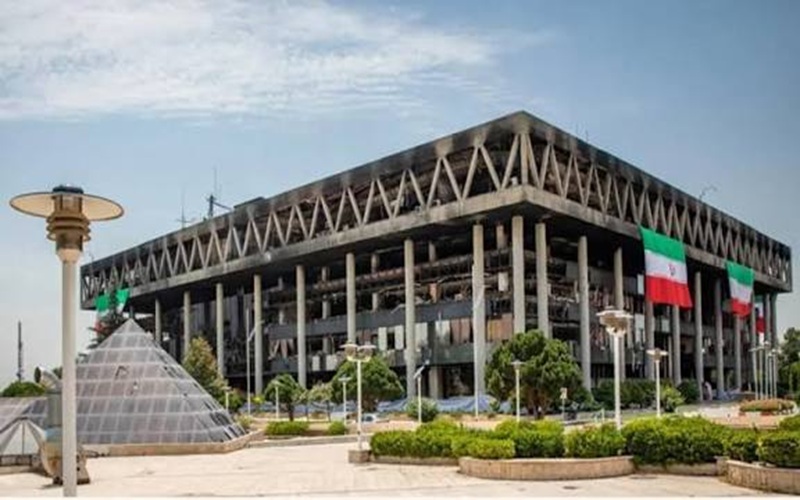

Pezeshkian’s reported push to remove state broadcaster chief Peyman Jebelli has triggered a new confrontation with hardliners, exposing deepening divisions even within the regime’s conservative camp over political influence, control of propaganda, and allegiance to the supreme leader.
The confrontation is particularly significant because Jebelli was appointed with the approval of Supreme Leader Ali Khamenei and continues to enjoy his backing. The dispute therefore goes beyond a disagreement over the performance of state television, revealing a broader struggle between competing factions over political influence and control of the regime’s propaganda apparatus.
Mohammad Mohajeri, a figure associated with the regime’s conservative camp, openly welcomed Pezeshkian’s reported attempt to remove Jebelli. Writing in the state-affiliated Khabar Online, Mohajeri argued that if Pezeshkian succeeded in dismissing the broadcaster’s chief, he would deserve congratulations.
Mohajeri also took aim at hardliners, arguing that they accept the authority of the supreme leader only as long as they believe he is acting in accordance with their own political interests.
His remarks point to a particularly sensitive contradiction within the regime: even factions that publicly claim absolute loyalty to Khamenei are engaged in competing efforts to influence and exploit his authority against their rivals.
A longstanding confrontation over state television
The current dispute is not new. Mohajeri pointed out that Jebelli’s five-year tenure has further undermined the credibility of the Islamic Republic of Iran Broadcasting (IRIB).
That criticism, however, comes with an important qualification: the state broadcaster has long functioned as a propaganda instrument of the regime rather than an independent media institution, and has never enjoyed genuine public credibility.
The confrontation became particularly visible in September, when Pezeshkian openly expressed his dissatisfaction with state television during a cabinet meeting, telling Jebelli that he had no desire to watch the broadcaster.
Jebelli responded defiantly, declaring:
“No narrative of fear, humiliation, or weakness is presented in this frame, and anyone who distances themselves from this honor is the one who loses.”
The exchange demonstrated the extent to which Jebelli considers himself protected by the supreme leader and able to challenge the president without facing immediate consequences.
The hardline Kayhan newspaper, associated with Hossein Shariatmadari, subsequently defended Jebelli, portraying expressions of support for him as part of a political mission orchestrated by rival factions.
These exchanges reveal that the dispute is not simply about programming or the broadcaster’s public image. It concerns who has the authority to shape the regime’s political narrative and whose interests the state’s powerful propaganda machinery serves.
Hardliners turn their fire on Pezeshkian
The confrontation has also taken place against a backdrop of increasing pressure on Pezeshkian from conservative and hardline factions, including calls for his impeachment.
The struggle over state television is one of several fronts on which competing factions are fighting over their share of political power and influence.
Disagreements extend to negotiations and foreign policy, the regime’s regional position, economic management, and the handling of domestic crises. Recent disputes over subsidies and the proposed implementation of food vouchers have provided another arena for factional attacks.
The economic crisis has intensified these tensions, as competing groups attempt to distance themselves from unpopular policies while holding their rivals responsible for the consequences.
Mohajeri’s criticism goes further than the dispute over Jebelli. He has also questioned the genuine commitment of hardline conservative figures to Khamenei, arguing that not even one of the hardliners he knows truly believes in or adheres to the supreme leader.
Such remarks expose the depth of mistrust within the regime’s own political establishment.
Deepening fractures within the regime
The latest confrontation illustrates how increasingly difficult it has become for the regime’s competing factions to contain their disputes behind a façade of political unity.
Even within the conservative camp, disagreements over appointments, institutional control, economic policy, and the distribution of power are becoming increasingly public and personal.
The state broadcaster, traditionally one of the supreme leader’s most important instruments of political control, has now become another battleground in these struggles.
Rather than resolving the underlying conflicts, the confrontation over Jebelli has exposed the competing interests and mutual distrust that lie beneath the regime’s claims of unity.
As economic and political crises accumulate, the factional struggle is becoming harder to conceal, revealing a ruling establishment increasingly preoccupied with defending its own positions and undermining its rivals.