


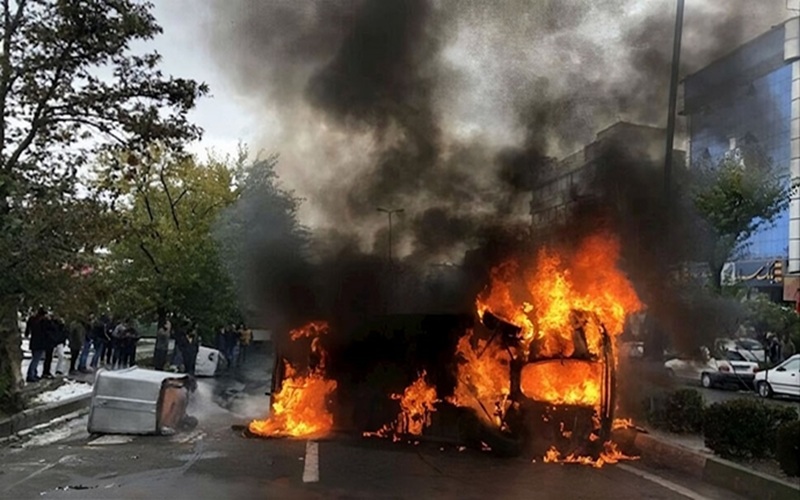

The November 2019 nationwide uprising marked a turning point in the fight against Iran’s regime, demonstrating the growing influence of Resistance Units, the leading role of women in street confrontations, and the emergence of an organized resistance capable of challenging the regime’s security apparatus.
November 2019: A turning point in organized resistance
The nationwide uprising of November 2019 marked a decisive turning point in the Iranian people’s struggle against religious dictatorship. Beyond its immediate scale and intensity, the uprising demonstrated a qualitative transformation in the protest movement: the growing connection between popular discontent and organized resistance capable of challenging the foundations of Iran’s ruling system.
Compared with the protests of 2009 and the nationwide demonstrations of December 2017 and January 2018, November 2019 revealed a more explicit rejection of the entire ruling establishment. The movement was no longer confined to demands for political reform or disputes between factions within the regime. Its central message was the rejection of the ruling system itself.
A defining feature of this transformation was the role of the Resistance Units, which helped translate public anger into organized action. Their presence, alongside the prominent participation of women in frontline confrontations, demonstrated that the struggle against the regime was developing an organizational dimension that extended beyond spontaneous street protests.
For the regime, this was particularly alarming. Its senior political and security officials repeatedly acknowledged the organizational character of the uprising and identified the People’s Mojahedin Organization of Iran (PMOI/MEK) and networks operating along its political and organizational lines as central threats.
Resistance Units and the organization of street protests
The significance of the November 2019 uprising cannot be understood solely through the number of cities involved or the scale of the regime’s violent response. Its importance also lay in the relationship between widespread popular participation and organized resistance.
The December 2017–January 2018 uprising had already established a decisive political break with the reformist narrative. The slogan “Reformist, hardliner, the game is over” expressed the growing rejection of the entire ruling establishment. November 2019 took this rejection further, demonstrating the capacity of an increasingly organized movement to confront the regime directly.
Resistance Units played an important role in this development. Their significance went beyond individual acts of protest. They represented an organized presence within society, helping sustain the spirit of resistance, encourage defiance, and connect local acts of opposition to a broader struggle for political change.
Women were particularly prominent in the November uprising. They took leading roles in street confrontations, displayed remarkable courage in breaking through security barriers, and helped drive the momentum of demonstrations. Even senior IRGC officials acknowledged that the prominent participation of women in initiating confrontations was a new feature of the uprising.
This combination of organized resistance and women’s leadership challenged the regime’s assumption that it could contain popular unrest through repression alone.
Regime officials exposed their fear of organized resistance
Statements by senior regime officials during and after the November 2019 uprising provide an important record of the authorities’ concerns about the organizational capacity of the resistance.
On November 25, 2019, Ali Shamkhani, then secretary of the Supreme National Security Council, acknowledged connections between demonstrators and the PMOI. He stated that some participants were connected to the organization and claimed that 34 PMOI members had been arrested. He also referred to a broader network of channels operating according to the organization’s political and operational line.
The following day, Shamkhani reiterated in a closed parliamentary session that individuals who had encouraged people to take to the streets had been identified as having links to the PMOI.
Ramadan Sharif, the IRGC spokesperson, also acknowledged the organizational dimension of the confrontations. On November 25, he described the combination of intense confrontations, organization, and the use of women to initiate clashes as a new experience for the regime.
These statements are significant because they reveal what the authorities considered particularly threatening: not simply the existence of public anger, but its connection to an organized force capable of mobilizing people and sustaining confrontation.
On December 4, 2019, then-President Hassan Rouhani went further, describing the uprising as the outcome of more than two years of planning. He claimed that organized forces had been preparing for an appropriate opportunity to act and called for them to be dealt with.
His remarks reflected the regime’s recognition that the November uprising could not be explained as an isolated reaction to the sudden increase in fuel prices.
Hesamodin Ashna, Rouhani’s political adviser and then head of the Center for Strategic Studies, also revealed the authorities’ alarm. On November 21, he compared the uprising to a new version of Operation Eternal Light, the PMOI’s 1988 military offensive, before suggesting that the regime had instead found itself facing a new Operation Mersad. His comparison illustrated the extent to which the authorities viewed the events through the lens of an organized confrontation with their principal opposition.
Khamenei’s statements revealed the regime’s central concern
The clearest indication of the regime’s fear came from Ali Khamenei himself.
On November 17, 2019, he publicly blamed the PMOI for the unrest, describing the organization as a hostile and criminal force. His subsequent statements on January 8, 2020, were even more revealing.
Khamenei referred to a meeting in Albania involving an American official and a group of Iranians shortly before the November uprising. He alleged that plans had been prepared in advance and that individuals had been organized to implement them once demonstrations began.
He also acknowledged that these preparations had preceded the protests and that participants had been made ready to act.
Regardless of the regime’s accusations and political characterization, the significance of Khamenei’s remarks lies in his own acknowledgment that the authorities viewed the uprising as connected to an organized resistance network, rather than merely a spontaneous eruption of public dissatisfaction.
For a regime that relies heavily on security forces, surveillance, arrests, and intimidation to prevent organized opposition, the prospect of a resistance movement with an established presence inside society represents a fundamental challenge.
From November 2019 to the continuation of resistance
The historical importance of November 2019 lies not only in the uprising itself, but also in what it demonstrated about the future of the struggle against Iran’s regime.
The protests showed that widespread public rejection of the ruling establishment could converge with organized resistance. They also demonstrated that the regime’s security apparatus faced a challenge extending beyond economic grievances or temporary demonstrations.
Resistance Units are important precisely because they help preserve this continuity. Their activities maintain a visible presence of opposition, challenge the atmosphere of fear imposed by the authorities, encourage further acts of defiance, and keep the prospect of organized resistance alive between successive waves of nationwide protests.
This continuity is essential in a country where the regime seeks to prevent demonstrations from developing into a sustained political movement. Without organization, each uprising risks being isolated, violently suppressed, and followed by an attempt to restore the atmosphere of intimidation. Organized resistance provides a means of carrying the struggle forward, preserving its political objectives and connecting individual acts of defiance to a broader movement for change.
November 2019 therefore represented more than another chapter of popular protest. It demonstrated the growing importance of Resistance Units as an organizing force in the confrontation with the regime and highlighted the decisive contribution of women to that struggle.
The uprising’s political message was clear: Iran’s future would not be determined through negotiations between factions of the ruling establishment or promises of reform from within the system. It would be shaped by the Iranian people’s struggle for an alternative based on popular sovereignty, democratic governance, and the rejection of both dictatorship and religious rule.
The Resistance Units have an essential role in sustaining that struggle. Their continued activities reflect the determination to prevent the sacrifices of November 2019 and subsequent uprisings from being reduced to isolated episodes of protest. They help carry forward the movement’s central demand: an end to the ruling dictatorship and the establishment of a democratic republic.