


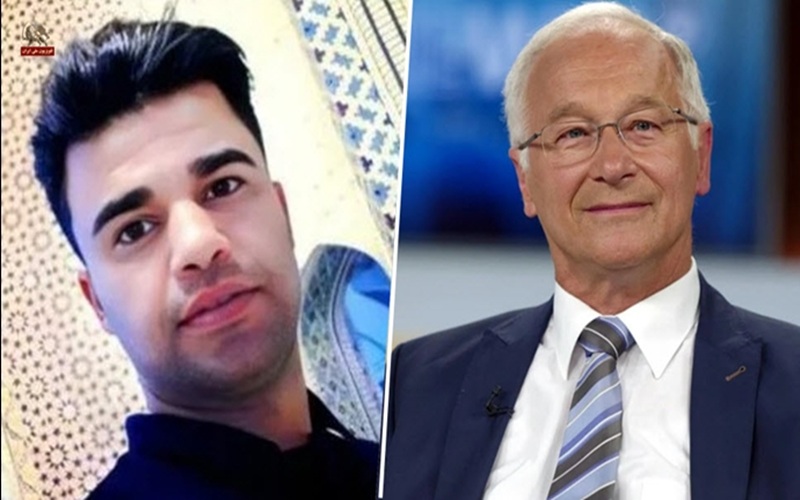

In an article published by Cicero, former German Bundestag member Martin Patzelt says the 2026 International Magnitsky Human Rights Award must translate into concrete diplomatic action to prevent the execution of the Iranian political prisoner.
Source: Cicero | Author: Martin Patzelt (CDU) | November 12, 2026
Mohammad Javad Vafaei-Sani, a 31-year-old Iranian boxing champion who has spent nearly seven years in prison under constant threat of execution, must not be abandoned to the Iranian regime’s execution machinery. This is the central message of an article by Martin Patzelt, former member of the German Bundestag and former Iran rapporteur, published in the German political magazine Cicero on November 12, 2026.
Patzelt argues that Vafaei-Sani’s receipt of the 2026 International Magnitsky Human Rights Award in the category of Outstanding Human Rights Activist must lead to concrete political consequences. The award was presented in London on November 12, but the imprisoned boxer could not attend the ceremony.
Drawing on his experience as a former member of the Bundestag’s Committee on Human Rights and Humanitarian Aid, Patzelt describes Vafaei-Sani’s case as a striking example of how the Iranian regime treats young people who stand up for freedom and human dignity.
Seven years in prison for opposing the regime
Vafaei-Sani, a silver medalist in national boxing championships and a martial arts trainer, was among those who participated in nationwide protests against the Iranian regime, particularly the November 2019 uprising.
He was arrested in March 2020 and accused of helping organize public protests and belonging to the People’s Mojahedin Organization of Iran (PMOI/MEK), the principal organized opposition movement.
According to Patzelt, human rights organizations have documented reports of torture, prolonged solitary confinement, and serious violations of fundamental legal safeguards in his case.
His death sentence was overturned twice, only to be reinstated by Iran’s Supreme Court in October 2025. Patzelt rejects any characterization of these proceedings as genuine justice, describing them instead as political arbitrariness.
The case demonstrates how the Iranian regime uses its judiciary to punish political dissent and intimidate those who challenge its rule.
International sports figures rally behind Vafaei-Sani
Patzelt highlights the extraordinary international solidarity that Vafaei-Sani’s case has generated, particularly among prominent figures in sports.
A year earlier, Britain’s The Guardian reported on a joint appeal signed by more than 20 Olympic medalists, coaches, and internationally recognized sports personalities demanding action to protect the imprisoned boxer.
Among the signatories were tennis legend Martina Navratilova, swimming champion Sharron Davies, British sailor Tracy Edwards, and former Australian international footballer Craig Foster.
The campaign gained further momentum toward the end of 2025 when two prominent figures in boxing joined the calls for his release.
Former world heavyweight boxing champion Henry Maske sent a personal letter demanding urgent international intervention. Vitali Klitschko, another former world boxing champion and now mayor of Kyiv, explicitly endorsed the international sports figures’ appeal.
Patzelt also recalls that more than 100 human rights experts and organizations had addressed an appeal to the United Nations in 2023, calling for action in Vafaei-Sani’s case.
Magnitsky Award highlights Iran’s escalating execution crisis
The 2026 International Magnitsky Human Rights Award was presented in London by Sir Bob Blackman, a member of the British House of Commons and chairman of the Conservative Party’s influential 1922 Committee.
Established in 2015, the awards recognize outstanding contributions to human rights, justice, and the fight against impunity.
Previous recipients have included former Belgian Prime Minister Guy Verhofstadt, US senators John McCain and Ben Cardin, British human rights lawyer Baroness Helena Kennedy, and Nobel Peace Prize laureate Maria Ressa.
Patzelt emphasizes that this year’s recognition comes amid a dramatic escalation in executions in Iran, with political prisoners increasingly among those facing the death penalty.
For Vafaei-Sani, therefore, international recognition is not merely symbolic. Public attention and sustained political pressure could make a decisive difference between life and death.
Patzelt calls on German government to confront Tehran
The former German parliamentarian argues that the award must be followed by immediate diplomatic and political measures. He calls on the German federal government to raise Vafaei-Sani’s case with Tehran at the highest diplomatic level.
His recommendations include:
- Summoning the Iranian ambassador: Berlin should formally confront the regime over the death sentence and make clear that carrying it out would have serious consequences for relations with Germany.
- European sanctions: Judges and officials responsible for torture and politically motivated judicial proceedings should be placed on the European Union’s sanctions list.
- Parliamentary sponsorship: Former colleagues in the Bundestag should take on political sponsorship of Vafaei-Sani, publicly monitoring his case and maintaining pressure on the Iranian authorities.
- Sports organizations’ intervention: The German Olympic Sports Confederation and the German Boxing Association should join the international campaign led by Henry Maske, Vitali Klitschko, and other prominent sports figures.
Patzelt stresses that parliamentary engagement can raise the political cost of executions. When elected representatives publicly adopt a prisoner’s case and refuse to let it disappear from the political agenda, the Iranian regime faces greater international scrutiny.
He also invokes the central principle behind the Magnitsky framework: those responsible for human rights violations must not enjoy impunity.
Concluding his appeal, Patzelt makes clear that international recognition alone cannot save a life. The award has created attention, but that attention carries an obligation to act.
Vafaei-Sani, he writes, has risked everything for the freedom of his country. The responsibility now lies with the international community to turn solidarity into effective political pressure.