


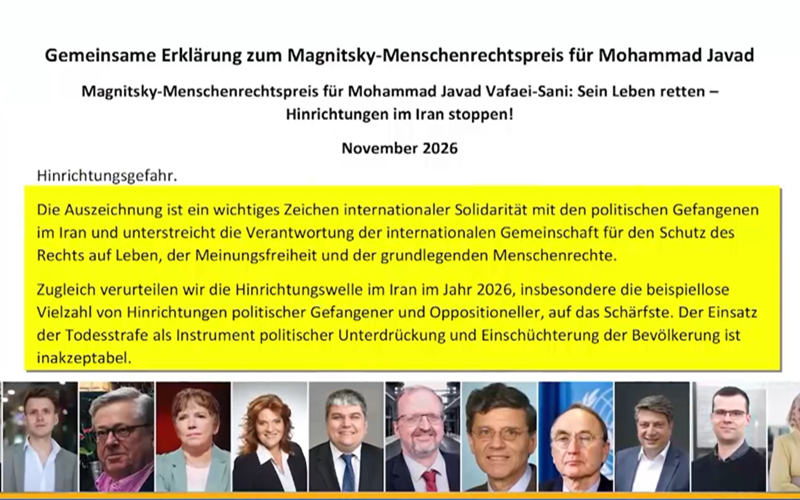

A cross-party group of German parliamentarians, former diplomats, religious leaders, and human rights advocates condemns Iran’s execution campaign and urges Berlin, the European Union, and the United Nations to intervene following the awarding of the 20th Magnitsky Human Rights Award to the Iranian political prisoner.
A broad group of German parliamentarians, former diplomats, religious leaders, and human rights advocates has issued a joint statement calling for the immediate rescue of Mohammad Javad Vafaei Sani, the Iranian political prisoner facing an imminent threat of execution. The statement follows the awarding of the 20th Magnitsky Human Rights Award to Vafaei Sani and calls on the German federal government, the European Union, and the United Nations to intensify political and diplomatic pressure on Iran’s regime.
Titled “Magnitsky Human Rights Award for Mohammad Javad Vafaei-Sani: Save His Life – Stop Executions in Iran!”, the November 2026 declaration describes the award as an important expression of international solidarity with political prisoners in Iran and a reminder of the international community’s responsibility to defend fundamental human rights.
The signatories emphasize that the award carries significance beyond the recognition of one individual. As they state:
“The award is an important sign of international solidarity with political prisoners in Iran and underscores the responsibility of the international community to protect the right to life, freedom of expression, and fundamental human rights.”
Mohammad Javad Vafaei Sani faces imminent execution
The German figures draw particular attention to the immediate danger facing Vafaei Sani. He was sentenced to death on charges of membership in the People’s Mojahedin Organization of Iran (PMOI/MEK). Despite international protests, Iran’s Supreme Court reaffirmed the death sentence, leaving him at acute risk of execution.
The signatories reject the use of capital punishment against individuals because of their political convictions or activities. They argue that Vafaei Sani’s case represents a broader pattern of political repression in which the death penalty is used to intimidate opponents and suppress dissent.
Their appeal is unequivocal: his life must be saved, and his death sentence must be overturned without delay.
German figures condemn Iran’s 2026 execution wave
Beyond Vafaei Sani’s individual case, the declaration strongly condemns the wave of executions carried out in Iran in 2026, particularly the unprecedented number of political prisoners and opposition members being put to death.
The signatories state:
“We strongly condemn the wave of executions in Iran in 2026, particularly the unprecedented number of executions of political prisoners and opposition members.”
They go further in describing the political purpose behind these executions:
“The use of the death penalty as an instrument of political repression and intimidation of the population is unacceptable.”
The statement places the execution of political prisoners within the wider context of the regime’s efforts to silence dissent and intimidate Iranian society. It makes clear that the international response must extend beyond individual cases and address the systematic use of executions as a tool of repression.
Call on Germany, the EU, and the UN to intervene
The signatories also express their support for the appeal issued by more than 100 human rights organizations and human rights defenders calling for Vafaei Sani’s life to be saved.
They write:
“We join the appeal of more than 100 human rights organizations and human rights defenders to save the life of Mohammad Javad Vafaei-Sani.”
The declaration specifically calls on the German federal government, the European Union, and the United Nations to increase political and diplomatic pressure on Iran’s regime.
Their demand is explicit:
“We call on the German federal government, the European Union, and the United Nations to increase political and diplomatic pressure on the Iranian regime to secure the immediate annulment of his death sentence and his release.”
This appeal places responsibility on Germany and other international institutions to translate expressions of solidarity into concrete diplomatic action aimed at preventing another political execution in Iran.
Signatories demand an end to executions and release of political prisoners
The declaration concludes by setting out demands that extend beyond Vafaei Sani’s case. The signatories insist that no individual should be sentenced to death for political beliefs or activities and call for an immediate halt to all executions in Iran.
Their concluding message states:
“The life of Mohammad Javad Vafaei-Sani must be saved. No one must be punished with death because of their political convictions or activities.”
They also demand:
“We demand an immediate halt to all executions in Iran, the release of all political prisoners, and accountability for those responsible for serious human rights violations.”
These demands connect the campaign to save Vafaei Sani with the broader struggle to end executions, secure the release of political prisoners, and hold perpetrators of human rights violations accountable.
Signatories of the joint statement
The declaration brings together prominent figures from German federal and state politics, diplomacy, religious leadership, constitutional law, and human rights advocacy.
The signatories are:
- Martin Patzelt – Former member of the German Bundestag (2013–2021) and its Committee on Human Rights and Humanitarian Aid.
- Prof. Dr. Margot Käßmann – Theologian and former Chair of the Council of the Evangelical Church in Germany (EKD).
- Dr. Saskia Ludwig – Member of the German Bundestag (MdB).
- Leo Dautzenberg – Former member of the German Bundestag (1998–2011).
- Ambassador (ret.) Dr. Joachim Rücker – Former President of the UN Human Rights Council.
- Ambassador (ret.) Dr. Dr. Hans-Ulrich Seidt – Former German diplomat and former Chief Inspector of the Federal Foreign Office.
- Prof. Dr. Christoph Degenhart – Constitutional law scholar and expert in constitutional law.
- Max Lucks – Member of the German Bundestag (MdB).
- Stefan Schmidt – Member of the German Bundestag (MdB).
- Dr. Fabian Fahl – Member of the German Bundestag (MdB).
- Christian Calderone – Member of a German state parliament (MdL).
- Sandra Weeser – Former member of the German Bundestag (2017–2025).
- Thomas Lutze – Former member of the German Bundestag (2009–2025).
- Marion Böker – Women’s rights advocate and human rights activist.
The joint declaration demonstrates support for Vafaei Sani across different political, professional, and religious backgrounds in Germany. By linking his immediate danger of execution to the wider repression of political prisoners in Iran, the signatories emphasize that international attention must translate into concrete political action.
Their message is clear: Mohammad Javad Vafaei Sani’s life must be saved, executions in Iran must stop, all political prisoners must be released, and those responsible for serious human rights violations must be held accountable.