


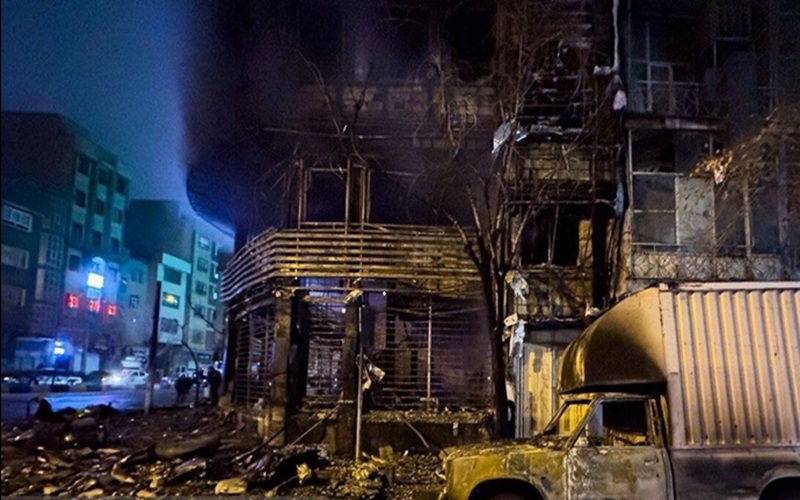

Growing concern over poverty, public despair, and the threat of another uprising exposes the regime’s lack of solutions and widening divisions at the top
Iran’s regime is increasingly preoccupied with domestic instability, even as regional tensions continue to dominate the political landscape. President Masoud Pezeshkian and other senior officials have repeatedly raised concerns about economic hardship, public frustration, and what they describe as efforts to undermine hope among the population. Their statements reveal a growing awareness of the dangers posed by widespread poverty and mounting social discontent.
Following his visit to Antalya, Pezeshkian described improving people’s living conditions and restoring their confidence in the future as one of his government’s principal concerns. Speaking about the purpose of diplomatic visits, he said:
“What concerns us is how to make people hopeful about their livelihoods, their lives, and their future, and how to make them believe that we are present on the scene.”
The repeated emphasis on public hope and economic conditions is significant. Across different factions of the regime, officials have increasingly acknowledged the seriousness of the domestic situation, suggesting that the country’s internal crises have become a central concern for the ruling establishment.
Regime officials increasingly worried about public despair
Pezeshkian is not the only senior official speaking about public confidence and economic hardship. Judiciary Chief Gholamhossein Mohseni Ejei has also warned about what he describes as psychological operations intended to undermine public morale.
On November 12, Ejei said:
“Today, efforts are being made to make people lose hope through psychological operations.”
Such statements point to a recurring concern within the regime: the possibility that economic hardship and growing dissatisfaction could turn into a broader challenge to its authority.
The regime’s own affiliated media have also acknowledged the social consequences of poverty. In an article published by Setareh Sobh, sociologist Amanollah Gharai Moghadam described the relationship between economic deprivation and social despair, warning:
“Poverty empties people’s pockets and brings feelings of humiliation and hopelessness. When a person feels they have nothing to lose, this becomes a dangerous stage.”
The significance of this warning extends beyond household finances. When people lose their ability to meet basic needs and see no prospect of improvement, economic frustration can develop into a much wider rejection of the existing political and social order.
For a regime already facing deep public dissatisfaction, this is a particularly sensitive issue.
Pezeshkian acknowledges the danger of hunger and unemployment
Pezeshkian himself has repeatedly acknowledged the seriousness of the economic situation. In another statement, he questioned how a government could concern itself with other matters while people were going hungry and remaining unemployed.
He said:
“I cannot be responsible for the country while people are hungry and unemployed, and then come here and talk about other things.”
The statement reflects the pressure facing the government as the consequences of economic mismanagement, unemployment, and declining living standards become increasingly difficult to ignore.
Economist Hossein Raghfar has also warned about the potential consequences of continuing these conditions, describing the possibility of a social explosion. In this context, the regime’s references to public despair and economic grievances are not simply discussions about welfare policy. They point to concerns about the political consequences of accumulated social anger.
The authorities frequently describe the prospect of widespread unrest as “rioting” or “disorder.” Yet the underlying problem they acknowledge is the possibility that economic and social grievances could develop into another nationwide uprising.
Disagreements over negotiations expose divisions at the top
The domestic crisis is also interacting with growing disagreements within the regime’s leadership over how to respond to external pressure.
Pezeshkian has argued against entering a confrontation that could be avoided, while insisting that the regime should not surrender to coercion. Addressing the possibility of war, he said:
“We will not surrender to bullying, but pay attention: if war breaks out, we will have problems. We have not surrendered to bullying, but logic and reason dictate that, as far as possible, you should not put yourself into a conflict that you can avoid. Some people sit comfortably in warm places and talk.”
His remarks expose the dilemma confronting the ruling establishment. On one side, the regime faces pressure to maintain its confrontational posture. On the other, an escalation could bring additional economic and political costs at a time when domestic conditions are already fragile.
The disagreement over negotiations and confrontation has become one of the clearest expressions of divisions within the regime’s leadership. Different factions disagree over which course of action offers the best chance of preserving the system, but they have yet to establish a common approach.
A regime caught between internal discontent and political deadlock
Three interconnected developments help explain the growing concern among senior officials.
First, divisions at the top are deepening over how to confront external pressure, particularly whether to pursue negotiations or maintain a confrontational approach. These disagreements reflect the absence of a unified strategy for dealing with the regime’s mounting problems.
Second, the authorities are increasingly concerned about the potential for economic grievances to develop into a broader social uprising. Their repeated references to poverty, unemployment, public despair, and the loss of hope indicate that they recognize the political implications of deteriorating living conditions.
Third, the regime faces a lack of viable solutions. Its economic and social problems cannot be addressed simply through statements promising hope, while its internal divisions make it more difficult to formulate and implement a coherent response.
These three developments reinforce one another. The absence of solutions intensifies disagreements within the leadership. Those disagreements, in turn, expose the regime’s vulnerability and deepen uncertainty throughout the system.
Meanwhile, the social conditions driving public dissatisfaction remain unresolved.
Pezeshkian’s repeated references to people’s livelihoods and future prospects, Ejei’s warnings about public hopelessness, and concerns raised by regime-affiliated commentators about poverty and social explosion all point to the same underlying problem.
For Iran’s regime, the danger is not limited to regional confrontation. It also lies in the possibility that mounting domestic grievances, combined with divisions and political deadlock at the top, could create conditions for another nationwide uprising.