


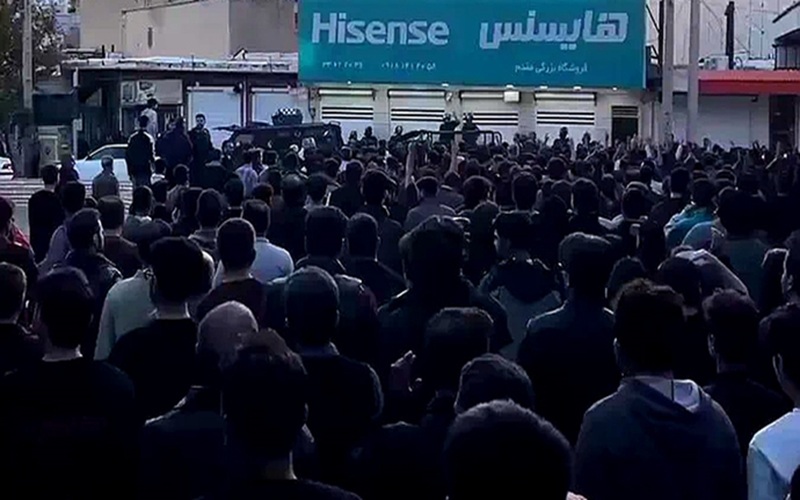

The death of oil refinery workers sparked genuine public anger in Abdanan, but a coordinated effort to amplify a narrow monarchist slogan sought to portray the protests as support for Reza Pahlavi, obscuring the demonstrators’ actual demands and their rejection of dictatorship.
The protests in Abdanan, Ilam Province, following a fatal bus accident involving employees of the Dehloran oil refinery, have exposed another attempt by Reza Pahlavi’s monarchist current to appropriate popular discontent and manufacture the appearance of political support.
The incident claimed 13 lives. In the aftermath, grieving residents took to the streets on Tuesday afternoon, gathering at Vali-Asr Square to mourn the victims and protest the conditions that had turned a workers’ commute into a deadly tragedy. Their anger reflected years of corruption, economic deprivation, inadequate infrastructure, and the ruling establishment’s indifference to public safety.
Videos from the gathering show hundreds of people, dressed in black, paying tribute to the victims with chants of “Ali Reza, may your soul rest in peace.” As the gathering developed into a protest, demonstrators shouted “Death to the dictator,” “Death to Khamenei,” and “Resign, resign.” Government banners were pulled down, while passing vehicles sounded their horns in solidarity.
The dominant message was unmistakable: public anger over the workers’ deaths had become an expression of opposition to the ruling dictatorship and its institutional failures.
Yet a very different picture soon emerged in monarchist media circles.
A short clip used to rewrite the protests
A 19-second video, in which the slogan “This is the final battle, Pahlavi will return” had been artificially dubbed over the original footage, was widely circulated as though it reflected the views of the demonstrators as a whole. This manipulated clip was presented without the broader context of the gathering, creating the misleading impression that the people of Abdanan had taken to the streets to demand the restoration of the monarchy.
However, the original, unaltered footage and other recordings from the scene tell a very different story, revealing a much broader protest centred on mourning the dead workers and expressing opposition to the dictatorship, rather than support for the restoration of the monarchy.
Manipulated video by the monarchist current
Original video of the same scene. People chanting: “Ali Reza, may your soul rest in peace.”
The contrast between the full footage and the selectively circulated clip exposed the mechanism behind the manipulation: isolate a brief segment, remove the surrounding context, amplify it across sympathetic channels, and present a minority slogan as the voice of an entire city.
The circumstances surrounding the monarchist slogans raise further questions. Another video from the Abdanan gathering shows individuals chanting “Javid Shah” (Long Live the Shah) in close proximity to the regime’s security forces. In a country where security personnel routinely suppress protests, arrest demonstrators, and use violence against dissent, the circumstances in which such politically charged slogans are voiced in their immediate presence warrant serious scrutiny.
Who were these individuals? Were they members of the grieving community, or had they gathered separately to give an otherwise anti-dictatorship protest a monarchist message? Other clips shared on social media and aired on satellite television appear to show the same group in the same square. Some fifteen to twenty people were already there, with police officers standing just a few metres away. As the protesters approached the square, members of the group began chanting ‘Long live the Shah!’ and filming themselves. The same group can also be heard chanting ‘This is the final battle, Pahlavi will return!’ The footage quickly spread across social media and was widely broadcast on satellite television.
Video – Abdanan, Ilam Province: At the 39-second mark, the camera pans in another direction, revealing that the group chanting “Javid Shah” (“Long live the Shah”) is standing just a few metres from the regime’s security forces. This raises questions about who the chanters were and how the footage has been used to portray a broader anti-dictatorship protest as a show of support for Reza Pahlavi.
The speed with which the footage spread deepened those suspicions. Almost immediately, clips of the group chanting in support of the monarchy and Reza Pahlavi appeared on social media accounts reportedly linked to the Iranian regime. Hundreds of accounts on X then circulated the clips widely. These accounts presented themselves as monarchist supporters, yet their operators are alleged to have used false profiles and government-issued “white SIM cards” that provide unfiltered internet access in Iran.
One of the thousands of accounts allegedly linked to the regime’s online operations is Pary 4, which presents itself as monarchist and whose operator reportedly used a government-issued “white SIM card”. It posted the same clip with the caption “Brave Abdanan chants, ‘This is the final battle. Pahlavi will return!’” Its profile picture and the location originally shown on the account also warrant a closer look, particularly given the fact that the operator later used a VPN to change the displayed location.
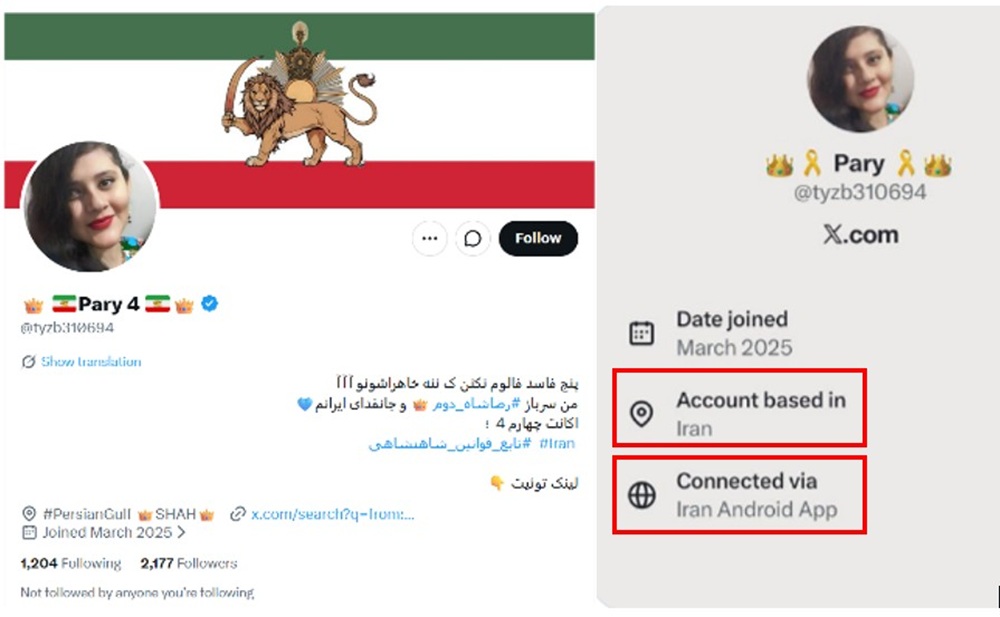
آبدانان غیور با شعار : این آخرین نبرده پهلوی برمیگرده شروع کردن 🔥🔥 امیدوارم زودتر ج.نگ هم شروع بشه همزمان با شروع اعتراضات 🔥🔥 اینترنت آبدانان مختل شده ، صداشون باشیم از حالا تا پایان عمر این حکومت، هر جا که ایرانیان کنار هم جمع شوند، همینها را میشنوید. خیابان مال مردم است. پس میگیریم. همهچیز را ، ایرانجانمان را ، هویتمان را ، کشور اهوراییمان را #جاويدشاه
— 👑 🇮🇷Pary 4 🇮🇷👑 (@tyzb310694) November 17, 2026
Hundreds of similar accounts have been actively involved in circulating manipulated videos alongside footage of this group’s pro-monarchist chants. Another example is the X account LouieStill, which presents itself as a monarchist supporter but is reportedly operated using a government-issued “white SIM card”, allowing unrestricted internet access in Iran. The account’s operator is also alleged to have begun using a VPN to conceal their actual location and avoid detection. The account has published numerous posts and replies in both Persian and English promoting these clips and amplifying slogans in support of Reza Pahlavi. A closer examination of several of its posts and replies illustrates the pattern of activity and raises further questions about the role such accounts may play in shaping the narrative surrounding the Abdanan protests.
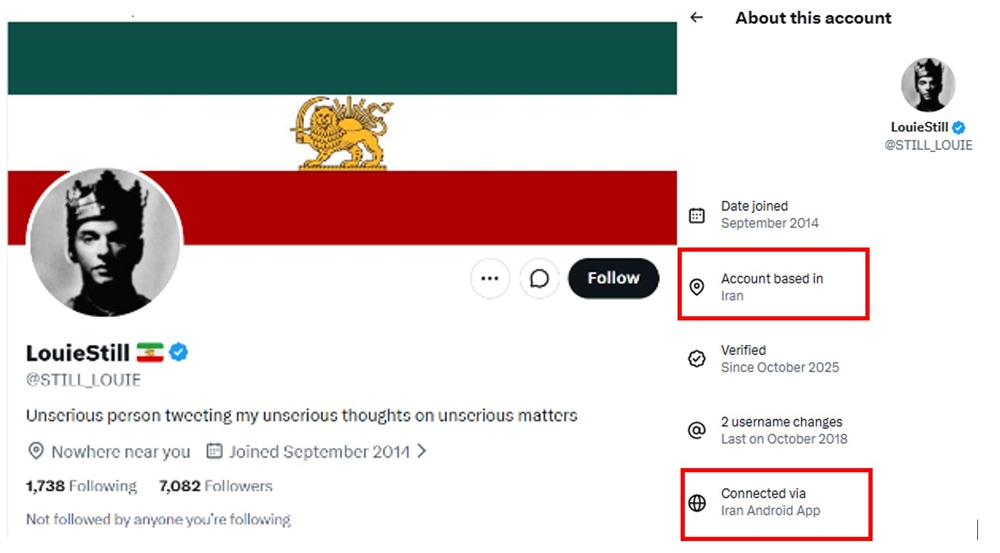
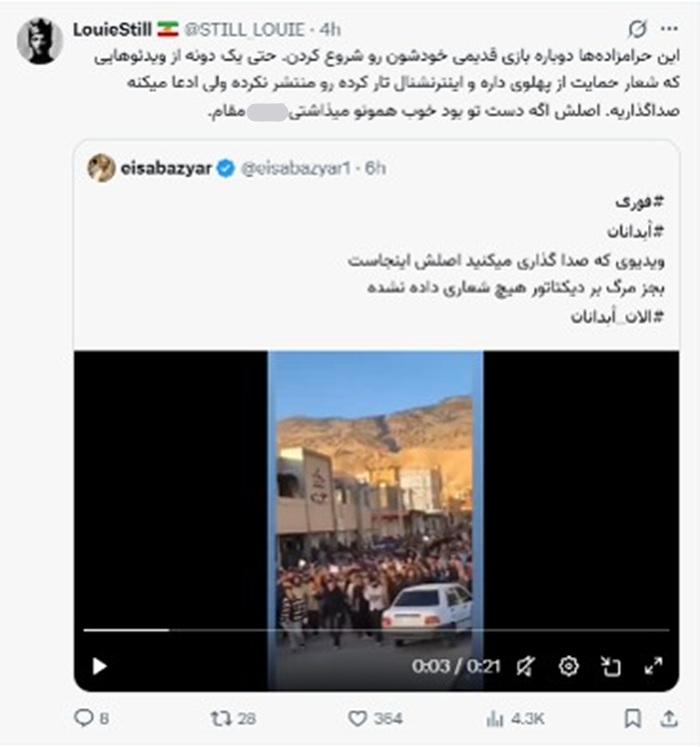
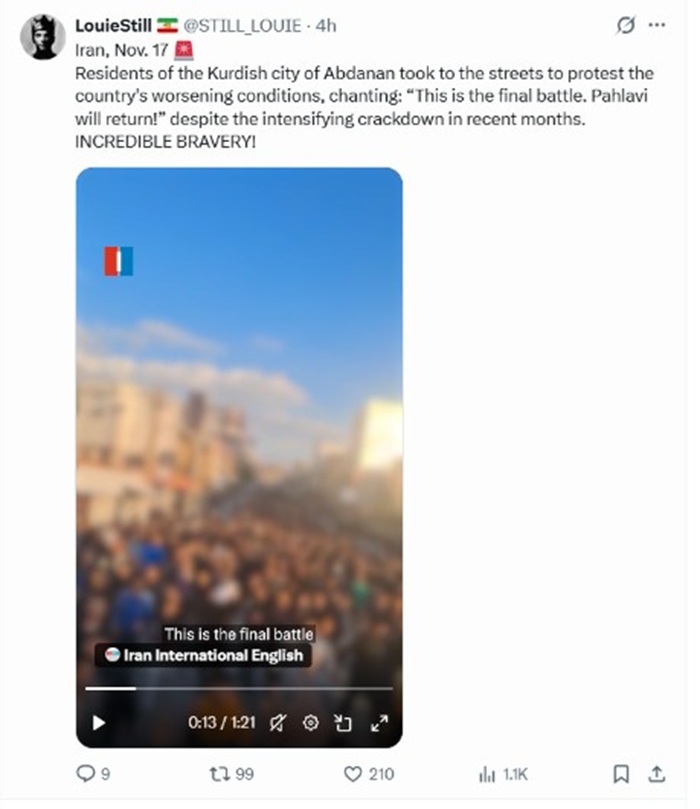
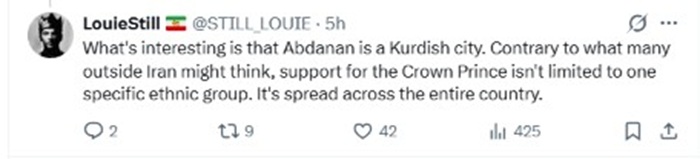

But a far more troubling question remains: how could a group openly chant “Long Live the Shah” and “Pahlavi Will Return” just a few metres from the regime’s security forces, only for footage of those chants to be rapidly circulated by accounts allegedly linked to the regime, masquerading as monarchist supporters? The suspicions deepen with the emergence of other videos in which pro-monarchist slogans appear to have been artificially dubbed over original protest footage. Widely amplified across social media and Persian-language satellite television, these clips have helped create the impression that Reza Pahlavi was the leading figure behind the uprising. Why would a regime that ruthlessly suppresses dissent appear to tolerate such chanting in the immediate presence of its security forces? Who benefits from this narrative, and could the combination of an apparently organised monarchist group, manipulated footage and coordinated online amplification point to a covert security operation intended to hijack a genuine anti-dictatorship uprising?
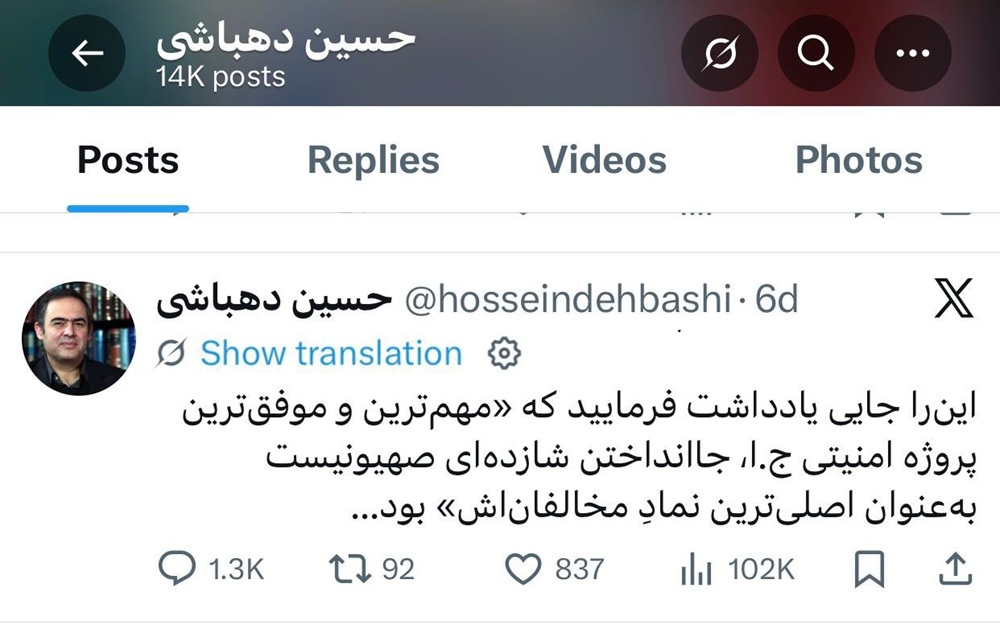
The Abdanan protests and the monarchist slogans heard in some of the footage have raised serious questions, while also shedding light on longstanding suspicions surrounding similar slogans at previous demonstrations. Perhaps the most important lesson from Abdanan is that any protest video circulating on social media featuring pro-monarchist chants should be treated with considerable scepticism. Such footage must be carefully scrutinised before being accepted as genuine evidence of public support for Reza Pahlavi, particularly given concerns that it may form part of a wider security operation designed to manipulate the opposition’s image. These suspicions are not new. Figures with reported connections to circles close to the regime have previously suggested that promoting the monarchy and Reza Pahlavi as the principal alternative to the Islamic Republic is itself a major intelligence operation. Hossein Dehbashi, a journalist described as having close ties to the regime’s intelligence establishment, expressed this allegation in particularly striking terms: “Mark my words: the Islamic Republic’s most important and successful intelligence operation was to establish a Zionist prince as the foremost symbol of opposition to the regime.”
Reza Pahlavi turns public suffering into a personal campaign
Reza Pahlavi quickly capitalized on the media attention. Appearing in a studio, he expressed superficial sympathy with the families of the deceased workers before shifting the focus to himself and his political campaign.
His declaration, “I am proud of you,” followed by the campaign slogan “We will take Iran back,” presented him as a national leader entitled to speak on behalf of the protesters.
But the central question is precisely who authorized him to claim that role.
The people of Abdanan had gathered to mourn their dead, protest the consequences of corruption and incompetence, and condemn dictatorship. Their suffering did not constitute an endorsement of Pahlavi, nor did a slogan chanted by a small group provide him with a political mandate.
This is a recurring problem with the monarchist current: rather than demonstrate a credible political base through transparent and accountable organization, it seeks to manufacture the appearance of popular endorsement through media amplification, selective imagery, and personal branding. The public’s grievances become material for a campaign centered not on the people’s right to determine their future, but on the political ambitions of one individual.
An alternative manufactured through media exposure
The controversy in Abdanan also highlights a broader weakness in Reza Pahlavi’s claims to political leadership: the gap between media visibility and demonstrable political support.
In an article published on November 10 in The Washington Examiner, Ambassador Ken Blackwell, a former U.S. representative to the United Nations Commission on Human Rights, challenged the portrayal of Pahlavi as a credible alternative to Iran’s ruling establishment.
Blackwell argued that the fundamental struggle in Iran is between a repressive ruling system and a society demanding freedom and national sovereignty. He described Pahlavi not as a political force comparable to that struggle, but as an opportunistic claimant who can exploit media exposure to create the appearance of an alternative.
Blackwell also addressed the use of manipulated protest footage and the controversy surrounding Pahlavi’s claims that more than 160,000 people had registered through his initiative, supposedly including military personnel, security forces, and civilian officials. He noted that no independently verifiable evidence had been presented to substantiate those figures and that no visible wave of defections from the regime followed.
These examples point to a fundamental distinction: political legitimacy cannot be established through inflated numbers, edited videos, or self-proclaimed leadership.