


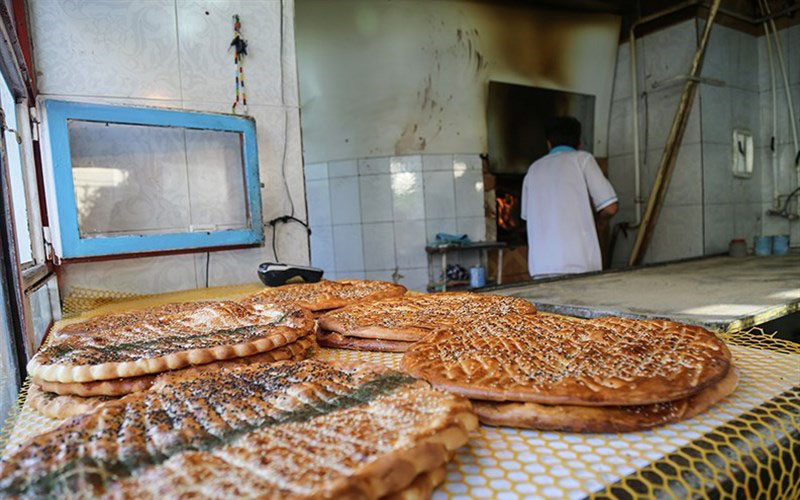

A digitally monitored, multi-tier pricing system for subsidized bread is expanding across Iranian provinces, raising concerns about reduced access to an essential staple, government control over household consumption, and the transfer of economic pressures onto low-income families.
The new system distinguishes between subsidized bread purchases and purchases charged at a higher commercial rate. Although officials describe the measure as an effort to prevent the misuse of subsidized flour and control excessive purchases, its implementation has raised questions about how much bread households can obtain at subsidized prices and who determines when their purchases exceed the permitted consumption pattern.
Subsidized bread increasingly subject to purchasing limits
According to reports published in Iranian media in November 2026, the new system initially underwent pilot implementation in Markazi Province before being extended to other areas, including Khuzestan and Zanjan. Reports have also identified Mazandaran and Ardabil among the provinces affected by the expanding system.
The reported average monthly flour allocation is approximately eight kilograms per person, although officials in Zanjan have stressed that this is an average consumption figure, not a uniform fixed quota for every individual or household.
Under the reported pricing structure, flour allocated at the subsidized rate costs approximately 2,300 tomans per kilogram, while purchases classified as excessive or commercial are calculated at approximately 12,650 tomans. This represents an increase of more than fivefold.
Officials say the system uses purchasing records from the previous two years, national identification numbers, household consumption patterns, and differences between urban and rural areas to determine what constitutes normal consumption. Purchases by individual family members are aggregated under the household’s registered head.
However, the lack of clear public information about the precise thresholds and calculation methods leaves households uncertain about when their purchases may be charged at the substantially higher rate.
Digital surveillance extends to everyday food consumption
The implementation of the policy relies on electronic payment terminals connected to the Nanino system. These devices record bread purchases and allow authorities to monitor consumption patterns through individual identification and household purchasing data.
Regime officials have acknowledged that the system makes it possible to track the quantity of bread purchased by individuals on a daily basis.
This represents an expansion of the regime’s digital monitoring of ordinary economic activity. Access to a basic food staple is increasingly linked to an electronic system capable of recording and evaluating household consumption.
The authorities have also centralized control over the implementation of the policy. Pricing decisions at provincial and municipal levels are handled by government officials, while bakers have little authority over the allocation rules or the distinction between subsidized and commercial sales.
According to reports describing the mechanism, the additional revenue collected from bread sold at commercial rates is transferred directly to government accounts.
Questions over flour quality and the distribution of subsidies
The new policy also raises questions about the quality and distribution of flour, as well as the management of the wheat supply chain.
Reports cited in criticism of the system point to declining flour quality and the increased use of bran, reportedly reaching approximately 15 percent in some cases. Such concerns are particularly significant because bread constitutes a major part of the daily diet of lower-income households.
A second concern involves the substantial gap between subsidized and commercial flour prices.
Under the existing system, wheat and flour receive preferential government support, but the benefits do not necessarily reach all consumers equally. Different categories of flour users, including subsidized bakeries, commercial bakeries, and food-processing industries, operate under different pricing arrangements.
The large difference between subsidized and commercial prices also creates opportunities for diversion, unauthorized distribution, and profiteering. Reports of flour being moved outside official distribution channels, including alleged cross-border smuggling, raise further questions about oversight of the subsidy system.
The government’s control over domestic wheat procurement adds another dimension. As the principal buyer of domestically produced wheat, the state controls the purchase and distribution process, giving government institutions considerable influence over the difference between guaranteed procurement prices and subsequent commercial sales.
Wheat reserves and the justification for tighter controls
The question of whether Iran faces an unavoidable shortage of wheat is particularly relevant.
In December 2025, the head of the state-run Government Trading Corporation announced that Iran had approximately four million metric tons of wheat in strategic reserves, equivalent to three to four months of domestic consumption. He also reported that the government had purchased approximately 7.7 million tons of wheat from domestic farmers that year.
More recent assessments by the UN Food and Agriculture Organization indicate that Iran’s wheat import requirement for the 2026/27 marketing year is forecast at approximately 2.5 million metric tons, reflecting carryover stocks and favorable domestic production in 2026.
These figures do not establish that Iran has no supply difficulties. However, they demonstrate why the government needs to explain the economic necessity, distributional consequences, and actual savings expected from restricting subsidized bread purchases.
The central issue is not simply the availability of wheat, but how the regime manages public resources, distributes subsidies, and determines who ultimately bears the cost of its economic policies.
Low-income households face the greatest pressure
The consequences of the new system are likely to be particularly severe for low-income families and larger households.
As food prices and inflation have eroded purchasing power, many poorer families have already reduced their consumption of more expensive sources of protein and dairy products. Bread has consequently become an increasingly important component of their daily nutrition.
Introducing a system that subjects purchases exceeding government-defined consumption patterns to a commercial price creates additional uncertainty for these households.
Even if officials maintain that ordinary purchases will remain subsidized, the absence of transparent and consistently communicated rules leaves families exposed to unexpected increases in their food expenses.
For households already struggling to meet basic needs, the prospect of exhausting their subsidized allocation and having to pay more than five times the subsidized flour rate for additional purchases represents another serious financial burden.
The expansion of bread rationing illustrates a broader economic problem: rather than addressing the institutional failures, financial mismanagement, and resource allocation practices behind the country’s economic difficulties, the regime is increasingly relying on controls over consumption and the reduction of public subsidy costs.
Bread, one of the most basic elements of the Iranian household diet, is now becoming another instrument through which the population experiences the consequences of the regime’s economic policies.