


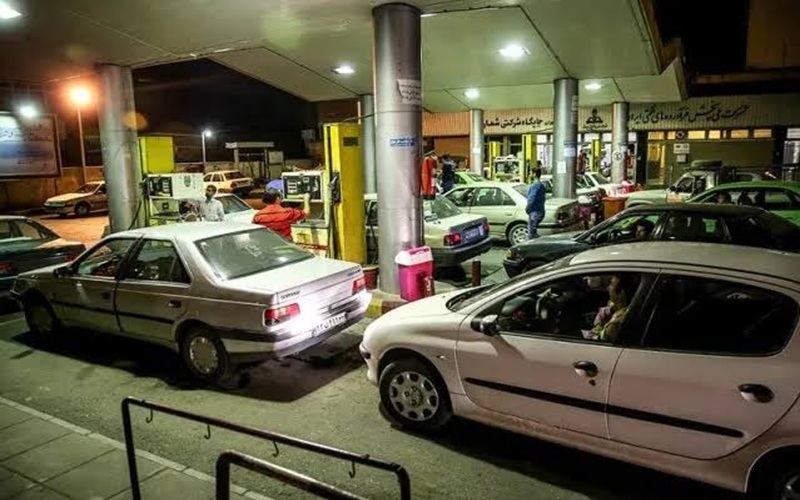

As the regime seeks to raise gasoline prices to cover budget shortfalls, millions of Iranians face rising costs while powerful state-linked institutions benefit from opaque wealth, tax privileges, and a vast fuel-smuggling trade.
The Iranian regime is once again moving toward higher gasoline prices, but its contradictory statements and shifting announcements reveal the political sensitivity of the issue.
Government officials, lawmakers, and state-affiliated media have repeatedly offered conflicting accounts of possible price increases, with decisions sometimes announced and subsequently withdrawn. Behind this uncertainty lies a familiar economic strategy: transferring the costs of the regime’s financial and policy failures onto ordinary citizens.
The argument most frequently advanced by officials is that gasoline is too cheap in Iran compared with prices in other Middle Eastern countries and therefore needs to be brought closer to international levels. But this comparison deliberately ignores a fundamental difference: Iranian wages are also dramatically lower.
Even using an estimated average monthly wage of 30 million tomans, workers earn only around €100 a month. Comparing fuel prices without accounting for purchasing power and income levels presents a distorted picture of the economic burden on households. While gasoline may be cheaper in nominal terms than in neighboring countries, the ability of ordinary Iranians to afford it is also far more limited.
The regime’s proposed price adjustments therefore cannot be separated from the wider collapse in household purchasing power. For families already struggling with food, housing, transportation, and other essential expenses, even gradual increases in fuel costs can have significant consequences.
Tax-exempt institutions and public wealth remain untouched
The government’s argument about gasoline prices also raises another question: why must ordinary citizens compensate for budget shortfalls while vast financial resources controlled by institutions affiliated with the supreme leader remain largely beyond independent scrutiny?
These institutions have accumulated substantial assets and operate without the kind of independent financial oversight expected of publicly accountable organizations. Their extensive economic activities and tax privileges further highlight the unequal distribution of financial obligations.
Rather than addressing the concentration of wealth and the lack of transparency surrounding these powerful institutions, the regime continues to look toward fuel prices and other essential goods as sources of additional revenue.
This approach places the burden of economic mismanagement on people who have little influence over the decisions producing the crisis, while politically connected economic networks retain access to substantial resources.
The 30-million-liter fuel-smuggling question
Another major contradiction lies in the scale of fuel smuggling from Iran. Reports carried by state media and official sources have put the volume of daily smuggling at approximately 20 million to 30 million liters, consisting predominantly of diesel.
At the upper end, 30 million liters represents an enormous volume of fuel, equivalent to roughly 189,000 barrels of liquid fuel per day. This is not a trade that can reasonably be explained by the activities of impoverished individuals transporting small quantities across border areas.
In Sistan and Baluchestan, economically marginalized residents engage in fuel transportation, often moving quantities of 100, 200, or even 600 liters to earn a living. These fuel carriers face dangerous conditions and security-force operations. Their activities, however, cannot account for an organized trade involving tens of millions of liters every day.
The scale of the reported smuggling points to the involvement of organized networks with access to transportation, storage, distribution infrastructure, and substantial financial resources. The Islamic Revolutionary Guard Corps (IRGC) has been identified in opposition analysis as a major beneficiary of this trade. Such networks also provide channels through which the regime can generate revenue outside conventional financial and regulatory mechanisms, including in the context of international sanctions.
The distinction between small-scale border fuel carriers and large-scale smuggling networks is essential. Treating them as equivalent obscures the economic structures behind the trade and shifts attention away from the powerful actors capable of organizing it.
Gradual price increases, without an explicit announcement
The regime’s approach to gasoline pricing also appears to involve introducing more expensive options rather than relying exclusively on a single, openly announced nationwide increase.
The introduction of imported premium gasoline at substantially higher prices provides one example. Reports have also indicated that premium-grade gasoline can be produced domestically, with quality reportedly reaching approximately 90 percent of that of imported premium fuel.
If domestic production can supply a comparable product, the decision to market expensive imported gasoline raises questions about the economic rationale behind the policy. More broadly, offering increasingly expensive fuel categories creates a mechanism for raising the effective cost of gasoline without necessarily announcing an across-the-board price adjustment.
This incremental approach allows the regime to test different pricing mechanisms while avoiding the immediate political consequences of a sudden and uniform increase.
The political cost of making households pay
Gasoline prices have particular political significance in Iran. The November 2019 uprising demonstrated how a sudden fuel-price increase can become a trigger for much broader public anger. The protests that followed the gasoline-price announcement spread across the country and were met with a deadly crackdown.
That experience remains an important backdrop to the current debate. The regime faces the challenge of securing additional revenue while avoiding a repeat of the public reaction associated with its previous fuel-price decision.
But the underlying economic pressures have not disappeared. Low wages, declining purchasing power, budget deficits, opaque financial institutions, and large-scale fuel smuggling remain interconnected features of the country’s economic crisis.
The central issue is therefore not simply how much Iranians pay for gasoline. It is why ordinary households are repeatedly asked to absorb the costs of policies over which they have no control, while powerful institutions and networks with access to public wealth and economic privileges remain largely insulated from the consequences.
Raising fuel prices may provide the regime with another source of revenue, but it does not address the structural problems behind the country’s economic crisis. Instead, it adds another burden to households already struggling to make ends meet.