


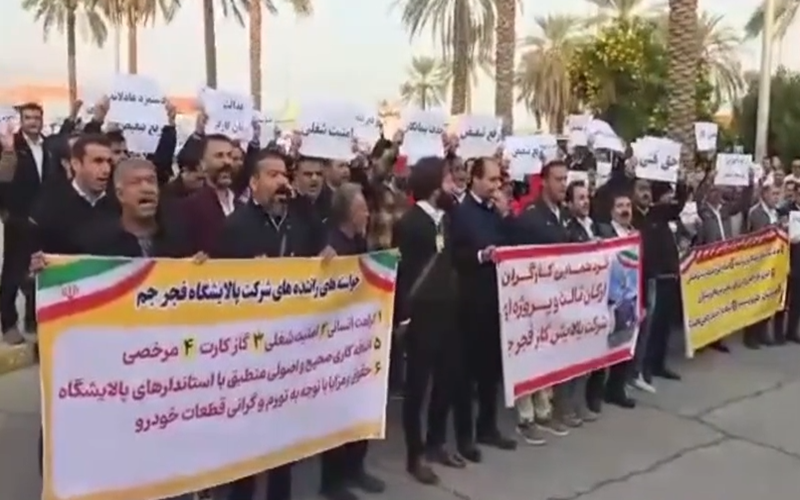

While government officials warn that raising workers’ wages could trigger price increases of up to 60 percent, lawmakers acknowledge that real inflation has exceeded 200 percent. Budget deficits, monetary policies, and government-imposed price hikes continue to erode household incomes.
Iran’s workers are facing another year of declining purchasing power as the government refuses to adjust wages to match the rising cost of living. Despite President Masoud Pezeshkian’s earlier promise to revise workers’ salaries in line with inflation halfway through the year, no such adjustment has materialized. Instead, government officials are warning that increasing wages could trigger another wave of price hikes, shifting the burden of economic mismanagement onto workers and low-income households.
Mohammad Reza Aref, Pezeshkian’s first vice president, recently warned that raising workers’ wages could lead to price increases of between 30 and 60 percent. His remarks effectively present wage increases as a threat to economic stability without offering any credible solution to the widening gap between incomes and living costs.
The warning comes as a member of the regime’s parliament has acknowledged that Iran’s actual inflation rate exceeds 200 percent. Against this backdrop, the government’s refusal to compensate workers for rising prices amounts to further reducing the real value of their already inadequate incomes.
Government blames wages while pursuing inflationary policies
The government’s position exposes a fundamental contradiction in its economic policies. Pezeshkian repeatedly presents public livelihoods as a central concern, yet his administration treats wage increases as a potential source of inflation while continuing to implement policies that drive up prices.
These include exchange-rate increases, higher fuel prices, government-controlled automobile pricing, and rising bank interest rates. Such measures add to production costs, increase financial pressures on businesses, and weaken household purchasing power.
Pezeshkian has also tied salary increases for government employees to savings in energy consumption, including electricity, natural gas, diesel, and gasoline. At the same time, he acknowledges that the government lacks the budgetary resources to adjust salaries in line with inflation.
This argument shifts responsibility onto wage earners, asking them to consume less while their incomes continue to lose value. The administration maintains that raising salaries without financial backing would expand the budget deficit and fuel inflation. However, it offers no convincing explanation for how workers are expected to survive when their wages cannot cover basic necessities.
Labor representatives and even some figures within the regime’s parliament have challenged the argument that wage increases are a decisive driver of inflation. The deeper problem lies in the government’s fiscal and monetary policies, persistent budget deficits, and the way public resources are distributed.
Workers pushed into multiple jobs as household incomes collapse
The consequences are already visible across working-class households. Labor activists quoted in the regime’s own media report that workers’ incomes are no longer sufficient to cover even basic food expenses through the end of the month.
Increasing numbers of workers are therefore forced to take second and third jobs, often in the informal economy, simply to make ends meet. The pressure extends beyond the primary breadwinner: women and even school-age children are increasingly compelled to enter the labor market to supplement household incomes.
This growing dependence on additional and often insecure employment reflects the erosion of wages under persistent inflation. Families are sacrificing time, education, and financial security just to maintain a minimum standard of living.
The crisis is also affecting the productive sector. Many factories and businesses are struggling to secure sufficient working capital to purchase raw materials and pay their employees. Stagflation, combined with repeated energy supply disruptions, has further weakened production and employment.
Under these conditions, a sudden wage increase without accompanying tax exemptions, accessible credit, or financial support could push small and medium-sized enterprises toward closure. The result would be further unemployment and additional pressure on an already impoverished workforce.
Banking policies and budget deficits remain at the heart of the crisis
Economic experts inside Iran have pointed to the banking system and the expansion of liquidity as essential factors in addressing inflation. They argue that the Central Bank must stop extending preferential financial facilities to individuals and networks that benefit from privileged access to public resources.
These arrangements allow well-connected beneficiaries to obtain financing and foreign currency through channels unavailable to ordinary businesses and citizens. Redirecting credit toward productive enterprises, rather than politically connected beneficiaries, is among the measures experts identify as necessary to curb monetary expansion and ease production constraints.
But such changes would require confronting the financial networks and institutional interests embedded in the regime’s economic system. The Central Bank, rather than operating independently to protect monetary stability, functions within a structure shaped by the ruling establishment’s priorities.
Consequently, the proposals advanced by the government and parliamentary committees largely preserve the same economic framework that has contributed to the current crisis. Without fundamental changes to fiscal management, banking practices, and the allocation of national resources, temporary adjustments to wages cannot resolve the underlying problems.
The government’s warnings about the inflationary consequences of wage increases offer little reassurance to workers. With inflation reportedly exceeding 200 percent, incomes falling short of basic food expenses, and businesses struggling to remain operational, the outlook for Iran’s working population is increasingly bleak. The regime continues to demand sacrifices from those least able to afford them while leaving the structural sources of economic instability untouched.