

While Iran’s economic indicators document mounting poverty, unemployment, and declining living standards, the regime’s president speaks of collecting more data to identify those in need, ignoring the policies and institutional failures that have pushed millions of families into deprivation.
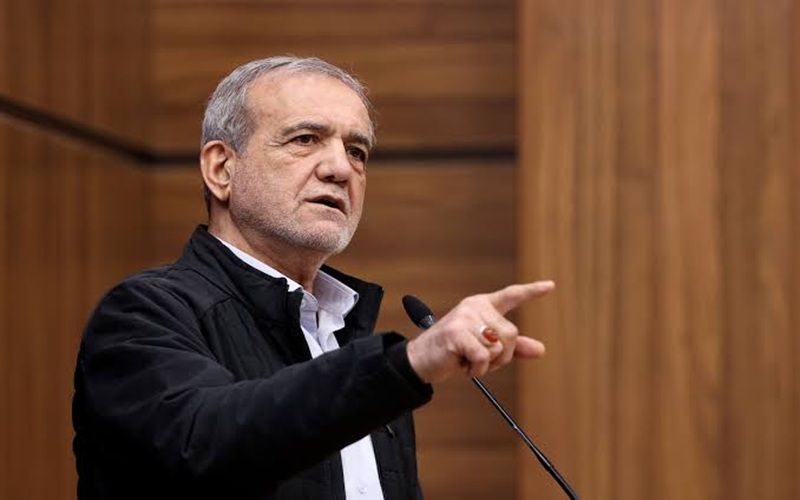
Speaking at a meeting on tax administration on November 15, 2026, Pezeshkian said:
“We want to identify those in need and provide them with greater assistance. Our goal is to identify needy people in society. To achieve this, we need accurate information and documented, verifiable data.”
His remarks, reported by several regime-affiliated media outlets, came despite the extensive economic and social statistics already published by Iran’s Statistical Center, covering inflation, unemployment, household expenditure, poverty, education, and other indicators of living conditions.
The contradiction is difficult to overlook. The authorities regularly publish figures documenting the deterioration of living standards, yet the president continues to speak about identifying the population in need rather than addressing the economic policies responsible for their impoverishment.
Housing costs expose the scale of economic hardship
A particularly revealing illustration appeared on the front page of the regime-affiliated Ruyesh-e Mellat newspaper on November 17, 2026, just two days after Pezeshkian’s remarks.
Its headline read:
“57 percent of Tehran residents’ income is spent on securing housing. Shelter remains at the top of household expenses.”
The figure illustrates the extraordinary pressure housing costs place on household budgets in the capital. When more than half of a family’s income goes toward securing shelter, little remains for food, healthcare, education, transportation, and other essential expenses.
For workers, employees, pensioners, and millions of renters, the housing crisis is not an abstract economic indicator. It determines whether families can maintain an adequate standard of living or are forced to cut back on other basic necessities.
The fact that this headline appeared in a regime-affiliated newspaper makes the contradiction with Pezeshkian’s remarks even more apparent. The economic hardship he says he wants to identify is already being documented in the regime’s own media.
Poverty is not an unknown phenomenon
The problem is not a shortage of statistics or the absence of information about vulnerable households. Iran’s Statistical Center publishes extensive economic and social data, while government-affiliated economists and researchers have repeatedly examined the country’s deteriorating living conditions.
Unemployment, inflation, declining purchasing power, rising housing costs, school dropout rates, child labor, and migration are all measurable indicators of the social consequences of the economic crisis.
Nor is a nationwide census necessary to establish that poverty has become widespread. Economists can assess deprivation through household expenditure surveys, income distribution, poverty thresholds, employment data, and other established indicators.
The more fundamental question is why a government that already possesses extensive statistical and administrative information continues to present the identification of poverty as a central challenge.
Pezeshkian is also familiar with the warnings issued by economists and social experts within the regime’s own institutional environment. Their assessments provide ample evidence of the consequences of years of economic mismanagement, corruption, and policies that have concentrated resources while leaving ordinary households increasingly exposed to financial hardship.
The daily reality behind the statistics
For millions of Iranians, the dimensions of poverty do not require another government investigation.
They are reflected in families struggling to pay rent, workers whose wages lose value under inflation, pensioners unable to cover basic expenses, and parents forced to make difficult decisions about their children’s food, education, and healthcare.
The protests and grievances of workers, teachers, and pensioners also provide a visible account of the economic pressures facing the population.
These are not isolated cases waiting to be discovered through a new identification program. They are the consequences of a nationwide economic and social crisis.
The central issue, therefore, is not whether the authorities can identify those living in poverty. It is whether they are prepared to confront the policies and institutional arrangements that keep producing poverty.
Treating the symptoms while preserving the causes
Pezeshkian’s remarks expose a fundamental contradiction in the regime’s approach to economic deprivation. Instead of placing responsibility on the structures that have contributed to the deterioration of living standards, the government presents poverty primarily as a problem of identifying eligible recipients for assistance.
Financial support for vulnerable households may provide temporary relief, but it cannot compensate for persistently declining purchasing power, inadequate wages, unaffordable housing, inflation, and the unequal distribution of national wealth.
The government’s own acknowledgment of widespread corruption, economic misconduct, and administrative failures further underscores the gap between identifying the consequences of the crisis and addressing its causes.
Pezeshkian is not an outsider confronting an inherited economic system over which he has no influence. He heads the executive branch responsible for implementing government policies and administering public resources. His administration is part of the political structure within which these economic conditions persist.
The question facing his government is therefore not how to discover the millions struggling to make ends meet. It is why, despite decades of official statistics, expert warnings, and visible social hardship, the same economic conditions continue to push more families into deprivation.
Poverty in Iran is not an undiscovered problem. It is the visible outcome of a governing system whose economic and political priorities have repeatedly failed to protect the livelihoods of the population.