


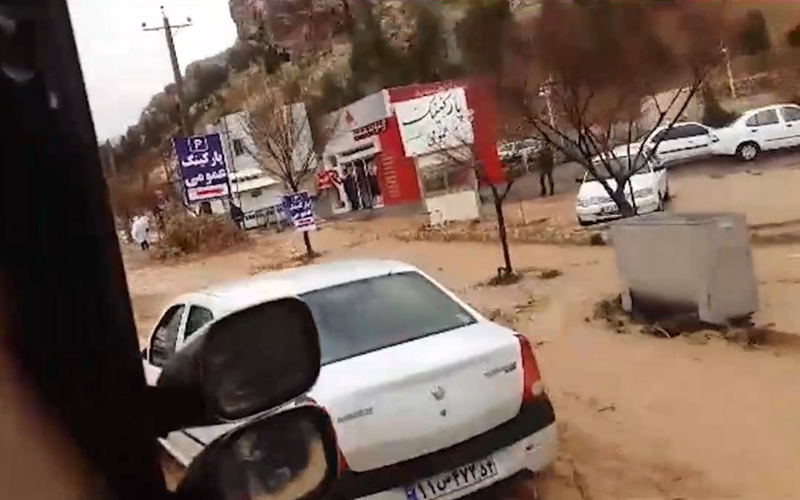

From the deadly 2019 Shiraz flood to the devastating inundation of Aq Qala, poorly designed infrastructure, abandoned flood-control projects, and construction linked to powerful government contractors have repeatedly turned rainfall into a deadly threat.
Every rainy season brings renewed danger to communities across Iran. Instead of replenishing water resources after years of drought, rainfall frequently turns into destructive floods, inundating streets, destroying homes, disrupting transportation, and claiming lives. From major cities such as Tehran, Mashhad, and Shiraz to smaller towns and rural communities, inadequate drainage systems and poorly planned infrastructure have repeatedly left people exposed to flooding.
Although floods are natural phenomena, the scale of their destruction is often determined by human decisions. In Iran, decades of inadequate planning, abandoned flood-control projects, construction in natural waterways, and infrastructure built without sufficient drainage capacity have contributed to disasters that could have been substantially mitigated.
The consequences are particularly evident in several major flood disasters that have exposed the weaknesses of the country’s infrastructure and the absence of effective accountability.
Shiraz’s 2019 flood: Construction over a natural waterway
The devastating flood at Shiraz’s Quran Gate during the Iranian New Year holidays in March 2019 remains one of the clearest examples of how infrastructure decisions can magnify natural hazards. More than 20 people died as torrents of water swept away vehicles, piled them against one another, and devastated the area.
Authorities initially presented the disaster as a natural event. However, subsequent examinations highlighted serious deficiencies in the area’s flood-management infrastructure.
According to the figures cited in technical assessments, between 17 and 24 millimeters of rain fell within just 14 minutes. The resulting water flow into the Quran Gate channel was estimated at approximately 70 cubic meters per second, while the channel’s capacity was only 20 cubic meters per second.
Yet the area had historically served as a natural flood passage. Instead of preserving and expanding this route, sections of the waterway were filled in and used for construction, including commercial developments. This reduced the space available for floodwater and increased the risk of destructive accumulation.
The failure to implement previously approved flood-control projects compounded the problem. In 1990, a plan was approved to construct a reservoir with a capacity of 50,000 cubic meters to control flooding in the area. It was never built. Subsequent proposals for two upstream flood-control dams also remained unimplemented.
Meanwhile, approximately 130 hectares of the Quran Gate watershed were reportedly converted into built-up areas and impermeable surfaces, preventing rainwater from naturally infiltrating the ground.
The contrast was stark: construction proceeded while essential flood-prevention infrastructure remained on paper. The 2019 disaster demonstrated the consequences of allowing development to take precedence over basic hydrological planning.
Aqqala: Roads and railways obstructed the flow of water
A similar pattern emerged during the devastating floods in Aqqala, Golestan Province, in 2019. The town and surrounding villages experienced extensive inundation, with floodwater remaining trapped across residential and agricultural areas.
One major factor identified in assessments of the disaster was the construction of a ring road and railway embankment that obstructed natural drainage routes. These elevated structures effectively acted as barriers, preventing water from flowing away from the affected areas.
The problem was reportedly compounded by inadequate culverts and water passages beneath the infrastructure. Properly designed crossings at multiple points could have allowed floodwater to pass through. Instead, insufficient drainage capacity contributed to the accumulation of water across the town and nearby villages.
The construction projects were attributed to contractors affiliated with the Islamic Revolutionary Guard Corps (IRGC). The criticism surrounding these projects focused on the consequences of inadequate engineering and cost-cutting in infrastructure intended to serve the public.
Emamzadeh Davoud: Failed flood-control structures
Another deadly example occurred in Emamzadeh Davoud, northwest of Tehran, where flooding in July 2022 killed 23 people.
Despite the area’s well-known exposure to flash floods, flood-control measures proved inadequate. Approximately 45 small check dams had reportedly been constructed upstream to reduce the force and volume of floodwater.
However, when the flood struck, many of these structures were destroyed in a chain reaction, with the resulting debris and water intensifying the destructive flow downstream.
The incident raised serious questions about the engineering, construction quality, and maintenance of flood-control infrastructure in vulnerable areas. Building protective structures is not enough; they must be designed to withstand the conditions they are intended to address.
Fragmented responsibilities leave flood management without accountability
Beyond individual engineering failures, Iran’s flood-management system suffers from fragmented institutional responsibilities. Several government bodies share responsibility for different aspects of flood prevention and emergency response:
- Meteorological Organization: Forecasting rainfall and issuing weather warnings.
- Ministry of Energy: Managing rivers, floodplains, dams, and water-control infrastructure through regional water companies.
- Ministry of Agriculture: Managing watersheds, vegetation, and soil conservation.
- Municipalities: Maintaining urban drainage networks, stormwater channels, and street-level infrastructure.
- Ministry of Roads and Urban Development: Designing and constructing road drainage systems, bridges, and transportation infrastructure.
- Provincial administrations and the National Disaster Management Organization: Coordinating emergency warnings, evacuations, and relief operations.
This division of responsibilities creates serious problems when coordination and accountability are absent. Failures in planning, construction, maintenance, and emergency response can overlap, while the institutions involved avoid taking responsibility for the resulting damage.
Effective flood management requires coordination across all these sectors, beginning long before rainfall occurs. Urban drainage, river management, watershed protection, and transportation infrastructure must be planned as interconnected systems rather than isolated projects.
The contrast with Iran’s own historical engineering is particularly striking. Persepolis, constructed more than 2,000 years ago, incorporated sophisticated underground drainage channels designed to carry away rainwater. Parts of this ancient drainage system can still function after maintenance and restoration.
Modern engineering offers far more advanced solutions, yet many Iranian cities continue to struggle with basic stormwater management.
International experience shows that flood damage can be reduced
No country can prevent every flood. Extreme rainfall and natural disasters cannot be eliminated entirely. However, international experience demonstrates that their destructive consequences can be significantly reduced through proper engineering, long-term planning, and effective public administration.
Japan has invested extensively in flood-control infrastructure and large-scale water-management systems. The Netherlands has adopted the principle of giving rivers more room to accommodate rising water levels rather than relying exclusively on barriers. Singapore has developed extensive urban drainage networks, while Copenhagen has redesigned public spaces, including parks, to temporarily store excess rainwater during extreme rainfall.
These approaches share a common principle: flood prevention must be incorporated into urban development and infrastructure planning from the outset.
Iran’s recurring disasters, by contrast, point to persistent weaknesses in planning, construction oversight, maintenance, and institutional coordination.
Corruption and the concentration of economic power undermine public safety
The broader problem extends beyond technical shortcomings. The concentration of economic power within institutions connected to the regime, particularly the IRGC and the office of Supreme Leader Ali Khamenei, has raised longstanding concerns about the influence of politically connected contractors and economic networks over public projects.
Experts inside Iran have acknowledged that just four major entities associated with the ruling establishment control more than 60 percent of the country’s economy. Such concentration of power makes transparency, independent oversight, and accountability particularly important in infrastructure development.
When construction contracts, public resources, and major economic projects operate within networks insulated from effective scrutiny, the quality and safety of infrastructure become public concerns. Roads, railways, dams, drainage systems, and flood-control projects are not merely commercial undertakings; their design and construction directly affect human lives.
The recurring floods across Iran demonstrate that rainfall alone does not explain the scale of the destruction. Natural hazards become deadly disasters when infrastructure is inadequate, preventive projects remain unfinished, and public institutions fail to coordinate their responsibilities.
For millions of Iranians, the arrival of the rainy season has become a source of anxiety rather than relief. Without transparent management, accountable institutions, and infrastructure designed around public safety, the same preventable failures will continue to expose communities to devastating consequences.