


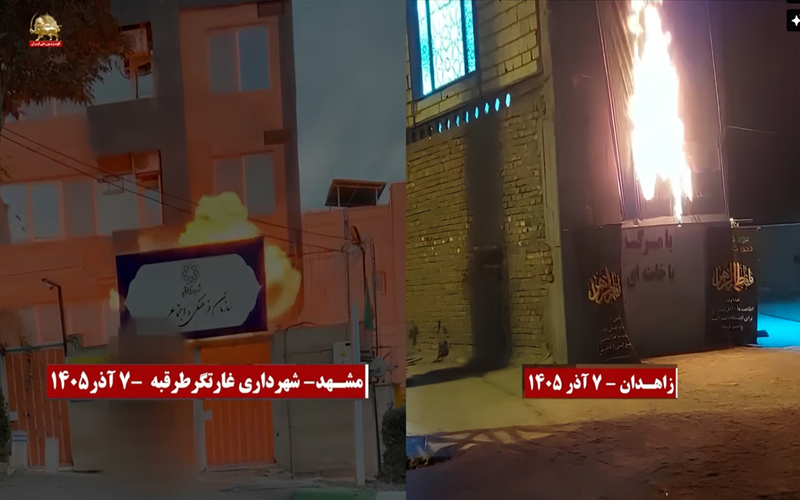

The third series of the “Clusters of People’s Wrath” campaign targeted IRGC and Basij installations, government symbols, and propaganda displays across several Iranian cities, highlighting public anger over crushing inflation and widening economic inequality.
The campaign highlights mounting public anger over the relentless increase in prices and the growing economic pressure on ordinary Iranians. While a small circle connected to the regime continues to enjoy privileges and access to wealth, millions of families face declining purchasing power and increasingly difficult living conditions.
The 15 operations took place in Mashhad, Ahvaz, Zahedan, Iranshahr, Khorramabad, Ilam, Chabahar, Isfahan, Gorgan, and Sirjan.
IRGC and Basij facilities targeted
Several operations directly targeted the regime’s security and repression infrastructure.
In Mashhad, explosions targeted an IRGC Basij district and the municipality of Torqabeh, described by the campaign as a center associated with plunder and corruption.
In Ahvaz, a Basij base belonging to the IRGC came under a shooting attack.
Other operations involved setting fire to Basij facilities using Molotov cocktails. These included:
- Zahedan: An IRGC Basij base.
- Iranshahr: Two reported attacks on IRGC Basij bases.
- Khorramabad: A Basij unit associated with student mobilization.
- Ilam: An IRGC Basij base.
- Chabahar: An IRGC Basij base.
The choice of targets reflects the campaign’s focus on institutions associated with the regime’s security apparatus and its domestic system of control.
Regime propaganda symbols set ablaze
Another component of the 15 operations targeted the regime’s propaganda displays and symbols.
In Isfahan, banners depicting Ruhollah Khomeini and Ali Khamenei, alongside images of those killed in the regime’s war, were set on fire. A separate operation also targeted a banner depicting Khomeini.
In Gorgan, a banner depicting Ali Khamenei was set ablaze.
In Zahedan, operations targeted banners depicting Khamenei, as well as displays featuring Khomeini, Khamenei, and Mojtaba Khamenei.
In Sirjan, a monument honoring Qassem Soleimani, the former commander of the IRGC Quds Force, was set on fire.
These actions directly challenged the regime’s efforts to maintain its ideological presence in public spaces through portraits, banners, and monuments.
“Every Iranian a rebel”
The campaign also carried a political message attributed to Massoud Rajavi, who contrasted the regime’s call for universal mobilization with a different vision of popular resistance.
Responding to the newly installed supreme leader’s statement that every Iranian should become a Basij member, Rajavi declared:
“Every Iranian a rebel.”
The slogan underscores the campaign’s rejection of the regime’s attempt to mobilize society behind its security apparatus. It presents resistance, rather than submission to state-directed mobilization, as the response to repression, economic hardship, and political exclusion.
Economic hardship fuels public anger
The campaign’s central theme is the unbearable rise in living costs and the widening economic divide in Iran.
Inflation and uncontrolled price increases have placed enormous pressure on households, particularly wage earners, pensioners, and low-income families. The growing gap between the population’s declining living standards and the privileges enjoyed by regime-connected institutions has further intensified public resentment.
By linking its operations to economic grievances, the Resistance Units are highlighting the connection between the regime’s political and security structures and the deteriorating living conditions of ordinary Iranians.
The 15 operations form the third installment of the Clusters of People’s Anger campaign, following earlier activities directed against repression centers and the regime’s efforts to suppress public dissent.
Together, these activities convey a message of defiance: despite censorship, security measures, and threats of punishment, organized resistance continues to challenge the regime’s authority and its symbols across Iran.