
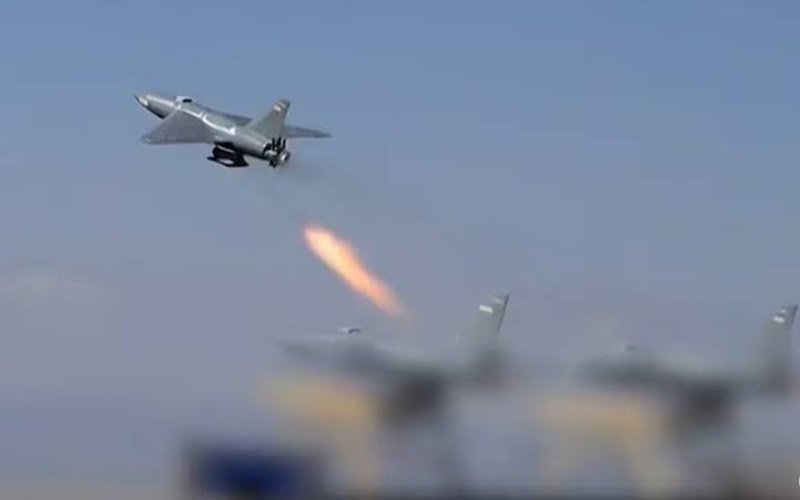

While Tehran continues issuing military threats against regional countries and Western governments, its denial of responsibility for the deadly drone attack in Kuwait exposes a regime increasingly constrained by the consequences of its actions and preoccupied with the threat of popular revolt.
The denial came as Kuwait summoned the Iranian regime’s ambassador to protest the attack. Rather than accepting Tehran’s explanation, regional and international governments have expressed condemnation and concern over the incident. European officials, Arab governments, and Gulf states have taken positions against the attack, reflecting a more pronounced willingness to confront Tehran over its regional conduct.
The contradiction is significant. A regime that has built much of its wartime posture around projecting defiance and demonstrating its willingness to cross military boundaries is now attempting to distance itself from an operation carrying potentially serious diplomatic and strategic consequences.
This is not simply a question of diplomatic messaging. It reflects a regime facing mounting constraints and increasingly concerned about the costs of further escalation.
Military bravado conceals strategic weakness
For years, the Iranian regime has relied on threats, military intimidation, and regional destabilization as instruments of power projection. Its strategy has often involved responding to pressure by expanding the confrontation and directing attacks toward neighboring countries.
Yet the current situation reveals the limits of this approach.
Having suffered significant military setbacks, the regime is operating under conditions of diminished capabilities and weakened command structures. The loss of key commanders and personnel, together with the death of Ali Khamenei, has further complicated its ability to project strength.
Against this background, Tehran’s increasingly aggressive rhetoric appears less like evidence of confidence than an effort to compensate for strategic weakness.
The contrast between its threats and its denial over Kuwait is particularly revealing. When the regime seeks to intimidate its adversaries, it presents itself as capable of striking anywhere. But when an attack provokes international condemnation and threatens to produce diplomatic consequences, it distances itself from responsibility.
The explanations coming from different regime figures have also lacked consistency. Some have denied involvement, others have suggested a false-flag operation, while military spokespeople have argued that Tehran would not have carried out such an attack because it did not want to trigger another confrontation.
Such contradictory messaging suggests an establishment struggling to balance its desire to project power with its fear of the consequences.
International isolation is narrowing Tehran’s room for maneuver
The response to the Kuwait incident comes amid growing international pressure on the Iranian regime.
In Germany, proceedings and investigations involving regime-linked terrorism have kept the issue of Tehran’s activities in Europe under scrutiny. Australia and Britain have taken sanctions-related measures against individuals connected to the regime. France has also faced renewed concerns over regime-linked activities, followed by reports of similar security concerns in Belgium.
These developments add to Tehran’s diplomatic isolation and reinforce the perception that its regional and international conduct carries increasingly serious costs.
The Kuwait incident is particularly important because it has prompted reactions from countries that have often preferred caution when dealing with Tehran. Governments have frequently sought to avoid direct confrontation, called for further investigations, or limited their responses.
The stronger reaction to this attack indicates that the regime’s ability to exploit international reluctance is not unlimited.
Nevertheless, international pressure is only one part of the problem facing the ruling establishment. Its deeper vulnerability lies inside Iran.
The regime’s real fear is another uprising
The central threat confronting Tehran is not simply the prospect of renewed international confrontation. It is the possibility that military pressure, economic deterioration, and growing public anger could combine to trigger another nationwide uprising.
Iran’s economic crisis is already placing enormous pressure on households. Soaring prices, the depreciation of the national currency, declining purchasing power, and widening inequality have intensified popular discontent.
These conditions create the potential for economic grievances to develop into broader political protests, particularly when combined with the regime’s weakened military and political position.
The ruling establishment understands this danger. Its recent messaging and security priorities increasingly reveal an overriding concern with preventing domestic unrest.
Even the messages attributed to Mojtaba Khamenei have emphasized the continuation of nightly Basij gatherings and activities intended to maintain the regime’s presence in public spaces and counter the possibility of protests.
This emphasis is revealing. At a time when regime officials are making sweeping military threats, the practical instructions directed at their own forces focus heavily on domestic mobilization and controlling the streets.
The contradiction between external bravado and internal defensive preparations points to the regime’s central strategic concern: preventing the Iranian population from turning its grievances into an organized challenge to its rule.
Distraction campaigns cannot eliminate the organized opposition
Another indication of this concern is the regime’s renewed effort to redirect attention away from the organized opposition.
For a period, Tehran sought to portray the external war as the defining confrontation, pushing the question of domestic resistance into the background. It also promoted alternative political projects and monarchist currents as distractions from the organized democratic opposition.
These efforts served a political purpose: fragmenting the opposition, creating confusion about the country’s democratic future, and diverting attention from the Resistance Units and the People’s Mojahedin Organization of Iran (PMOI/MEK).
But the regime’s own media and security officials have repeatedly returned to warnings about the opposition’s activities.
Tasnim, an outlet affiliated with the Islamic Revolutionary Guard Corps (IRGC), has recently published material focusing on the history and activities of the PMOI. Ramadan Sharif, an IRGC spokesman, has also warned about the organization’s influence and its ability to shape developments inside Iran.
Such repeated warnings are difficult to reconcile with the regime’s attempts to portray the organized opposition as politically irrelevant.
The renewed focus on these subjects suggests that Tehran remains concerned about the possibility that organized resistance could connect with wider public discontent and help turn isolated protests into a sustained challenge to the ruling establishment.
A regime running out of options
The Iranian regime’s contradictory response to the Kuwait attack reflects a broader strategic predicament.
Its external threats are increasingly difficult to translate into effective power projection. Its economic resources are under severe pressure, its military capabilities have suffered major setbacks, and its international isolation has deepened.
At the same time, its traditional instruments of domestic control are facing growing challenges. Repression, propaganda, psychological operations, and attempts to manufacture alternative political narratives have not eliminated the underlying causes of public opposition.
The regime’s overriding priority remains the preservation of its rule. This explains why its public rhetoric can be so aggressive while its practical behavior is increasingly cautious when the consequences threaten its survival.
The Kuwait episode offers a revealing example: a government that seeks to demonstrate its willingness to escalate regional conflicts but retreats into denial when confronted with the diplomatic costs.
Ultimately, the regime’s most consequential confrontation is not with foreign governments. It is with the Iranian people and the organized resistance challenging its rule.
As economic hardship deepens and the regime’s political and military weaknesses become more visible, the possibility of renewed popular uprising remains its greatest source of insecurity.
A ruling establishment that has exhausted much of its military, economic, and political leverage may find it increasingly difficult to contain such a challenge. Its apparent lack of strategic options could make a future crisis far more difficult to manage than previous ones.