


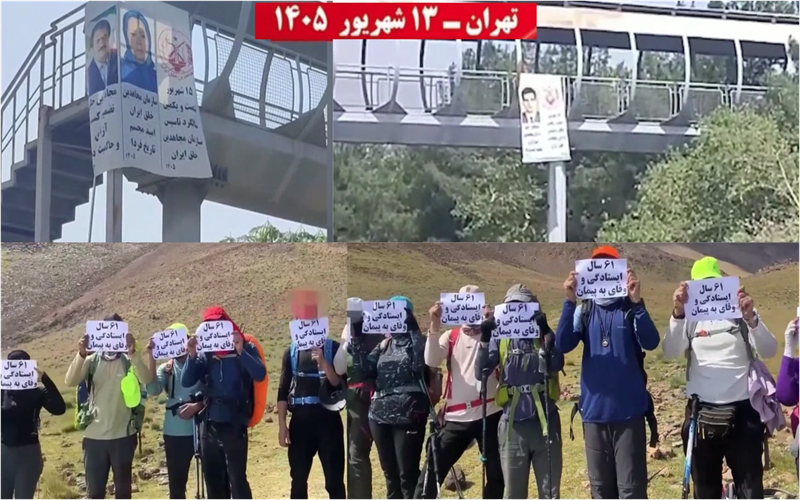

Resistance Units marked the 61st anniversary of the PMOI’s founding with 150 reported activities across dozens of Iranian cities, highlighting resistance, rejection of both monarchy and clerical rule, and calls for a democratic republic.
Resistance Units of the People’s Mojahedin Organization of Iran (PMOI/MEK) carried out 150 reported activities across Iran to mark the 61st anniversary of the organization’s founding, according to material released by the Iranian Resistance.
The reported actions included collective activities, banners and emblems displayed in public locations, images of the organization’s founders, mountain-climbing actions, flower tributes, and graffiti in numerous cities. The activities were reported in Tehran, Tabriz, Urmia, Mashhad, Karaj, Isfahan, Shiraz, Qom, Ahvaz, Sari, Kermanshah, Kerman, Hamadan, Arak, Khorramabad, Sanandaj, Zabol, Kashan, Saveh, Iranshahr, Marvdasht, Qaemshahr, Behshahr, Fasa, Malayer, Baneh, Shirvan, Tabas, and other locations.
The actions focused on the PMOI’s six decades of political struggle and its stated opposition to both the former monarchy and the current clerical regime.
“61 Years of Resistance and Perseverance”
A recurring message throughout the reported activities was the commemoration of 61 years of what participants described as uninterrupted resistance.
Among the slogans displayed were: “61 years of perseverance, 61 years of sacrifice, 61 years of saying no to Shah and no to Mullah.”
Another message described the PMOI as a movement founded on principles of opposition to dictatorship, foreign domination, and exploitation, while emphasizing the sacrifices of those killed during the organization’s history.
In Tehran, Resistance Units reportedly installed PMOI symbols and images of Mohammad Hanifnejad, one of the organization’s founders, on bridges and other prominent locations. Images of Hanifnejad, Saeed Mohsen, and Asghar Badizadegan were displayed with messages honoring them as early examples of sacrifice, honesty, and perseverance.
One of the messages declared: “The great achievement of the organization’s founders was establishing an organization founded on truthfulness and sacrifice.”
Rejecting Both Monarchy and Clerical Rule
The rejection of both political systems was among the most prominent themes of the anniversary activities.
Messages repeatedly declared: “61 years of saying no to Shah and no to Mullah.”
Other slogans called for “neither monarchy nor supreme leadership, but democracy and equality,” while several actions promoted the establishment of “a democratic republic free of Mullah and Shah.”
In Qom, one reported banner stated:
“Our goal is not to seize power, but to transfer it to the people of Iran.”
Another message referred to Maryam Rajavi’s proposed Ten-Point Plan as a framework for what participants described as a free Iran of the future.
Actions Across Major Iranian Cities
In Tehran, the reported activities included the installation of PMOI emblems on bridges, banners featuring Maryam Rajavi, collective actions by mountain climbers, and displays of statements attributed to the organization’s leaders.
One slogan described the PMOI as “the living embodiment of tomorrow’s history,” while another called it “a stronghold of freedom for Iran.”
In Shiraz, Resistance Units reportedly carried out several collective actions emphasizing “61 years of resistance and boundless sacrifice.” Other messages described the PMOI as a guarantor of freedom and democracy.
Kermanshah saw displays of the founders’ images and messages marking “61 years of resistance against Shah and Mullah.” In Mashhad, Karaj, Isfahan, Ahvaz, Sanandaj, Kashan, and other cities, similar collective activities and displays were reported.
In Zabol, a reported action combined the anniversary message with slogans against former Supreme Leader Ali Khamenei and in support of Resistance Units.
Graffiti was also reportedly carried out in multiple cities, extending the anniversary campaign beyond organized displays and into public spaces.
A Message of Continuity and Political Change
Across the reported actions, the Resistance Units portrayed the PMOI’s 61-year history as a continuing struggle rather than a historical commemoration alone.
Messages attributed to Maryam Rajavi emphasized the role of the PMOI in guiding younger generations involved in protests, while statements attributed to Massoud Rajavi portrayed the organization as committed to the overthrow of the clerical regime and the establishment of popular sovereignty.
One recurring message stated:
“The Mojahedin in the contemporary history of this homeland are the guarantee of the overthrow of the anti-human regime.”
Another declared:
“The democratic revolution of the Iranian people will put an end to the religious dictatorship.”
The breadth of the reported activities—from Tehran and major provincial centers to smaller cities—was presented as evidence of continued activity by Resistance Units inside Iran.
The anniversary campaign ultimately centered on three interconnected themes: continuity of resistance, rejection of both monarchy and clerical dictatorship, and the pursuit of a democratic republic based on popular sovereignty.