
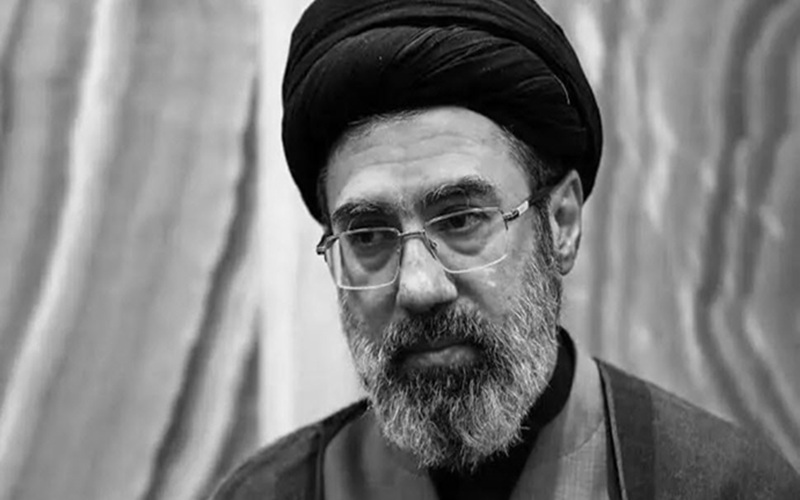

A striking contradiction between Mojtaba Khamenei’s call to suppress reports of the regime’s failures and Masoud Pezeshkian’s warning that society is “on the edge” exposes both the depth of internal divisions and the ruling establishment’s fear of another uprising.
A revealing contradiction has emerged at the highest levels of Iran’s ruling establishment. The regime’s supreme leader Mojtaba Khamenei has called for the regime’s weaknesses and failures to be concealed, while President Masoud Pezeshkian has publicly warned that the Iranian people are already “on the edge” and that another shock could push them over it.
The contradiction is more than a dispute over messaging. It exposes two fundamental realities confronting the regime: deepening divisions at the top and a shared fear that mounting social and economic pressure could trigger another nationwide uprising.
“Do Not Highlight Our Weaknesses”
In a televised message on August 28, Mojtaba Khamenei warned against openly discussing the regime’s shortcomings.
He argued that weaknesses and deficiencies should not be “narrated” or highlighted, claiming that doing so while the regime faces external pressure could strengthen its enemies and discourage its supporters.
The message amounts to a call for tighter control over the public presentation of the regime’s failures. Rather than allowing the depth of the crises to be openly discussed, the emphasis is on suppressing information and maintaining morale.
But almost immediately, Pezeshkian presented a starkly different picture.
Speaking on regime television on the same day, he acknowledged that the country’s economic situation is becoming increasingly difficult. He pointed to problems with imports, declining revenues, and the regime’s inability to secure sufficient fuel.
Most significantly, he warned: “People are now on the edge. If I put another pressure on them, they may fall off the edge.”
The statement was an unusually direct acknowledgment that the government itself recognizes the explosive potential of the current situation.
Two Narratives, One Deepening Crisis
The contradiction between these statements reveals a central dilemma for the regime.
One approach is to conceal the extent of the crisis, restrict discussion of failures, maintain a wartime atmosphere, and rely on repression to prevent popular mobilization.
The other recognizes that the social situation has become so fragile that additional pressure could trigger a much broader explosion.
The dispute is therefore not simply about whether the regime should tell the truth. Neither side represents a commitment to transparency. Both have extensive records of censorship and manipulation.
The disagreement concerns how best to preserve the ruling system.
This conflict has increasingly become visible in statements by officials and political figures associated with different power centers. Government spokespersons have even acknowledged that certain poverty statistics should not be publicly discussed, illustrating how sensitive the authorities have become to information that could expose the depth of the economic crisis.
At the same time, officials cannot completely conceal the consequences of that crisis. Prices, shortages, unemployment, power outages, inflation, and declining living standards are experienced directly by millions of people every day.
The “Unity” Narrative Masks Fear
The repeated calls for unity from different factions of the regime also reveal an important contradiction.
If the ruling establishment were confident in its position, it would have little reason to repeatedly warn its own factions against internal disputes. Yet the calls for unity have coincided with increasingly public clashes between political camps.
Arguments over economic policy, negotiations, repression, and the handling of social discontent have become increasingly sharp.
Even seemingly mundane issues have become political ammunition. In one exchange, a government critic confronted Pezeshkian with the sarcastic question, “Is the [strait] your father’s inheritance?” Other officials have been drawn into disputes over the price of basic necessities, including diapers, whose prices have reportedly soared dramatically.
These confrontations reveal how economic grievances are becoming inseparable from the regime’s political infighting.
Both Camps Fear the People
Despite their differences, the rival factions share one fundamental concern: they fear the Iranian people.
The dispute is primarily over how to prevent popular anger from becoming a sustained uprising.
The more hardline current favors maintaining a climate of confrontation and repression, including executions and security measures, as a means of controlling society.
The rival camp argues that excessive repression can have the opposite effect, intensifying public anger and accelerating an eventual explosion. From this perspective, reducing tensions and pursuing agreements is a means of lowering the pressure inside society.
Neither approach addresses the underlying causes of the crisis.
The economic collapse, poverty, corruption, environmental destruction, failing public services, political repression, and absence of basic freedoms are products of decades of governance under the clerical regime. No change in public relations strategy can erase those realities.
A Crisis That Cannot Be Hidden
The regime can censor statistics, restrict media coverage, and order officials to avoid discussing certain failures. But it cannot censor what people experience every day.
A family that cannot afford food does not need a government report to tell it that inflation is devastating its livelihood. A worker facing unemployment does not need official statistics to understand the economic crisis. A retiree unable to pay for medicine does not need a television program to explain the collapse of social protection.
In the age of widespread access to information, attempts to conceal reality also face practical limits. Citizens communicate through social media, messaging platforms, personal networks, and increasingly through direct street protests.
This is why the contradiction between Mojtaba Khamenei’s call for silence and Pezeshkian’s warning about society being “on the edge” is so significant.
The regime’s factions may disagree over whether to conceal the crisis or selectively acknowledge it, and over whether repression or de-escalation offers the better survival strategy. But beneath those differences lies a shared recognition: the pressure inside Iranian society has reached a dangerous level.
As the regime’s internal conflicts intensify, the question is not whether the crises exist. The people already know that they do.
The question is how long the ruling establishment can contain the accumulated anger before its political divisions, economic failures, and popular resistance converge into a challenge it can no longer control.