


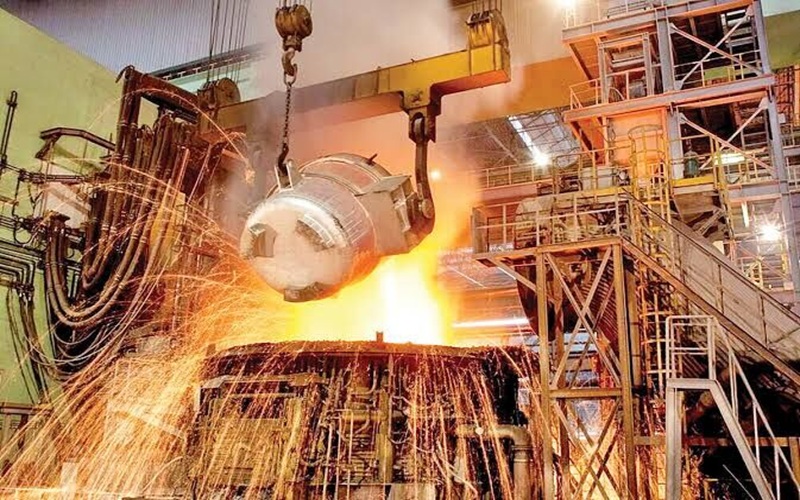

War-inflicted losses, water scarcity, and economic constraints expose deep vulnerabilities in Iran regime’s industrial backbone
In the aftermath of the 40-day war involving the United States, Israel, and the Iranian regime, emerging reports indicate that key segments of Iran’s steel industry have sustained extensive damage. Major complexes, including Khuzestan Steel Company and Mobarakeh Steel Company in Isfahan, are said to require substantial reconstruction and infrastructure modernization.
The Iran regime’s Minister of Economic Affairs and Finance has stated that rebuilding damaged industries—particularly steel—will be guided by criteria such as water consumption. For many analysts, this signals a reduced likelihood that major facilities like Mobarakeh Steel will be reconstructed in their current locations in Iran’s central plateau, a region long plagued by severe water shortages.
Experts in energy and environmental policy have repeatedly warned that, given land-use constraints and the water-intensive nature of steel production, maintaining such industries in central Iran is no longer viable. Instead, they argue for a gradual relocation of steel production to coastal regions along the Persian Gulf and the Sea of Oman. Supporting this view, Iran’s Planning and Budget Organization has indicated that future development of steel industries must align with regional climatic conditions and available water resources.
Despite these considerations, some analysts argue that influential networks within the steel sector—often referred to as the “steel mafia”—continue to exert decisive influence over strategic decisions, potentially obstructing relocation efforts. At the same time, international sanctions and financial constraints cast serious doubt over the feasibility of rapid reconstruction. Some experts suggest that even under optimal conditions, full recovery of the sector may take more than a decade.
According to available reports, the damage inflicted on steel facilities in Khuzestan and Isfahan provinces has significantly reduced production capacity. Initial estimates—considered optimistic by some analysts—indicate that at least 10 million tons of annual steel production capacity has been taken offline. This represents roughly 25 to 30 percent of Iran’s total steel output, which previously stood at approximately 31.9 million tons per year, making it one of the Iran regime’s key industrial drivers.
The sudden contraction in capacity is expected to trigger cascading effects across the broader economy. Disruptions at major producers such as Khuzestan Steel and Mobarakeh Steel are likely to impact downstream industries, including construction, automotive manufacturing, and energy infrastructure. As a result, supply chains across multiple sectors may face significant disruptions in the coming months.
From a macroeconomic perspective, analysts warn that reduced steel production and exports will place additional strain on the Iran regime’s foreign currency reserves. Under extensive international sanctions, steel exports have served as one of the few relatively stable sources of foreign exchange.
A decline in export capacity could weaken the non-oil trade balance, intensify pressure on the currency market, and limit the ability to import intermediate and capital goods. This, in turn, would further slow industrial growth and deepen economic stagnation.
The implications extend beyond production and trade. Iran’s capital market and household welfare are also exposed to the fallout. A significant portion of public assets, including shares distributed under the “Justice Shares” program, are concentrated in major steel companies. Reduced profitability in these firms is likely to depress stock values and diminish investment returns for millions of shareholders.
At the production level, reduced steel supply is expected to increase input costs for industrial manufacturers, driving up prices of final goods such as automobiles, home appliances, and housing. This dynamic, coupled with heightened economic uncertainty, may encourage hoarding behavior within supply chains and place additional pressure on small and medium-sized enterprises. The result is a classic case of cost-push inflation within an already fragile economy.
Labor markets are also at risk. Estimates suggest that more than 50,000 individuals are directly employed in Iran’s steel industry, with millions more dependent on it indirectly. However, recent reports indicate that over half of economic enterprises have considered workforce reductions in the past month alone—an alarming trend that could lead to rising unemployment and increased social pressures.
Ultimately, the crisis unfolding in Iran’s steel sector is not merely an isolated industrial disruption. It reflects deeper structural vulnerabilities within the Iran regime’s economy—vulnerabilities that are increasingly exposed under the combined weight of war, sanctions, chronic inflation, and systemic mismanagement. Together, these factors cast significant doubt over the prospects for recovery and a return to economic stability in the near future.