


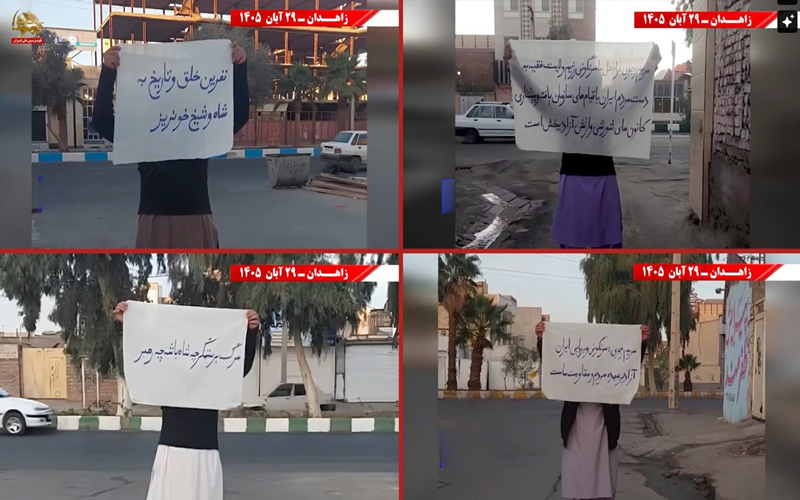

In their latest activities on November 20, rebellious youth in Zahedan highlighted statements by Massoud and Maryam Rajavi, backed political prisoners and human rights defender Mohammad Javad Vafaei Sani, condemned executions, and called for organized resistance to overthrow the clerical dictatorship.
November 20, 2026 | Zahedan, Iran
Rebellious youth in Zahedan used their latest campaign of political activities to reaffirm the need for organized resistance and a nationwide uprising to overthrow Iran’s ruling theocracy. Their messages highlighted statements by Massoud and Maryam Rajavi on the prospects for another uprising, the role of Resistance Units, support for political prisoners, and the establishment of a democratic republic.
The campaign also expressed support for Mohammad Javad Vafaei Sani, the Iranian political prisoner and boxing champion who received the 2026 Magnitsky Human Rights Award. It condemned the regime’s escalating use of executions against political prisoners and protesters and stressed that Iran’s future must be free of both religious and monarchical dictatorship.
Massoud Rajavi: The overthrow of the regime is inevitable
Messages reflecting Massoud Rajavi’s statements emphasized the determination of rebellious youth to prepare for successive uprisings and ultimately overthrow the clerical establishment.
One message declared that those rising against the regime would mobilize with complete determination for further uprisings and the eventual overthrow of the ruling system. Another stated that the regime’s downfall was inevitable.
Other messages stressed that the ruling establishment responds only to firmness and strength, rejecting the notion that gradual economic deterioration and mounting living costs could indefinitely prevent popular revolt.
A central theme was the rejection of dictatorship in all its forms. The slogans called on Iranians to consign the current clerical establishment to history just as they rejected the former monarchy.
The campaign explicitly rejected slogans associated with both the Pahlavi monarchy and the Islamic Republic, including “Long Live the Shah” and “Khamenei is the Leader.” Its message was that neither royal rule nor clerical rule offers a democratic future for Iran.
Maryam Rajavi: Organized resistance is the path to freedom
Statements by Maryam Rajavi placed particular emphasis on the responsibility of the Iranian people and their organized resistance to bring about political change.
She stressed that the clerical regime would not be overthrown through foreign bombing or war, nor through foreign propaganda, fabricated news, and manipulated videos. Instead, the responsibility for overthrowing the regime and establishing a free Iran rests with the Iranian people and their resistance movement.
Her messages highlighted the role of organized uprisings, Resistance Units, and the Liberation Army in confronting the ruling establishment.
Another message argued that the mobilizing force of society is far stronger than the regime’s machinery of repression. It also warned that the regime’s continued diversion of national resources toward preserving its rule has left resistance and protest as the necessary response.
The campaign conveyed her assessment that conditions for another major uprising are more favorable than ever and that the Iranian people remain determined to achieve freedom and democracy.
Support for political prisoners and condemnation of executions
The Zahedan activities also highlighted the international recognition awarded to Mohammad Javad Vafaei Sani, presenting it as a message of solidarity with political prisoners throughout Iran.
Maryam Rajavi’s message described the Magnitsky Human Rights Award as support not only for Vafaei Sani but for all political prisoners.
The campaign directly addressed the regime’s execution policy, holding Supreme Leader Ali Khamenei responsible for the escalating executions, particularly those targeting PMOI members and rebellious youth.
These messages came amid continuing concerns over the use of capital punishment to intimidate society, silence political opposition, and prevent the emergence of another nationwide uprising.
Opposition to surveillance and repression in schools
Another issue raised in the campaign was the regime’s reported plans to install surveillance cameras in classrooms.
Maryam Rajavi’s statement characterized this measure as evidence of the authorities’ fear of students and their potential role in future uprisings. The message highlighted the regime’s determination to extend its security apparatus into educational institutions, reflecting its concern about political awareness and dissent among younger generations.
The activities also criticized the diversion and plundering of Iran’s national wealth. Rather than serving the needs of the population, the country’s resources are being spent on maintaining the ruling system, domestic repression, controversial nuclear projects, and warmongering.
Zahedan slogans: Neither Shah nor Mullah
The clearest message of the campaign emerged through the slogans displayed by rebellious youth. They rejected the idea that Iran must choose between two forms of authoritarian rule and instead demanded democracy, equality, and a republic.
Among the slogans were:
- “Death to the oppressor, be it the Shah or the Supreme Leader!”
- “From Zahedan to Tehran, death to the oppressor, be it the Shah or the Supreme Leader!”
- “Monarchy and the Supreme Leader’s rule: a hundred years of crimes!”
- “Dictatorship is dictatorship, whether it wears a turban or a crown!”
- “Neither monarchy nor supreme leadership: democracy and equality!”
- “Neither Mullah nor Shah: freedom and a democratic republic!”
Another slogan declared: “The people and history curse the bloodthirsty Shah and Mullah.”
The repetition of these messages in Zahedan underscores the campaign’s insistence that Iran’s democratic future cannot be built by restoring the monarchy or preserving the existing clerical system.
A democratic republic, not another dictatorship
The latest activities in Zahedan brought together three central themes of the resistance campaign: solidarity with political prisoners, the rejection of executions and repression, and the need for organized popular action to overthrow the regime.
They also reinforced a political distinction that runs through the movement’s messaging: opposition to the clerical dictatorship does not mean support for a return to monarchical rule. The objective is a democratic republic based on popular sovereignty, equality, and political freedoms.
By highlighting the role of Resistance Units and the prospect of another uprising, the young activists in Zahedan presented their campaign as part of a continuing struggle for fundamental political change.
Their central message was unequivocal: Iran’s future belongs neither to a Shah nor to a Mullah, but to its people.