


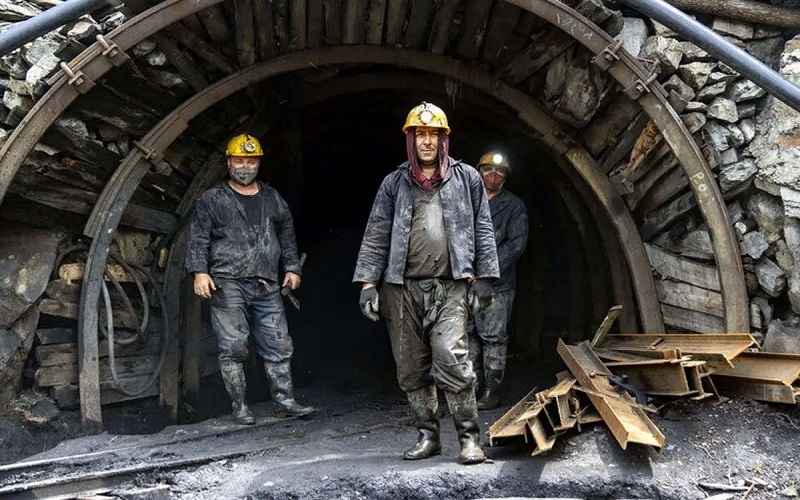

Iran’s mining sector faces a dire safety crisis, with traditional and unsafe practices putting workers’ lives at constant risk. Ahmad Meydari, Minister of Cooperatives, Labour, and Social Welfare, recently revealed alarming statistics: of the country’s 101 mines, 100 operate with traditional methods, lacking modern safety measures. “The lives of workers in these mines are in danger,” Meydari said, highlighting the absence of proper standards and safety protocols, particularly in 62 coal mines. The Ministry has formally requested the judicial system to shut down seven unsafe mines.
Lax Standards and Faulty Equipment
Meydari admitted on November 22 that nearly all mining equipment imported into Iran lacks essential safety certifications. “We have yet to define proper standards for mining equipment and machinery,” he stated, identifying locomotives, life-saving devices, and non-standard sensors as primary culprits behind mining accidents.
The absence of rigorous safety regulations has led to an increase in fatal incidents in Iranian mines. Meydari’s revelations reflect a broader systemic neglect that has cost lives and continues to jeopardize worker safety.
Recent Mining Disasters
Iran’s mining industry has seen a disturbing rise in fatal accidents in recent years. On November 14, the collapse of the Kalat coal mine in the Cheshmesaran area of Golestan Province resulted in one death and two injuries. This tragedy came shortly after a catastrophic explosion at a coal mine in Tabas on September 21, which claimed 53 lives and left many hospitalized in nearby cities, including Birjand, Mashhad, and Yazd.
The Tabas explosion has sparked renewed scrutiny. Mohammad Reza Bahraman, head of Iran’s Mining House, announced on October 22 that unsafe coal mines would be shut down for three months to facilitate mechanization. However, Bahraman warned of logistical challenges in closing coal mines, which require continuous drainage of water and gas.
A Legacy of Neglect
Iran’s mining sector has a grim history of deadly accidents. The deadliest recent disaster occurred in April 2017 at the Yurt Azadshahr coal mine in Golestan Province, where a methane gas explosion claimed 43 workers’ lives.
Despite these recurring tragedies, mechanization remains elusive. Bahraman highlighted that only one out of 200 mines in the country is mechanized, underscoring the lack of investment in modernizing facilities. “Development in the mining sector cannot be achieved without addressing safety and environmental concerns,” he stressed.
Growth Amidst Crisis
Paradoxically, Iran’s mining sector has expanded in recent years. According to the Iranian Statistics Center, the number of operational mines rose to 6,250 in 2021, a 2.4% increase from the previous year. Employment in the sector also grew, with 130,358 workers recorded in 2021—a 3.8% rise compared to 2020.
However, this growth has not translated into improved safety or working conditions. Instead, the expansion of the sector has exacerbated risks, with traditional practices persisting alongside the absence of regulatory oversight.
Urgent Need for Reform
The tragic stories from Iran’s mines highlight an urgent need for systemic reform. Modernizing equipment, enforcing safety standards, and investing in worker training must become national priorities. Without these measures, Iran’s mining sector will continue to endanger lives while failing to reach its full potential.
As the Iranian regime grapples with this crisis, the question remains: will the government prioritize the safety and well-being of its workers, or will mining tragedies persist as an enduring stain on the country’s labor landscape?