



Runaway inflation, food shortages, and collapsing purchasing power expose a regime that has lost all control over Iran’s economy—and its society.
An Economy in Freefall, a Regime Without Answers
Iran’s deteriorating economic conditions have moved beyond hardship and entered the realm of systemic collapse. Rapidly rising inflation, severe pressure on household livelihoods, and uncontrollable price volatility have produced a nationwide crisis—one that has intensified dramatically over the past two years and convinced large segments of society that economic governance has completely slipped out of the regime’s control.
The continuous rise in living costs, combined with the regime’s total failure to curb inflation, has pushed the economy to a point where even insiders within the regime now concede that short-term fixes and temporary shocks can no longer stabilize the system. What Iran is facing is not a cyclical downturn, but the implosion of a model built on corruption, rent-seeking, and authoritarian mismanagement.
Food Insecurity on a Scale Unseen Even in Wartime
The regime’s economic collapse is most visible at the dinner table. Cooking oil shortages, sudden spikes in chicken and egg prices, astronomical meat and dairy costs, and public outrage over the price of rice—so extreme that state-affiliated media have suggested barley as a substitute—have turned basic nutrition into a daily struggle.
Economic analysts note that even during the Iran–Iraq war of the 1980s, food insecurity never reached this level of severity or breadth. Today, millions of households face the erosion of food security while the regime continues to issue hollow reassurances.
Unpredictable and rapid price changes have eliminated even the possibility of basic household planning. Families now live in a permanent state of economic emergency, unsure whether they can afford essential goods from one week to the next.
From Market Protests to Open Rejection of the Regime
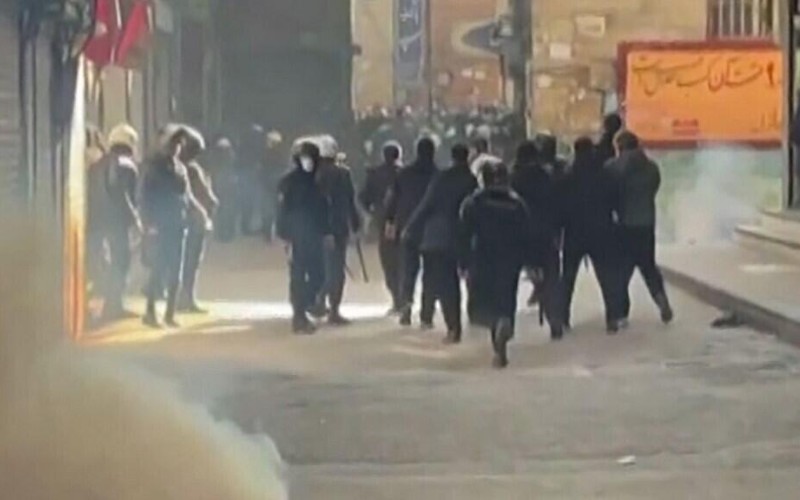
This suffocating pressure has pushed even traditionally conservative social groups—particularly bazaar merchants—back into the streets, recalling the mass protests of November 2019. Market closures and strikes, once unthinkable without elite backing, have reemerged as signs of a society pushed beyond endurance.
What began as protests against daily—and sometimes hourly—price changes quickly spread across social layers. The message became unmistakable: this is no longer about inflation alone. The economic crisis has crossed the threshold from social discontent into a demand for regime change.
Corruption as the Core of the Crisis
While regime officials routinely blame sanctions, this narrative collapses under scrutiny. Sanctions may intensify pressure, but they are not the root cause of Iran’s economic disaster. The primary drivers are institutionalized corruption, rent distribution, and structural incompetence embedded in the regime’s economic decision-making.
Iran’s economy is dominated by a web of intermediaries, monopolies, regime-linked importers, security institutions, and state–private hybrids that profit directly from chaos. With the backing—overt and covert—of powerful political and security organs, this corruption network exercises near-total influence over prices and supply chains.
In simple terms, the public has reached a clear conclusion: the Iranian regime, in all its forms, is the problem.
Inflation Numbers That Mask a Social Emergency
Official data released in late December 2025 and early January 2026—coinciding with the renewed wave of protests—confirm the acceleration of economic collapse. The Consumer Price Index reached 435.1, while annual inflation surpassed 43 percent, rising nearly two percentage points in a single month.
At the same time, the currency market spiraled further out of control, with the U.S. dollar climbing to approximately 150,000 tomans. This collapse of the national currency, combined with rising fuel prices, monetary tightening on essential goods, and the regime’s attempt to impose a single exchange rate, has directly fueled price explosions across everyday commodities.
Inflation in Iran is no longer an abstract statistic. It has become a daily force shaping survival itself.
Essentials Becoming Luxuries
The consequences are stark. Cooking oil has virtually disappeared from shelves, with the price of a two-liter bottle soaring to around 700,000 tomans, a three- to fourfold increase since October 2025. Chicken prices have risen to 230,000–250,000 tomans per kilogram, while individual eggs now cost approximately 15,000 tomans each.
Experts attribute this disaster to the absence of any coherent economic strategy and the yawning gap between regime promises and lived reality—a gap that has destroyed public trust and intensified anger.
Cash Handouts as an Admission of Failure
Following changes in the economic team, including the return of Abdolnaser Hemmati and the removal of the central bank chief, the regime openly acknowledged severe foreign currency shortages. In response, it eliminated subsidized exchange rates and promised to compensate households directly.
Under the new plan, each individual receives 1 million tomans per month, equivalent to roughly seven U.S. dollars. In the context of explosive inflation, this payment lost most of its value within weeks. Rather than easing hardship, it became a symbol of policy bankruptcy and political cynicism.
Survival on Credit, Hunger by Design
Recent market observations show a disturbing trend: large numbers of citizens are now buying basic food items—including bread, dairy, and legumes—on credit. Cooking oil is scarce, and eggs, chicken, red meat, and fish have been removed entirely from many households’ diets.
This is not temporary hardship. It is evidence of the systematic exhaustion of society’s ability to survive under the regime’s rule.
Even regime officials now openly warn of further price increases of 20 to 30 percent, effectively admitting that the market has slipped beyond their control.
A Crisis With No Exit Under the Current Regime
Before promised food vouchers even fully reach households, prices have already surged again. Hoarding and widespread shortages have become commonplace, pushing the livelihood crisis into an even more dangerous phase.
This trajectory points to one conclusion: without fundamental political change, Iran’s economic instability will deepen further in the months ahead. The regime has neither the capacity nor the will to reform the system it has corrupted.
What Iran is experiencing is not mismanagement—it is the logical outcome of decades of authoritarian rule, corruption, and economic plunder. The collapse of living standards is not an accident. It is the final bill being paid by a society forced to survive under a regime that has long ceased to govern in the public interest.