



Resistance Units report 30 acts of arson and 60 other activities, followed by 30 additional actions honoring executed protesters Amirhossein Ebrahimi and Amirhossein Maleki, targeting symbols and facilities associated with the Iranian regime in cities across the country.
Iran’s Resistance Units reported a new wave of anti-repression activities across Iran during the second week of Aban 1405 (October 30–November 5, 2026), under the banner of the November Uprising Campaign. According to their published account, the activities included 30 acts of arson and 60 other revolutionary actions, followed by a further 30 operations in response to the execution of two uprising protesters in Isfahan.
The activities, carried out in numerous cities and provinces, targeted symbols of the ruling establishment, Basij bases, facilities associated with the Islamic Revolutionary Guard Corps (IRGC), and locations identified by the Resistance Units as centers of repression and intelligence operations.
The campaign was dedicated to the memory of those killed in the struggle against dictatorship, with its central message rejecting both the former monarchy and the current religious dictatorship.
30 acts of arson and 60 other resistance activities
Under the slogan of the November Uprising Campaign, Resistance Units reported 30 acts of arson involving regime-related installations, banners, and propaganda displays, alongside 60 other activities, including graffiti, leaflet distribution, and public displays of resistance messages.
Among the reported actions:
- Tehran: Two Basij bases, as well as banners depicting former regime president Ebrahim Raisi and IRGC commander Qassem Soleimani, were set on fire.
- Tabriz: Resistance Units reported attacks on several religious seminaries, Basij facilities, and propaganda banners depicting Ali Khamenei and Mojtaba Khamenei.
- Mashhad: Banners depicting Mojtaba Khamenei and Ali Khamenei were set on fire.
- Isfahan: Activities included setting fire to a Khamenei banner and a sign identifying an alleged intelligence ministry surveillance center.
- Ahvaz and Dezful: Basij bases were set on fire.
- Kermanshah: Banners depicting Ali Khamenei were set on fire at three locations.
- Abadan, Bojnurd, Sabzevar, Marand, and Mahshahr: Resistance Units reported setting fire to banners and posters depicting regime leaders.
- Babol: A banner depicting Ruhollah Khomeini, Ali Khamenei, and Mojtaba Khamenei was set on fire.
- Chabahar, Iranshahr, and Rask: Activities targeted Basij facilities and an IRGC battalion headquarters.
The campaign also included graffiti and leaflet distribution carrying political messages. In Tehran, one inscription declared, “Woe to the day when we take up arms.” In Isfahan, leaflets called for the abolition of the principle of clerical rule and condemned both monarchy and theocracy as a century of dictatorship and crimes.
In Mashhad, graffiti at three locations proclaimed, “Long live the National Liberation Army of Iran.” In Kermanshah, slogans called for democracy and equality while rejecting both monarchy and clerical leadership. Other messages in Sari called for an end to the principle of Velayat-e Faqih and affirmed the demand for freedom.
Messages attributed to Massoud Rajavi and Maryam Rajavi were also displayed in Tehran, Shiraz, and Isfahan, including calls for the end of clerical rule and the continuation of resistance against the regime.
Additional graffiti and leaflets bearing slogans such as “Salute to Rajavi” were reported in Tehran, Mashhad, Isfahan, Shiraz, Sari, Kermanshah, Bushehr, Arak, Zahedan, Nahavand, Kordkuy, Rudsar, and Nurabad.
30 further actions in response to the executions in Isfahan
A second series of activities was explicitly dedicated to Amirhossein Ebrahimi and Amirhossein Maleki, two prisoners arrested during the December uprising who were executed by the regime in Isfahan’s Dastgerd Prison.
Under the message “Salute to the executed rebels Amirhossein Ebrahimi and Amirhossein Maleki,” Resistance Units reported 30 additional actions across Tehran, Isfahan, Mashhad, Tabriz, Shiraz, Kermanshah, Bandar Abbas, Zahedan, Sabzevar, Dezful, Marand, Chabahar, Mahshahr, Iranshahr, Bijar, Rask, and Nurabad in Fars Province.
The reported activities included:
- Tehran: An explosion at the Imam Khomeini Relief Committee.
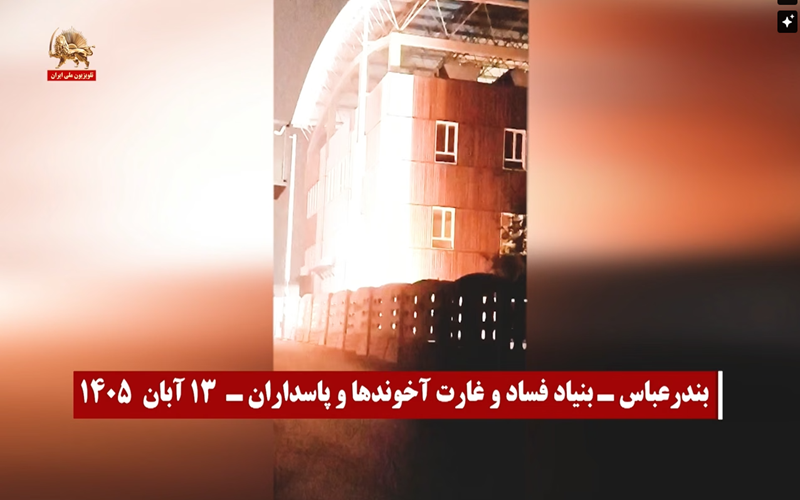
- Bandar Abbas: An explosion at a foundation identified by the Resistance Units as an institution involved in corruption and the plundering of public wealth.
- Isfahan: Several banners depicting Khomeini and Khamenei were set on fire, alongside a sign identifying an intelligence ministry surveillance center.
- Mashhad: A Basij base described by the Resistance Units as targeting students, as well as propaganda banners, was set on fire.
- Tabriz: Banners depicting Ali Khamenei and Mojtaba Khamenei were set on fire at several locations.
- Shiraz: Banners depicting the two Khameneis were set on fire.
- Kermanshah: A Basij facility and several regime propaganda banners were set on fire.
- Zahedan: A banner depicting Ali Khamenei and a Basij base were set on fire.
- Dezful and Sabzevar: Basij facilities and propaganda banners were targeted.
- Mahshahr, Marand, and Chabahar: Activities included setting fire to banners and Basij bases.
- Iranshahr and Bijar: Basij bases were set on fire.
- Rask: A facility identified as an operational base for the regime’s proxy forces was set on fire.
- Nurabad, Fars Province: Banners depicting Khomeini, Ali Khamenei, and Mojtaba Khamenei were set on fire, accompanied by the slogan, “Death to the oppressor, whether Shah or supreme leader.”
The second series was presented as a response to the regime’s execution of Ebrahimi and Maleki, reinforcing the message that executions would not silence opposition or deter the younger generation from continuing its resistance.
Rejection of both monarchic and religious dictatorship
A consistent theme across the reported activities was the rejection of both the current religious dictatorship and the restoration of the former monarchy.
Slogans such as “Neither monarchy nor leadership, democracy and equality” and “Neither crown nor turban; the mullah’s time is over” reflected the Resistance Units’ emphasis on a democratic alternative rather than a return to authoritarian rule.
The campaign’s repeated references to the National Liberation Army of Iran and the messages of Massoud Rajavi and Maryam Rajavi also placed these activities within the broader framework of organized resistance and the struggle for a democratic republic.
Across the two successive campaigns, the Resistance Units reported 90 actions, combining attacks on regime-related installations and propaganda displays with graffiti, leaflets, and commemorative activities.
The activities’ central message was that the executions of political prisoners and protesters would not extinguish resistance, while the demand for an end to dictatorship remained directed against both the Shah’s monarchy and the ruling clerical establishment.