


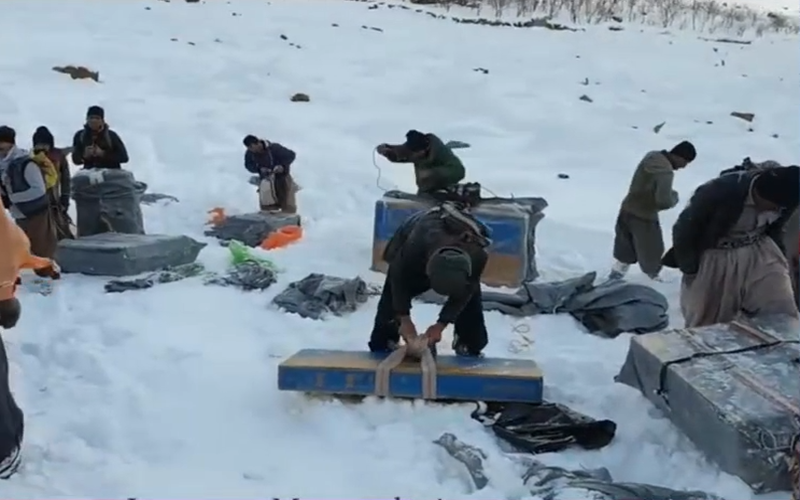

From Kurdish porters and Baluch fuel carriers to Tehran’s street vendors, poverty and the destruction of livelihoods are forcing vulnerable families into dangerous work while state repression deepens their hardship.
When Earning a Living Becomes a Matter of Life and Death
For millions of people across Iran, earning a living has become a struggle against poverty, insecurity, and the threat of physical harm. In the country’s border provinces, Kurdish porters carry heavy loads across dangerous mountain terrain, while Baluch fuel carriers navigate hazardous routes under the threat of gunfire. In major cities, impoverished street vendors risk losing their entire investment when municipal authorities destroy their stalls and merchandise.
These are not isolated hardships. They reflect a broader economic and social crisis in which the absence of stable employment, persistent regional deprivation, and coercive state policies leave vulnerable people with few ways to support their families.
A September 23, 2026, report by Mai Sato, the UN Special Rapporteur on the situation of human rights in Iran, highlighted reports of extrajudicial killings of Kurdish porters and Baluch fuel carriers. The report described cases in which border forces allegedly opened fire at close range without warning. In one instance, officials reportedly told a victim’s family that he had fallen while crossing mountainous terrain, but forensic findings contradicted that account, identifying a gunshot wound to the head.
The findings underscore the human cost of a system in which people struggling to survive can face lethal violence while pursuing informal work.
Formalizing Portering Will Not End the Crisis
Kurdish porters, commonly known as kolbars, operate in border areas of Kurdistan, West Azerbaijan, and Kermanshah provinces. Many carry goods across mountainous routes because regular employment and lawful opportunities for cross-border trade remain insufficient.
Their circumstances expose the limitations of proposals to formalize portering as an occupation. Registration or insurance schemes may offer limited administrative recognition, but they do not resolve the underlying problem: people are compelled to carry heavy commercial goods across dangerous terrain because they lack viable alternatives.
A 2017 initiative to provide insurance coverage for 18,000 porters illustrates the gap between official announcements and the realities of their lives. Treating portering as a conventional job risks normalizing a condition in which people must carry refrigerators, washing machines, and other heavy goods on their backs through mountains to earn an income.
A more fundamental response would involve creating lawful employment, establishing legitimate cross-border trading mechanisms, and developing disadvantaged border regions. Designating eligible areas as free-trade zones and facilitating regulated commerce could provide alternatives to dangerous informal transportation.
Without such changes, administrative recognition alone cannot eliminate the economic pressures that drive people into the mountains.
Gunfire, Mines, and Treacherous Mountain Routes
Portering exposes workers to multiple hazards. In addition to direct gunfire from security forces, they face falls from steep slopes, extreme cold, icy paths, and landmines. Heavy loads make already dangerous journeys more difficult, particularly in winter conditions.
The workers include university graduates, people with bachelor’s and master’s degrees, and accomplished athletes. Their participation in such work illustrates how educational attainment and personal ability offer little protection when stable employment is unavailable.
According to figures attributed to Kolbarnews, at least 20 porters and border traders were killed or injured during the first half of the Iranian year 1405, which began in March 2026. The figures identified military gunfire as the direct cause in 18 cases.
The UN Special Rapporteur’s September report also recorded at least 12 deaths among Kurdish porters since the beginning of 2026, attributed to gunfire by border forces or the Islamic Revolutionary Guard Corps.
These figures cover different reporting categories and should not be treated as directly interchangeable. Together, however, they illustrate the persistent danger facing border workers. The absence of comprehensive official statistics further complicates efforts to establish the full scale of the casualties, leaving families and independent monitors to document many of the deaths and injuries.
Baluch Fuel Carriers and Southern Coastal Communities
The same economic pressures affect Baluch fuel carriers, known as sookhtbars, in southeastern Iran. Like Kurdish porters, they often undertake hazardous work because lawful employment opportunities are limited.
UN human rights experts reported in September 2026 that fuel carriers faced deadly shootings and dangerous pursuits by security forces. At least 13 fuel carriers were reportedly killed between January and August 2026.
The crisis extends beyond land borders. In southern provinces, including Sistan and Baluchestan, Khuzestan, and Hormozgan, many families depend on fishing, maritime commerce, and other forms of informal work. These communities face longstanding deprivation, uneven development, and environmental pressures, compounded by restrictions that can threaten their means of survival.
The UN General Assembly’s September 2026 report, document A/81/371, addressed the severe vulnerabilities created by economic and security policies affecting disadvantaged populations.
Across these regions, the central issue is not simply the informality of people’s work. It is the lack of sustainable economic alternatives and the consequences when those who depend on informal livelihoods encounter coercive enforcement.
Tehran’s Street Vendors Lose Their Livelihoods
The same pattern is visible far from Iran’s mountainous borderlands. In Tehran, street vendors and small traders face the destruction of their goods and stalls, often losing the capital they need to support their families.
According to a Euro-Sy report published on October 26, 2026, municipal agents used heavy machinery and a loader on October 18 to destroy vendors’ goods and stalls at Tehran’s central fruit and vegetable market. The operation triggered angry confrontations.
The destroyed merchandise reportedly belonged to vendors who had stayed awake throughout the night in preparation for selling their goods. The value of the lost stock was estimated at between 50 million and 60 million tomans per vendor or load, according to the report.
For people operating on narrow margins, the destruction of merchandise means more than the loss of a day’s earnings. It can wipe out the capital invested in purchasing and transporting goods, eliminating the means to continue working and leaving entire families without their principal source of income.
Enforcement that destroys livelihoods without providing viable alternatives deepens the insecurity that drives people into informal work in the first place.
Resistance to the Destruction of Livelihoods
The October 18 operation also prompted a response from organized opposition activists. On October 23, 2026, Resistance Units carried out 10 protest operations in Tehran and six other cities: Tabriz, Mashhad, Shahriar, Masjed Soleyman, Iranshahr, and Nazarabad. According to opposition reports, the actions targeted regime-linked institutions and symbols in response to the destruction of the vendors’ livelihoods.
The episode connects local economic grievances to a wider confrontation over the conditions under which Iranians are forced to live and work.
From Kurdish porters carrying heavy loads across mountain passes to Baluch fuel carriers facing deadly pursuits and Tehran vendors watching their investments being destroyed, the underlying problem remains the absence of secure and sustainable livelihoods.
Formal registration cannot substitute for economic opportunity, and punitive enforcement cannot resolve poverty. Addressing these conditions requires lawful employment, viable border trade, investment in neglected regions, and protection for people seeking to earn an honest living.
When survival depends on work that exposes people to death, injury, or the destruction of everything they own, the crisis extends beyond employment. It becomes a question of human dignity, economic security, and the right to make a living without fear.